Grid Dominance: Tesla Locks In Massive $5B Megapack Deal to Rewrite Europe's Energy Rules
For years, Tesla skeptics argued that Elon Musk’s promise of the Energy division eventually rivaling its automotive business was nothing more than a h...
Editorial Team
World Of EV
For years, Tesla skeptics argued that Elon Musk’s promise of the Energy division eventually rivaling its automotive business was nothing more than a hype machine designed to buoy a volatile stock. Today, that narrative has been shattered.
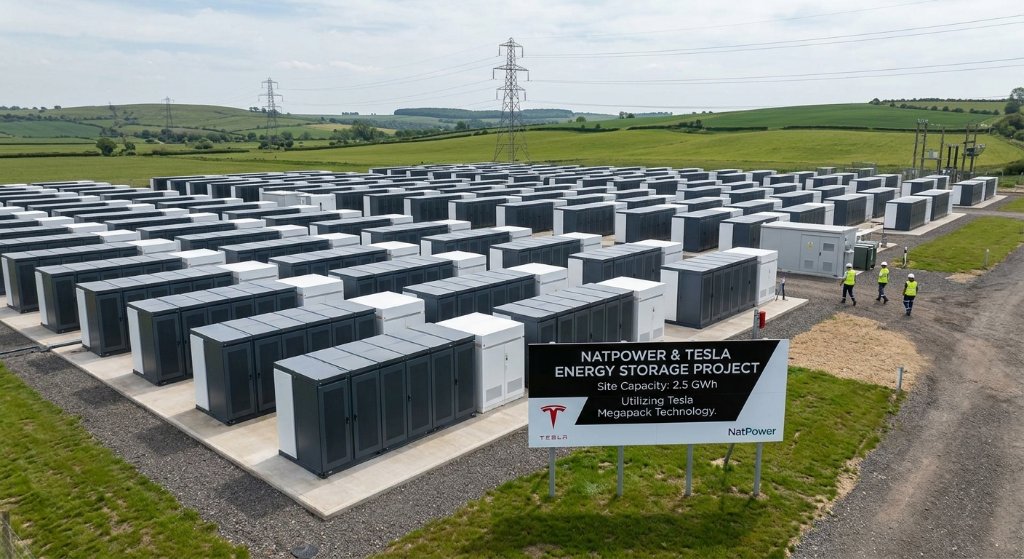
In a monumental shift that redraws the boundaries of the global energy sector, Tesla and independent European energy infrastructure giant NatPower have struck a multi-billion-dollar deal to build an unprecedented 25 gigawatt-hours (GWh) of battery storage capacity across Italy and Great Britain. Representing the single largest European grid-scale battery agreement in history, the multi-phase program is designed to ultimately scale past a staggering 100 GWh, with projected revenues topping $15 billion over a 20-year span.
The Blueprint: $5 Billion and 25 GWh of Pure Power
At its core, this partnership represents a seismic shift from localized, piecemeal battery installations to coordinated, multi-national energy infrastructure. The program begins with five initial utility-scale projects.
Here are the critical details of the landmark deal:
- The Hardware: Tesla will supply thousands of its high-capacity Megapack battery systems, which utilize cobalt-free Lithium Iron Phosphate (LFP) chemistry optimized for grid-scale safety, longevity, and rapid thermal deployment.
- The Scale: An initial phase deploying 25 GWh of capacity—the equivalent energy storage of roughly 330,000 Tesla Model Y Long Range battery packs.
- The Growth Runway: A long-term ambition to exceed 100 GWh of installed capacity, vastly outpacing any existing commercial storage pipeline in Europe.
- The Financials: An estimated initial construction cost of $4 billion to $5 billion, with total projected portfolio revenues crossing the $15 billion mark over the next two decades.
This is not a simple transaction where a manufacturer drops off shipping containers of batteries and walks away. Tesla is acting as the primary engineering, procurement, and construction (EPC) partner, integrating the hardware directly into the electrical transmission systems of Italy and the UK.
The Secret Weapon: Autobidder and Software Monopolization
While headlines will naturally focus on the massive physical footprints of these Megapack installations, the real power of this deal lies in the software. Under the agreement, NatPower will own and operate the facilities, but Tesla will run the back-end using its proprietary Autobidder trading platform.
Autobidder is an artificial intelligence-driven energy monetization tool that functions as an automated, high-frequency trader for electricity. It continuously analyzes market demand, weather patterns, and pricing signals to decide exactly when to charge the batteries (buying cheap, excess renewable energy) and when to discharge them back into the grid (selling at peak premium prices).
Crucially, Tesla is leveraging this software to provide "long-term revenue warranties". By guaranteeing a baseline of operational profitability through its algorithms, Tesla has unlocked a "bankable" model. This high level of financial predictability allows NatPower to easily secure lower-cost capital from institutional investors, solving the infrastructure sector's historic bottleneck: the gap between capital availability and execution certainty.
Why This Matters:
This is a watershed moment for the global transition to sustainable energy. The implications of this deal stretch far beyond the borders of Italy and Britain:
- Tesla’s Safety Net Amid Automotive Headwinds: As the electric vehicle market undergoes periods of cyclical cooling and intense price competition, Tesla’s energy division is stepping up as an incredibly lucrative, high-margin buffer. Fulfilling the initial 25 GWh order alone will consume approximately 62.5% of the annual production capacity of Tesla's Lathrop Megafactory (currently capable of producing 40 GWh of Megapacks per year). This diversification shifts Tesla from "just a car company" to a core infrastructure utility.
- The Decarbonization Bottleneck Solved: Wind and solar power are notoriously intermittent; they produce electricity when the weather permits, not necessarily when grids demand it. In the UK and Italy, grid operators have routinely been forced to pay renewable energy producers to shut down (curtailment) to avoid overloading the system. These massive Megapack installations act as a giant sponge, saving clean energy that would otherwise go to waste and stabilizing grids under strain from the rapid adoption of EVs and AI data centers.
- A Warning Shot to Legacy Competitors: Traditional grid hardware giants like Siemens, Fluence, and even battery-dominant rivals like BYD are being outmaneuvered. None of them can offer the same vertically integrated package: advanced battery hardware, in-house EPC services, AI trading software (Autobidder), and bankable revenue warranties. Tesla isn’t just selling batteries; it is selling a turnkey, risk-free cash flow engine.
- What This Means for the Consumer: For EV owners, grid-scale storage on this level is a massive win. By dampening peak electricity pricing and integrating cheaper solar and wind power, utility-scale batteries will ultimately drive down the cost of domestic electricity, making home EV charging even more economical and preventing localized brownouts as millions of new EVs plug into the grid over the coming decade.
Conclusion
By linking massive physical infrastructure with advanced AI-driven financial software, Tesla and NatPower have established the new gold standard for utility-scale energy projects. This $15 billion alliance proves that the real value of the clean energy transition isn't just in the cars we drive, but in how we store, trade, and secure the power that fuels them. As Tesla continues to scale its global Megafactories, its energy division is quietly positioning itself to become the backbone of the 21st-century grid.