Growing Pains: Why China's 46% NEV Fault Rate and Skyrocketing Repair Costs Are a Wake-up Call for the EV Industry
China’s rapid transition to New Energy Vehicles (NEVs) has long been hailed as a masterclass in industrial scaling, with brands like BYD, Li Auto, and...
Editorial Team
World Of EV
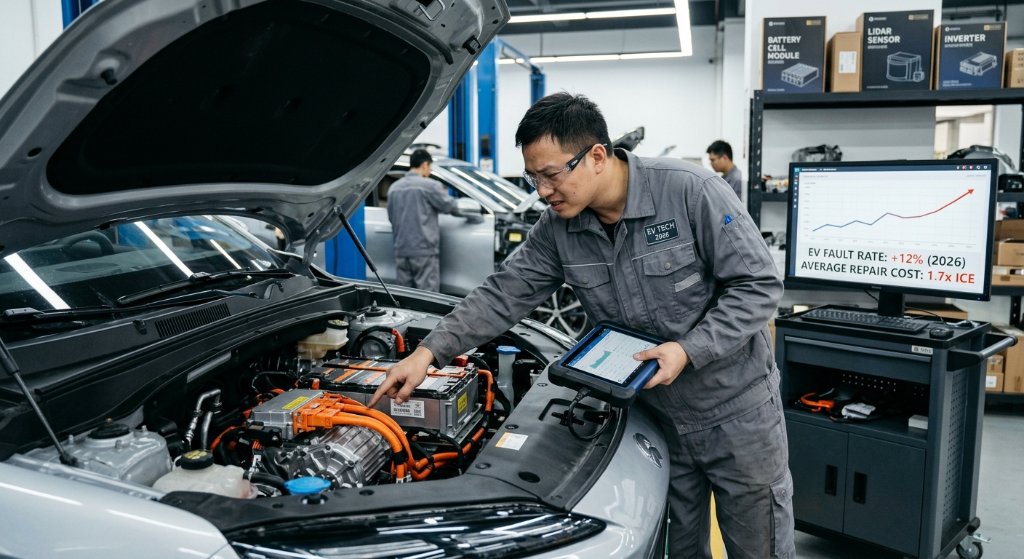
China’s rapid transition to New Energy Vehicles (NEVs) has long been hailed as a masterclass in industrial scaling, with brands like BYD, Li Auto, and Xiaomi pushing the boundaries of vehicle technology. But beneath the sleek designs, hyper-advanced driver assistance systems, and rapid-fire production cycles lies a simmering ownership crisis. The newly released 2026 China NEV After-Sales Service Study has exposed a stark reality: the fault rate for NEVs has climbed to a staggering 46.1%, representing a sharp 12% year-over-year surge from 2025.
This isn't just a minor speed bump; it's a structural warning sign. In the early days of electrification, pioneers promised that having fewer moving parts would translate to virtually maintenance-free motoring. However, as modern NEVs transform into complex, software-defined "computers on wheels," delicate sensor suites, integrated structural batteries, and massive touchscreen monoliths are shifting the financial burden from routine mechanical upkeep to catastrophic, wallet-draining component failures.
The High-Tech Culprits: Batteries, LiDAR, and Screen Integration
At the heart of this ownership crisis is the astronomical cost of replacement parts. According to the study, the average repair cost for an NEV is now 1.7 times higher than its internal combustion engine (ICE) counterpart. This gap is driven primarily by advanced hardware that was once reserved for high-end luxury vehicles but is now standard in mainstream Chinese NEVs.
Key drivers of these spiraling costs include:
- Lithium Battery Packs: While battery raw material costs have stabilized, modern structural integration—such as cell-to-chassis (CTC) and cell-to-pack (CTP) designs—means that even minor structural accidents often require replacing the entire expensive pack rather than individual cells.
- LiDAR and Sensor Suites: Front-end fender benders that once cost a few hundred dollars to fix now involve replacing highly sensitive, calibration-heavy LiDAR sensors, high-definition cameras, and radar units typically mounted in high-risk impact zones.
- Complex Central Touchscreen Integration: Monolithic infotainment screens act as the brain of the vehicle, integrating climate control, ADAS settings, and core driving functions. A software glitch or a cracked panel frequently requires replacing an entirely new, highly integrated dashboard computer assembly.
The Ripple Effect: Premium Spikes and Repair Bottlenecks
The financial pain doesn't stop at the dealership repair bay. The compounding issues of complex systems and specialized parts have begun to heavily penalize consumers in daily operation.
First, insurance actuaries are adjusting to the high write-off rates of modern EVs. Because minor body damage can compromise an integrated battery pack, insurers are increasingly totaling vehicles rather than repairing them, sending premium rates soaring. Second, the highly specialized nature of advanced sensors and high-voltage components, combined with a critical shortage of certified high-voltage technicians, has created a massive bottleneck. Consumers are reporting unprecedented waiting periods, leaving them without vehicles for weeks—and sometimes months—while waiting for parts and diagnostic clearance.
Why This Matters:
This data marks a watershed moment that will force a major shift in how automakers design and build EVs. Up until now, the Chinese market was locked in a fierce "feature war," where OEMs raced to pack as many screens, lidars, and software-driven gimmicks into cheap vehicles as possible to win market share. This study proves that the software-startup approach of "move fast and break things" doesn't work when consumers are left holding a massive bill.
- The Winners: Legacy OEMs who took a more conservative, modular approach to vehicle architecture. Brands that prioritize modular repairability over hyper-integration will see their reputations for reliability and total cost of ownership (TCO) surge. Third-party repair networks that can master component-level EV repair (rather than total replacement) will also find a highly lucrative market.
- The Losers: Hyper-aggressive EV startups and budget brands operating on razor-thin margins. If consumers begin factoring in a 70% premium on repairs and skyrocketing insurance, the demand for budget-friendly electric cars with high-tech gimmicks will dry up. This is a "grow up or die" moment for NEV manufacturers; they must pivot from a "digital-first" to a "serviceability-first" engineering mindset.
Looking Ahead
As the global EV market matures, the industry's focus must shift from simply selling cars to sustaining them. The 2026 after-sales study is a stark reminder that an EV’s true value isn't measured in 0-100 km/h acceleration times or screen real estate, but in its ability to remain on the road affordably. Automakers who fail to address this 46.1% fault rate and the compounding repair costs risk alienating the very buyers who drove the electric revolution in the first place.