Hawaii EV Owner Cracks the Code: How a Powerwall 'Life Hack' Delivers 100% Free, Grid-Independent Commuting
Electric vehicle ownership promised a clean, cheap alternative to fossil fuels, but skyrocketing utility rates and increasingly hostile solar policies...
Editorial Team
World Of EV
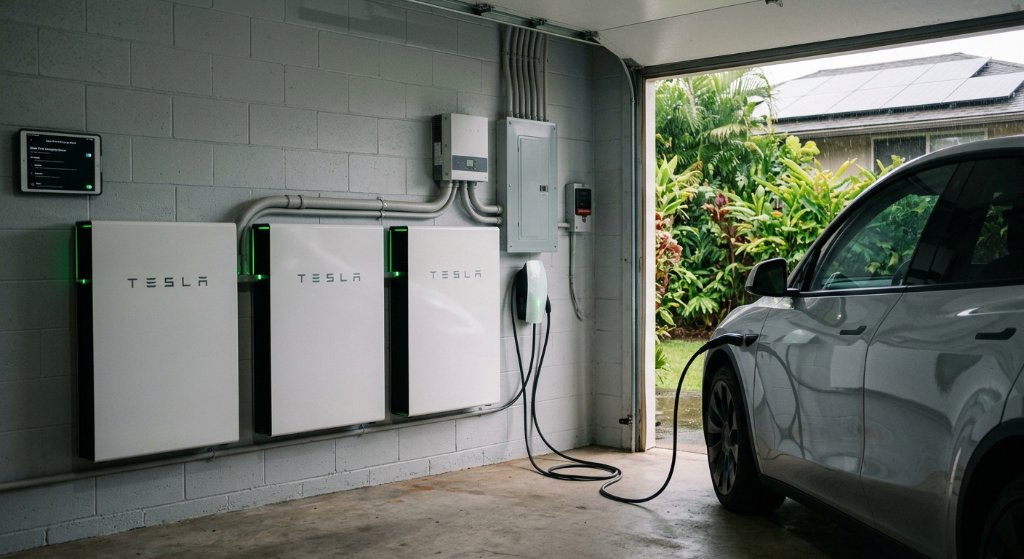
Electric vehicle ownership promised a clean, cheap alternative to fossil fuels, but skyrocketing utility rates and increasingly hostile solar policies are souring the deal for many. In Hawaii Kai, however, one clever EV owner has bypassed the grid entirely. By orchestrating a closed-loop system using a Tesla Powerwall and rooftop solar, they have managed to power their daily commute on 100% self-generated sunshine—all while keeping home emergency backup reserves strictly protected.
Hawaii's energy market has long served as a canary in the coal mine for the rest of the United States. With the state's transition away from lucrative net metering (NEM) to Customer Self-Supply (CSS) programs, exporting solar energy back to the grid is no longer financially viable. Combine that with Hawaii's electricity rates—which regularly top 40 cents per kWh—and EV owners are forced to get creative. This Hawaii Kai case study represents the next evolution of decentralized energy, proving that with the right automation, the EV can become a seamless extension of a home microgrid.
Anatomy of the Closed-Loop System
The core of this "life hack" lies in smart scheduling and automated energy routing. The owner resolved the classic solar dilemma: solar panels produce energy during the day when the car is often away at work, while the EV needs charging at night when the sun isn't shining.
- Daytime Storage Capture: Instead of exporting excess solar energy to the grid for pennies, the homeowner's rooftop solar system routes all surplus generation directly into a Tesla Powerwall during peak daylight hours.
- The "Zero Grid" Charging Cycle: The EV is programmed to initiate its charging cycle strictly overnight, drawing power directly from the Powerwall's stored energy rather than the utility grid.
- Preserving the Emergency Reserve: To prevent a scenario where charging the EV leaves the home vulnerable to power outages, the Powerwall is configured with a strict reserve limit (e.g., 20%). The system automatically halts EV charging if the battery drops to this threshold, ensuring the home is never left in the dark.
Maximizing ROI on Battery Investment
For years, critics argued that home batteries were too expensive to justify for backup power alone. However, by utilizing the battery daily to fuel a vehicle, the owner has dramatically accelerated the payback period of their equipment.
Key technical and financial advantages of this setup include:
- Peak Shaving: Eliminates the need to pull high-tariff utility power during evening peak hours.
- Zero Export Waste: Keeps 100% of the generated green energy within the household ecosystem, maximizing the value of every photon captured.
- Hardware Longevity: By coordinating charge cycles intelligently, both the EV battery and the Powerwall operate within optimal thermal and capacity thresholds, mitigating premature degradation.
Why This Matters:
- The Death of Net Metering: Across the US, utilities are dismantling solar incentives. California's highly controversial NEM 3.0 policy slashed export rates by roughly 75%, effectively killing the financial viability of "solar-only" setups. This Hawaii Kai blueprint is the survival guide for the modern solar owner. Under these new utility regimes, self-consumption is the only path to a positive ROI.
- The Ecosystem Lock-In Advantage: Tesla wins big here. Their proprietary ecosystem (Tesla vehicle + Powerwall + Solar) integrates natively through the Tesla App, allowing features like "Charge on Solar" to function out-of-the-box. Competitors like Hyundai, Ford, and GM are scrambling to match this level of seamless software integration. While bidirectional Vehicle-to-Home (V2H) technology remains bogged down by complex utility approvals and expensive bidirectional hardware, this stationary-to-EV setup is highly practical and available today.
- A Warning Shot to Grid Operators: If EV owners can successfully decouple their transportation fuel costs from the grid, utilities lose their most lucrative future growth driver. This is a do-or-die moment for utility companies: they must adapt to support home microgrids with fairer tariffs, or watch their highest-value customers cut the cord entirely.
What started as a clever local life hack in Hawaii is actually the frontline of the global clean energy transition. As grid reliability falters and utility rates continue to climb nationwide, the shift from passive EV ownership to active home energy orchestration is no longer a hobbyist's luxury—it is a financial necessity. The future of driving isn't just electric; it's self-generated, self-stored, and entirely self-controlled.