Hyundai Launches 'AllDayEnergy' Platform to Turn EVs Into Money-Saving Mobile Power Stations
For years, the promise of the "battery on wheels" has been dangled in front of electric vehicle buyers like a futuristic carrot. While pioneers like t...
Editorial Team
World Of EV
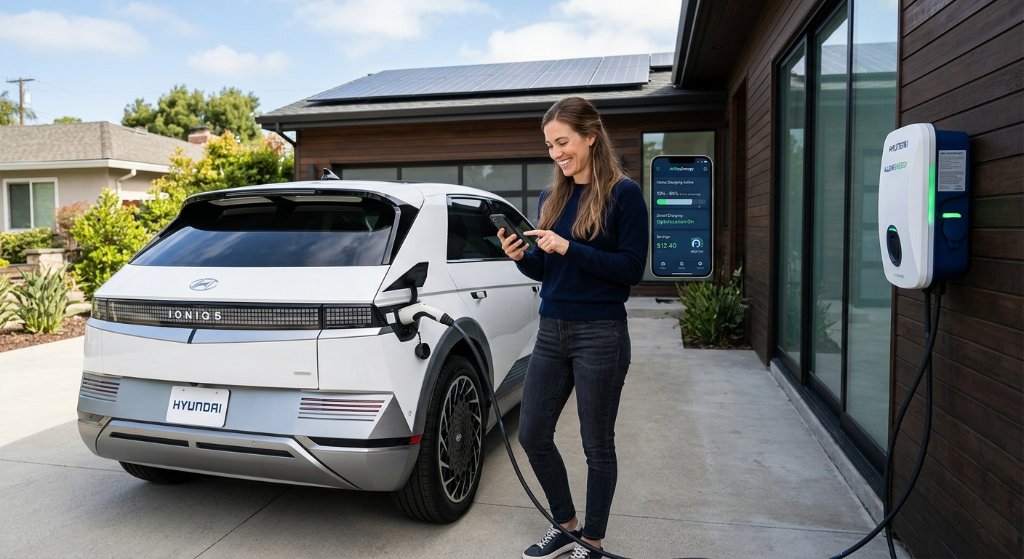
For years, the promise of the "battery on wheels" has been dangled in front of electric vehicle buyers like a futuristic carrot. While pioneers like the Hyundai Ioniq 5 and Kia EV6 first turned heads in 2021 by offering Vehicle-to-Load (V2L) technology—allowing drivers to plug in laptops or camp stoves—the grander dream of seamless, grid-level integration remained a fragmented puzzle. That puzzle is finally being solved.
Hyundai Motor Group has officially taken the wraps off AllDayEnergy, a unified, global Vehicle-to-Everything (V2X) energy services platform. Designed to consolidate the automotive giant's smart charging, vehicle-to-grid (V2G), and vehicle-to-home (V2H) offerings under a single, streamlined app interface, AllDayEnergy signals Hyundai’s transition from a mere vehicle manufacturer into a global smart energy service provider.
Consolidating Global Innovation into One Interface
Before this launch, Hyundai Motor Group operated a series of disconnected, region-specific energy projects. While technologically successful, they lacked a unified consumer-facing identity. In Jeju Island, South Korea, Hyundai piloted V2G systems to balance local grids. In the wildfire-prone regions of the United States, it deployed emergency V2H backup power. Meanwhile, in the Netherlands, it trialed V1G (Smart Charging) to dynamically adjust charging speeds based on utility pricing.
AllDayEnergy synthesizes these disparate projects into a cohesive, global product. Customers will manage everything via the native Hyundai and Kia vehicle applications. The service is organized into three core pillars:
- Smart Charging (V1G): Automatically manages charging schedules based on real-time grid pricing, off-peak rates, and customer preference.
- Vehicle-to-Home (V2H): Empowers the EV battery to supply emergency backup electricity directly to a residence, ensuring a household remains powered during blackouts or extreme weather events.
- Vehicle-to-Grid (V2G): Connects the vehicle's high-capacity battery back to the municipal power grid, allowing owners to sell surplus electricity back to utility companies during peak demand.
The Phased Rollout
Hyundai will kick off the rollout of AllDayEnergy in the United Kingdom in the second half of 2026, starting with V1G Smart Charging via the Kia App. From there, the service will expand sequentially to include V2H and V2G capabilities, with plans to quickly scale the platform across continental Europe, North America, and South Korea through both Kia and Hyundai brand applications.
Why This Matters:
This is a calculated, strategic move designed to target the single biggest bottleneck in current EV adoption: Total Cost of Ownership (TCO). As the global EV market navigates a transitional plateau, buyers are demanding real-world financial incentives beyond federal tax credits. AllDayEnergy tackles this head-on by transforming an EV from a depreciating transportation asset into an active, revenue-generating household utility. By utilizing energy arbitrage—charging during cheap off-peak hours and discharging to power the home or feed the grid during expensive peak windows—EV owners can realistically slash their monthly household electricity bills.
Furthermore, this establishes Hyundai as a formidable challenger to competitors like Tesla and Ford. While Ford offered bidirectional backup with the F-150 Lightning, the physical setup required expensive, proprietary home installation kits. Tesla, on the other hand, has spent years protecting its Powerwall stationary battery ecosystem, historically dragging its feet on V2G. By launching a standardized software framework capable of scaling globally across multiple vehicle lines, Hyundai is democratizing V2X. If the company can successfully navigate local regulatory hurdles with utility providers worldwide, AllDayEnergy could very well change how the industry calculates the long-term value of buying an EV.
With AllDayEnergy, Hyundai Motor Group is executing a critical pivot, demonstrating that the future of the automotive industry isn't just about build quality and driving range, but how seamlessly a vehicle integrates into the modern smart grid. As the platform begins its UK rollout, all eyes will be on whether this software-driven ecosystem can deliver the concrete financial savings that today’s budget-conscious EV buyers are looking for.