Inside Tesla's Cybercab Emergency Playbook: How First Responders Rescue Passengers from a Cockpit with No Controls
# Inside Tesla's Cybercab Emergency Playbook: How First Responders Rescue Passengers from a Cockpit with No Controls Tesla is officially on the clock...
Editorial Team
World Of EV
Inside Tesla's Cybercab Emergency Playbook: How First Responders Rescue Passengers from a Cockpit with No Controls
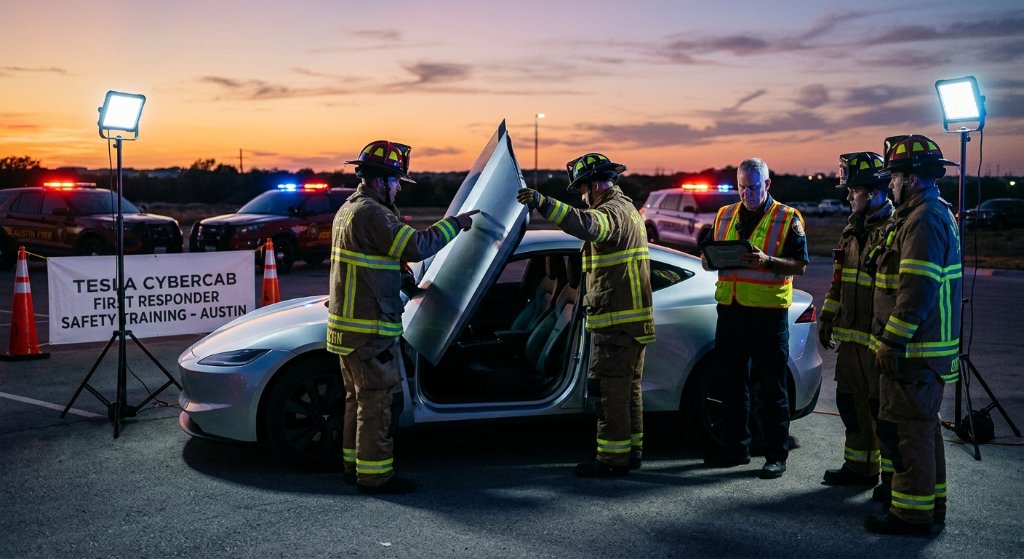
Tesla is officially on the clock in Austin, Texas. Just weeks after deploying its custom-built Cybercab robotaxis on public roads, the EV pioneer is addressing the elephant in the room: how do emergency crews handle a vehicle that has no steering wheel, no pedals, and no traditional door handles? To soothe local anxieties and lay down a regulatory blueprint, Tesla published a dedicated crash and fire safety training video alongside a detailed emergency response guide targeting first responders in the Austin metro area.
This proactive safety push comes at a critical juncture. When Tesla CEO Elon Musk first unveiled the sleek, two-seat Cybercab at the "We, Robot" event in October 2024, critics dismissed the driverless, keyless pod as a far-off fantasy. But with actual production-intent units hitting Austin streets this September, the reality of a driverless future is colliding with municipal pragmatism. Local emergency crews suddenly find themselves staring down a vehicle that completely defies a century of automotive rescue protocols.
The Touchscreen Joystick: A Solution or a Glove-Friendly Nightmare?
Without physical steering columns or pedals, moving a stalled or crashed Cybercab out of an active roadway presents a unique logistical hurdle. Tesla's solution bypasses physical overrides entirely in favor of digital access:
- The Virtual Joystick: First responders can manually steer and maneuver the Cybercab using a virtual joystick integrated directly into the central touchscreen.
- Strict Authentication: This control is not consumer-accessible. Rescue teams must contact Tesla Robotaxi Support to authenticate and unlock the emergency joystick interface.
- The Glove Dilemma: Austin Fire Department personnel have already voiced skepticism. Firefighters wearing heavy, flame-resistant turnout gloves face an immediate challenge navigating capacitive touchscreens in high-stress, smoky emergency environments.
Breaching the Butterfly Cabin
Securing a crash scene requires rapid access to the cabin and immediate high-voltage isolation. Because the Cybercab features upward-opening butterfly doors and completely lacks exterior door handles, traditional extraction methods are useless:
- B-Pillar Microphones: First responders can communicate with Tesla support via integrated microphones on the B-pillars without opening the car doors.
- De-energizing the Rig: The training instructs crews on how to access manual physical release cables and cut-loops to instantly sever the 12V and high-voltage lithium-ion battery lines, preventing thermal runaway.
Designing for Crashes, Not Drivers
Shedding the constraint of human driver visibility allowed Tesla's engineers to redesign structural physics:
- Ultra-Rigid A-Pillars: In traditional vehicles, A-pillars are kept slim to preserve the driver's field of view. The Cybercab features exceptionally thick, chunky A-pillars. Because there is no human driver looking out, Tesla maximized structural reinforcement, building an exceptionally rigid passenger cell designed to withstand severe frontal, offset, and rollover impacts.
Why This Matters:
Tesla’s safety campaign is a calculated offensive in the high-stakes war for autonomous vehicle dominance. By establishing direct channels (including a dedicated support email: RobotaxiFirstResponderSafety@tesla.com) and physical training workshops, Tesla aims to bypass the municipal backlash that severely crippled GM's Cruise in San Francisco.
However, this safety playbook exposes a fundamental philosophical divide between Silicon Valley and municipal emergency services. Tech companies view the digital touchscreen and remote support centers as the ultimate tools for safety and control. First responders, meanwhile, view them as potential points of failure. If a Cybercab suffers a catastrophic electrical failure that fries the touchscreen, or if cellular networks drop, firefighters cannot easily move the vehicle to clear a fire lane.
The stakes are "do-or-die" for Tesla. If the Austin Fire Department—or regulators at the NHTSA—deem the steering-wheel-free cockpit too dangerous or cumbersome during emergency incidents, the Cybercab's rapid scaling plans will grind to a halt. Tesla isn't just testing autonomous driving software here; it is testing whether modern emergency infrastructure can tolerate a vehicle that relies entirely on a digital umbilical cord.
Conclusion
Tesla’s new training push proves that the transition to autonomy is as much about managing human friction on the ground as it is about refining camera algorithms in the cloud. By reimagining cabin structure and digitizing emergency controls, Tesla is aggressively pushing the envelope of vehicle design. Whether local fire departments embrace the touchscreens or demand physical emergency overrides will ultimately dictate how fast the Cybercab spreads from the streets of Austin to the rest of the world.