IONNA Dethrones Tesla in Customer Satisfaction, Doubling Its 400 kW Charging Network in 2026
Remember the early days of non-Tesla public EV charging? Broken screens, failed payment handshakes, and the pure anxiety of hoping a third-party stall...
Editorial Team
World Of EV
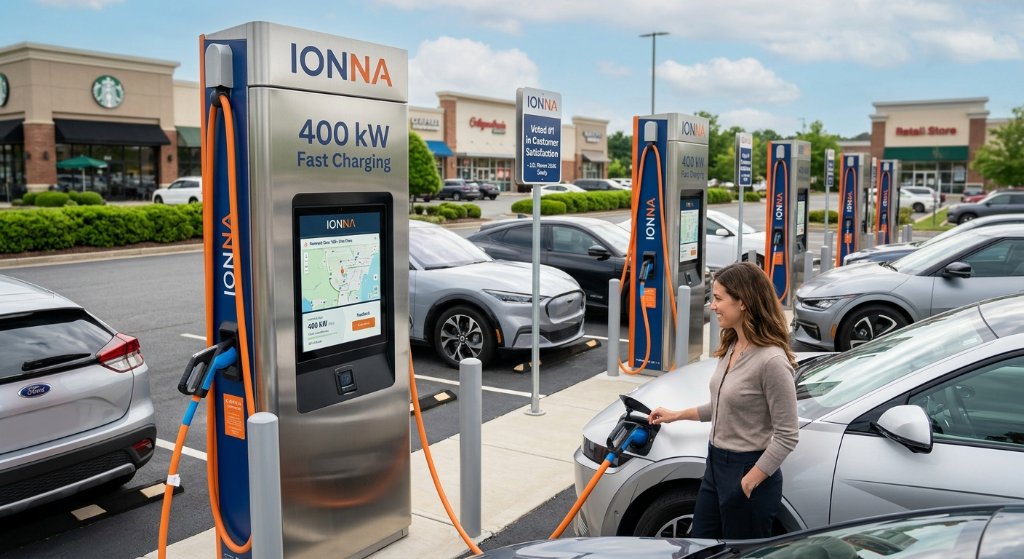
Remember the early days of non-Tesla public EV charging? Broken screens, failed payment handshakes, and the pure anxiety of hoping a third-party stall would actually output its promised charging speeds. For years, legacy automakers watched helplessly as Tesla’s seamless, reliable Supercharger network remained their rival's greatest sales tool. In response, eight of the world’s largest automotive giants—BMW, GM, Honda, Hyundai, Kia, Mercedes-Benz, Stellantis, and Toyota—pooled their resources in 2024 to build IONNA.
Now, in 2026, IONNA is executing a masterclass in how to build a premium public charging network. The automaker-backed joint venture recently announced that it has more than doubled its U.S. network this year, surpassing 180 live high-speed charging sites. More impressively, IONNA topped J.D. Power’s 2026 U.S. Electric Vehicle Experience (EVX) Public Charging Study for DC Fast Chargers in its first year of eligibility, proving that rapid scaling does not have to come at the expense of quality.
Scale Meets Quality: The Rise of the 400 kW 'Rechargery'
IONNA entered 2026 with just 80 active locations, but a hyper-aggressive expansion campaign has pushed that number past 180. Unlike older public networks that rely heavily on aging 150 kW or 350 kW hardware, IONNA is standardizing high-speed 400 kW chargers using advanced Alpitronic hardware and proprietary in-house software.
A significant driver of this rapid footprint expansion is IONNA’s strategic partnership with convenience retail giant Circle K. Since the partnership kicked off in April 2026, the joint venture has brought more than 40 upgraded "Rechargeries" online, on its way to an ultimate target of 350+ locations. These sites feature both NACS (North American Charging Standard) and CCS connectors to support all EV drivers.
- Massive Footprint Expansion: IONNA has more than doubled its live sites in 2026, now operating over 180 high-speed locations across the United States.
- Cutting-Edge Hardware: Every site features 400 kW charging capabilities, establishing IONNA as the largest ultra-fast 400 kW network in the country.
- Premium Retail Partnerships: Over 40 Circle K "Rechargeries" are currently live, blending high-speed charging with convenient retail amenities.
Death to the Proprietary App: Frictionless Charging
In a refreshing move for EV drivers suffering from "app fatigue," IONNA has entirely bypassed the development of a proprietary smartphone application. Instead, the network has built its infrastructure to integrate seamlessly with 19 existing partner software platforms, including Presto, ChargeHub, and EV Connect, alongside native automaker applications.
Furthermore, the joint venture is heavily leaning into Plug & Charge capabilities. Drivers of BMW, GM, Hyundai, and Mercedes-Benz EVs currently receive a 10% charging discount when authenticating through their native automaker apps, with Toyota, Lexus, Honda, Kia, and Stellantis expected to follow. Volvo drivers already enjoy seamless Plug & Charge integration on the network, with Toyota and Lexus models gaining support imminently.
- Zero App Fatigue: Bypassing a dedicated IONNA app allows drivers to use 19 supported partner and OEM platforms they already know.
- Direct Automaker Discounts: EV owners from BMW, GM, Hyundai, and Mercedes-Benz currently receive a 10% discount, with remaining backing brands to follow.
- Plug & Charge Activation: Seamless plug-and-charge capability is already active for Volvo, with Toyota and Lexus integration launching shortly.
Putting Drivers in the Driver's Seat: The Advisory Council
To ensure customer satisfaction remains high during this aggressive growth phase, IONNA has established a dedicated Driver Advisory Council. Co-captained by prominent EV community voices from Out of Spec and State of Charge, this council directly gathers consumer feedback to address real-world usability. The council will focus on resolving reliability pain points, optimizing physical layout safety, and improving ambient lighting at charging hubs to keep the experience top-tier.
Why This Matters:
IONNA’s rapid ascent and first-place J.D. Power ranking send a seismic shockwave through the EV charging ecosystem. For years, Tesla’s Supercharger network was the gold standard, universally regarded as the only public charging network that "just worked". By falling behind IONNA, Mercedes-Benz, and Rivian in the 2026 study, Tesla’s aura of untouchable charging dominance has officially fractured.
The Winners:
First and foremost, the consumer wins. EV drivers no longer have to choose between the reliability of Tesla’s ecosystem and the open, high-voltage architectures of third-party networks. Additionally, legacy automakers win. By backing IONNA, brands like Hyundai and Mercedes-Benz can finally showcase their 800V architectures, pulling up to 400 kW chargers that allow their vehicles to charge at maximum speed—something Tesla's standard V3 Superchargers (capped at 250 kW) simply cannot facilitate.
The Losers:
Older third-party charging networks like Electrify America and EVgo are the biggest losers here. They have spent years struggling with legacy hardware reliability issues and frustrating customer service. IONNA has bypassed these hurdles by utilizing top-tier Alpitronic hardware and designing its software from the ground up to prevent the digital handshaking errors that plague older networks.
This is a critical, "do-or-die" moment for the non-Tesla EV market. If legacy automakers cannot convince buyers that public charging is reliable, EV adoption will stall. IONNA’s stellar rise proves that when automakers actually collaborate and take control of their infrastructure destiny, they can build a network that eclipses Tesla in satisfaction, speed, and usability.
IONNA is well on its way toward its ultimate goal of blanketing North America with 30,000 plugs by 2030. While it is not yet the fastest-growing network by sheer volume—a title still held by Tesla—its unrelenting focus on quality, open-access software integration, and blistering 400 kW speeds marks a new, mature era for public charging. For the prospective EV buyer sitting on the fence, public charging anxiety just lost its loudest argument.