J.P. Morgan Reimagines Tesla's Future: AI and Robotics Propel Massive Valuation Upgrade
J.P. Morgan, a firm traditionally cautious on Tesla's stock, has delivered a striking endorsement that signals a profound shift in how Wall Street vie...
Editorial Team
World Of EV
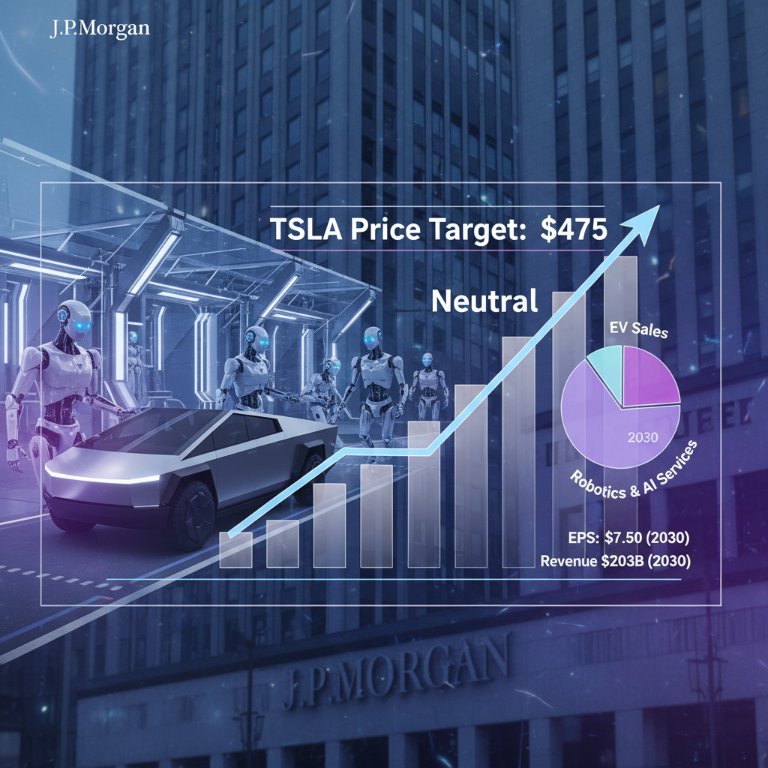
J.P. Morgan, a firm traditionally cautious on Tesla's stock, has delivered a striking endorsement that signals a profound shift in how Wall Street views the EV pioneer. In a move that sent ripples through the market, the financial giant upgraded Tesla's stock rating from 'underweight' to 'neutral' and, more significantly, dramatically increased its price target from a mere $145 to an astonishing $475. This isn't just a minor adjustment; it's a fundamental re-evaluation of Tesla's core business and long-term potential, pivoting away from a singular focus on vehicle sales to embrace its burgeoning role as an AI and robotics powerhouse.
A Fundamental Shift in Valuation Metrics
For years, J.P. Morgan maintained a skeptical 'underweight' rating on Tesla, largely tethering its valuation to the cyclical nature of automotive manufacturing and near-term electric vehicle earnings. This latest upgrade, however, marks a clear departure from that traditional perspective, acknowledging a deeper narrative unfolding within the company. The new $475 price target represents a nearly threefold increase, indicating a profound recalibration of what constitutes Tesla's value proposition.
- Previous Price Target: $145
- New Price Target: $475
- Rating Change: From 'Underweight' to 'Neutral'
Autonomy and Robotics: The New Growth Engines
Analysts at J.P. Morgan now believe that Tesla's valuation is increasingly influenced by its aggressive advancements in autonomous driving and robotics. This crucial insight underscores Tesla's evolution from solely an automotive manufacturer to a diversified technology conglomerate. The firm projects that nearly half of Tesla's substantial revenue growth over the next five years will be driven by these nascent yet rapidly expanding service and new business segments.
- Projected Revenue Growth: Doubling from approximately $95 billion in 2025 to roughly $203 billion by 2030.
- Growth Driver: Nearly 50% of this growth is attributed to services and new businesses related to autonomy and robotics.
Long-Term Earnings Inflection Point
The financial firm's projections paint a compelling picture for Tesla's long-term profitability, anticipating a significant 'inflection' point in earnings per share (EPS) beyond 2028. This forecast highlights a future where Tesla's innovative ventures in AI and robotics begin to yield substantial financial returns, significantly enhancing its bottom line.
- Projected EPS 2026: Approximately $1.95
- Projected EPS 2030: Approximately $7.50, signaling a nearly fourfold increase.
Why This Matters:
This dramatic shift in J.P. Morgan's stance is more than just an analyst upgrade; it's a powerful signal to the entire market. It validates Tesla's long-held, often-questioned vision of transcending mere automotive manufacturing to become a leader in artificial intelligence and robotics. For savvy EV enthusiasts and industry professionals, this indicates a recognition that the true value of Tesla lies not just in the cars it sells today, but in the software, data, and autonomous capabilities it is developing for tomorrow. This could redefine how other automotive companies are valued, compelling them to accelerate their own AI and software strategies or risk being left behind. Companies focused purely on hardware and traditional vehicle sales might find themselves increasingly undervalued compared to those demonstrating robust software and AI ecosystems. Tesla, therefore, is being recognized as a tech giant first, with vehicles serving as platforms for its groundbreaking AI and robotics developments. This move solidifies Tesla's position as a forward-thinking technology company and underscores the immense disruptive potential of its non-automotive initiatives.
Tesla's future, as envisioned by J.P. Morgan, is clearly one where its prowess in autonomous driving and robotics takes center stage, driving unprecedented revenue and earnings growth. This re-evaluation sets a new benchmark for how innovation in AI and software can fundamentally reshape the financial outlook of a company, extending its influence far beyond its initial market segment.