Lucid Air Hit With Massive 'Park Outside' Fire Recall: Why Software Is Both the Poison and the Antidote
The Lucid Air has spent the last few years redefining the premium electric sedan segment with its jaw-dropping range, sleek aerodynamics, and physics-...
Editorial Team
World Of EV
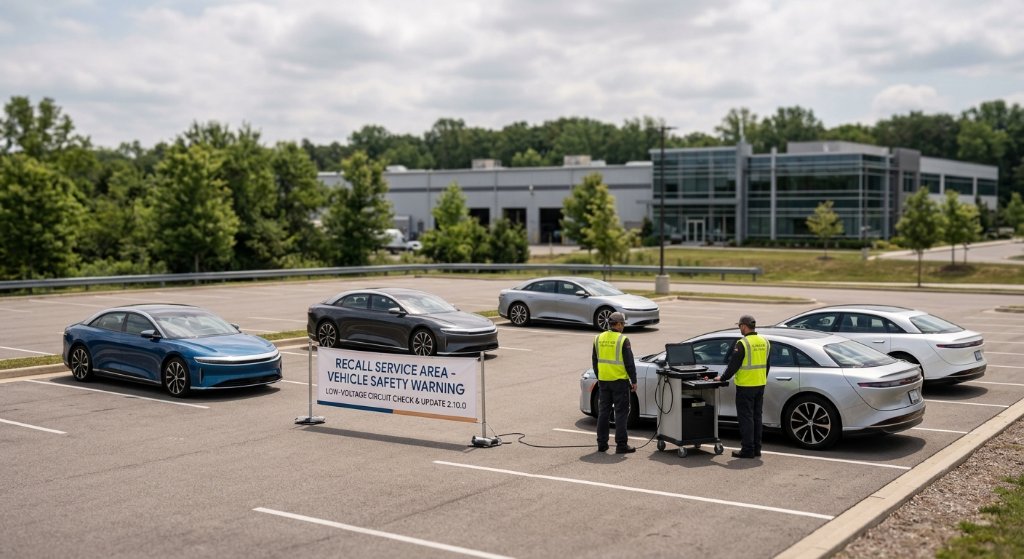
The Lucid Air has spent the last few years redefining the premium electric sedan segment with its jaw-dropping range, sleek aerodynamics, and physics-defying performance. But even the most highly engineered electric vehicles aren’t immune to the growing pains of a hardware-startup-turned-automaker. Lucid Motors is facing its most significant safety hurdle yet, issuing a sweeping "park outside" recall for 27,185 of its flagship sedans due to a potential fire hazard.
The National Highway Traffic Safety Administration (NHTSA) and Lucid have urgently advised owners of affected 2022 through 2026 model-year vehicles to park them outdoors and away from structures. At the heart of the issue is a software-related low-voltage circuit vulnerability. This marks a critical moment for the Saudi-backed EV manufacturer as it navigates a tricky year of quality-control challenges while trying to launch its next-generation Gravity SUV.
The eFuse Vulnerability: What Went Wrong?
Unlike legacy vehicles that rely on traditional physical fuses that "pop" and break the connection when an electrical circuit draws too much current, modern software-defined vehicles like the Lucid Air utilize electronic fuses, or eFuses. In this case, the eFuse software logic managing the Air's low-voltage exterior lighting circuits—specifically the headlights, taillights, and center high-mounted stop lamp (CHMSL)—had a severe gap in overcurrent protection.
Instead of shutting down when excess current flowed through, the logic allowed the circuits to remain energized at dangerously high amperages. This has led to:
- Overheating and Melting: The low-voltage wiring harnesses can overheat, causing smoke, melting, or full-blown fires.
- Loss of Vital Lighting: Overheated circuits can cause critical headlights, taillights, or rear brake lights to fail, significantly increasing crash risk.
- Documented Incidents: Lucid initiated the safety investigation after a series of incidents, including three confirmed fires and four reports of smoke originating from the vehicle's front corners and rear brake lamp assembly.
The Scope and the Software Solution
This recall is massive relative to Lucid's manufacturing footprint, covering virtually every Lucid Air built between October 11, 2021, and July 27, 2026 (representing roughly 62% of all vehicles the company has ever delivered globally). Fortunately for both Lucid and its customers, the remedy does not require a trip to a physical service center. Lucid has engineered an over-the-air (OTA) software fix:
- The Software Remedy: Software version 2.10.0 (and later) lowers the eFuse amperage threshold and completely disables the retry logic that previously allowed a faulted circuit to re-energize during the same key cycle.
- Deployment Status: Out of the 27,185 affected vehicles, Lucid has already successfully pushed the OTA update to 20,719 cars.
- Remaining Risk: There are still 6,466 outstanding vehicles that have not yet received the update. Owners of these specific vehicles must park outside and away from buildings until version 2.10.0 is successfully installed.
A String of Setbacks
While the ability to patch more than 27,000 vehicles remotely is a triumph of Lucid's software-centric architecture, this recall is the latest in a string of quality-control headaches. This is Lucid’s fourth recall of the year, following:
- January: A recall of 10,816 vehicles over rearview camera display failures.
- March: A recall of 3,627 vehicles for improperly secured half-shaft bolts.
- May: A recall of 2,039 vehicles for faulty drive unit inverters that could cause a sudden loss of propulsion.
Why This Matters:
This massive recall is a double-edged sword for Lucid, presenting both a warning sign of early-stage automotive scaling and a validation of the modern Software-Defined Vehicle (SDV) paradigm.
The Bad News: At over 27,000 vehicles, this recall is larger than Lucid’s entire delivery volume for 2025 (15,841 vehicles). For a niche, ultra-luxury startup competing against the likes of Porsche and Mercedes-Benz, brand reputation is everything. A "park outside" warning issued by the NHTSA is the most severe consumer advisory possible, triggering immediate anxiety for owners. With Lucid preparing to launch its highly anticipated Gravity SUV and ramping up development for its midsize "Cosmos" platform, these recurring quality issues threaten to sap crucial engineering focus and strain customer support.
The Silver Lining: This is a showcase of why software-first EV architectures are winning the technology war. If a legacy automaker had to recall nearly every vehicle it had ever sold for a physical wire-harness replacement, the logistical and financial toll would be devastating—likely running into tens of millions of dollars. For Lucid, because of its eFuse architecture, the cost of fixing over 76% of the fleet before the recall was even publicly filed is negligible, restricted mostly to software development and compliance.
Ultimately, this is a "do-or-die" era for Lucid as it strives to achieve volume profitability. It proves that while Lucid's software agility can save its balance sheet from ruin, the company must urgently tighten its pre-production quality controls if it wants consumers to trust its upcoming family-movers.
Moving Forward
As Lucid works to notify the remaining 6,466 owners by mid-October, the immediate priority is clear: get those vehicles updated. For the broader industry, it's a stark reminder that while software can solve our physical problems overnight, getting the hardware logic right the first time remains paramount. Lucid has the technology to survive this stumble, but the runway is getting shorter.