Lucid and Bolt Forge 25,000-Vehicle European Robotaxi Alliance, Reshaping the Autonomous Race
Lucid Group is charting a bold, high-volume path far beyond the exclusive luxury market that has defined its brand to date. In a monumental move to sc...
Editorial Team
World Of EV
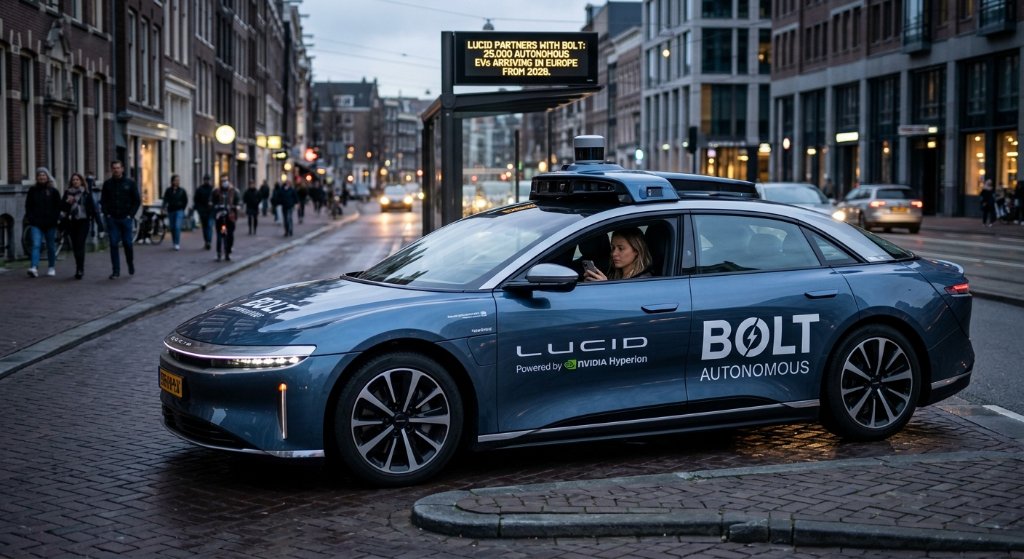
Lucid Group is charting a bold, high-volume path far beyond the exclusive luxury market that has defined its brand to date. In a monumental move to scale its technology, Lucid and European shared-mobility giant Bolt have announced a strategic partnership to co-develop and deploy at least 25,000 fully autonomous Level 4 electric vehicles across Europe, with initial rollouts projected to begin in 2028.
This deal represents a seismic shift for Newark-based Lucid. Traditionally known for building ultra-premium, ultra-efficient EVs like the Air sedan, the automaker has historically struggled with production bottlenecks and high cash-burn rates, leading to a massive restructuring campaign under advisor AlixPartners to slash $1.4 billion in cash consumption. Under the leadership of CEO Silvio Napoli, Lucid is aggressively transitioning from a low-volume luxury manufacturer into a global software-defined vehicle platform powerhouse, leveraging its newly established "Lucid Technologies" division to unlock fleet scale.
A High-Volume Foundation: The Midsize Platform
Instead of adapting its existing flagship sedans or the premium Gravity SUV, Lucid is utilizing its upcoming, highly anticipated Midsize platform to serve as the backbone for the Bolt partnership. While this affordable platform faced a brief six-week development delay recently, its integration into Bolt's operations establishes an immediate, high-volume demand signal.
Under the agreement, the two companies will co-develop "autonomous-driving-system-ready" (ADS-ready) vehicles right from the drawing board, ensuring hardware and software are perfectly synchronized. Key highlights of the partnership include:
- Massive Fleet Scale: A minimum of 25,000 Level 4 autonomous vehicles will hit major European cities, supporting Bolt’s ultimate goal of 100,000 AVs by 2035.
- NVIDIA Hyperion Power: The autonomous driving architecture will rely on NVIDIA Hyperion, a production-ready reference platform combining immense AI compute with a standardized sensor suite.
- Clean Division of Labor: Bolt Autonomous Driving Solutions will own, operate, and maintain the physical fleet while managing regulatory partnerships. Lucid Technologies will supply the vehicle platform, AI functions, and digital integration.
- Deep Co-Design: Bolt's decade of operating data across 850 European cities will actively shape the vehicle's design, safety parameters, and rider-experience software.
Navigating Fragmented European Roads
Deploying autonomous fleets in Europe is a vastly different beast than operating in the US or China, largely due to tight city layouts and highly fragmented regulatory landscapes. Bolt Founder and CEO Markus Villig highlighted this complexity, noting that successful AV integration requires "data, software, vehicles, and operations to work as one system built for European roads."
By collaborating at the product development stage, the partnership aims to proactively satisfy strict European safety regulations, paving a smoother regulatory pathway toward the 2028 launch. It also marks Lucid's second massive robotaxi play, following its US-based commitment to deploy 35,000 vehicles with Uber and Nuro.
Why This Matters:
For EV enthusiasts and prospective buyers, this announcement signals that Lucid is building the industrial and financial foundation to survive long-term. Historically, Lucid's world-class powertrain efficiency has been trapped in expensive, niche luxury vehicles. By pivoting to high-volume commercial fleet deals, Lucid is executing a highly strategic, asset-light robotaxi play.
The Commercial De-risking: Unlike Tesla, which is attempting the highly capital-intensive and logistically complex path of building and operating its own dedicated robotaxi network (such as the Cybercab), Lucid is acting as a technology and vehicle supplier to established giants. Between the 35,000-vehicle Uber commitment in the US and this new 25,000-vehicle Bolt alliance in Europe, Lucid has secured guaranteed commercial demand for 60,000 units of its upcoming Midsize platform before the first car even rolls off the line. This dramatically lowers the risk of expanding its manufacturing capacity.
Winners and Losers: The clear winner here is NVIDIA, whose Hyperion platform continues to cement itself as the standardized Android of the self-driving world. Bolt also wins by securing a reliable, ultra-efficient EV platform tailored for its business. On the losing end are proprietary, vertically-integrated robotaxi startups trying to build hardware, software, and fleet networks from scratch—a strategy that is proving increasingly unsustainable in a high-interest-rate environment.
Looking Ahead to 2028
With a 2028 deployment window, Lucid and Bolt have given themselves a realistic timeline to solve the physical, digital, and regulatory hurdles of European robotaxis. If they succeed, Lucid will have successfully decoupled its financial future from the volatile consumer EV market, transforming itself into an indispensable infrastructure provider for the autonomous era.