Lucid Motors Plunges: A Luxury EV Dream Fades Amidst Plummeting Valuation and Market Retreat
Once heralded as a potential 'Tesla killer' with ambitious plans to redefine luxury electric vehicles, Lucid Motors finds itself in a precarious posit...
Editorial Team
World Of EV
Once heralded as a potential 'Tesla killer' with ambitious plans to redefine luxury electric vehicles, Lucid Motors finds itself in a precarious position. The company’s market capitalization has plummeted to a stark $2 billion, with its stock hitting a new record low of $5.22 per share. This dramatic downturn signals a significant loss of investor confidence and raises critical questions about the future viability of the high-end EV manufacturer.
From its initial public offering via a SPAC merger in 2021, Lucid captured headlines with its stunning Air sedan, promising industry-leading range and performance. The company quickly achieved a market valuation that once soared past $90 billion, fueled by hype and strong pre-orders. However, production struggles, a challenging economic climate, and intense competition have consistently hampered its ability to deliver on those promises and scale efficiently.
Financial Headwinds and Plummeting Valuation
The $2 billion market cap and $5.22 stock price represent a staggering fall from grace for Lucid. This financial contraction reflects several critical challenges:
- Production Bottlenecks: Lucid has consistently struggled to meet its own production targets, hindering revenue generation and increasing investor skepticism.
- Intense Competition: The luxury EV segment, while niche, is fiercely competitive, with established players like Porsche, Mercedes-Benz, and BMW, alongside Tesla, offering compelling alternatives.
- Economic Pressures: High interest rates and inflationary pressures have dampened consumer enthusiasm for high-priced luxury goods, including premium EVs.
- High Operating Costs: As a startup building a manufacturing infrastructure from the ground up, Lucid incurs significant operating expenses that are difficult to cover with limited vehicle deliveries.
Retreat from Oslo: A Strategic Reassessment
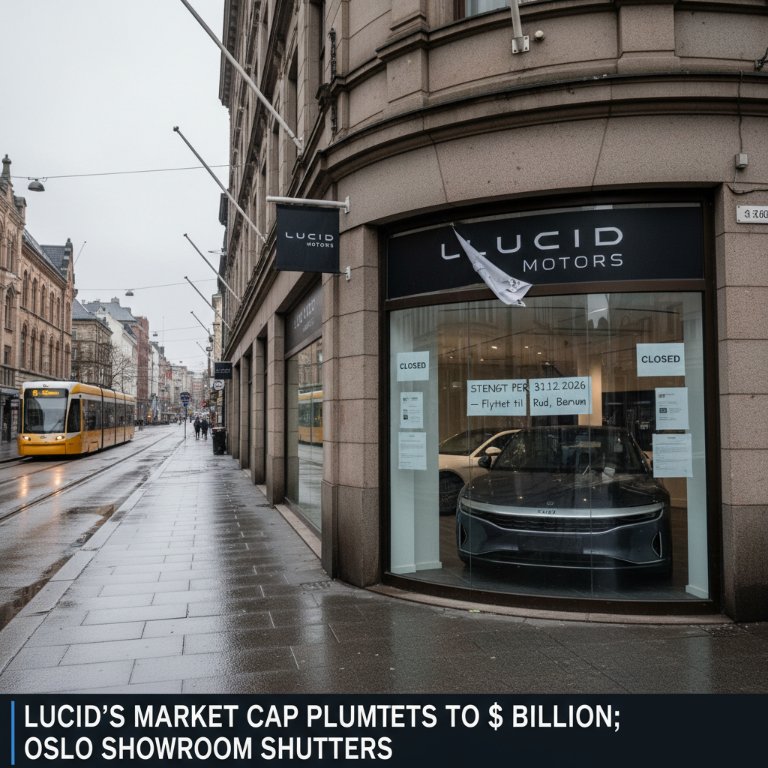
In a clear operational response to these market challenges, Lucid Motors has decided to close its Oslo showroom located on Karl Johans gate. This move directly follows a complete lack of customer sales in Oslo throughout 2026, forcing Lucid to consolidate all Norwegian operations at its existing service and delivery center in Rud, Bærum.
Norway has long been a global leader in EV adoption, boasting one of the highest per-capita EV sales rates worldwide. For a premium EV brand like Lucid to fail to secure a single customer sale in this market throughout an entire year is a damning indictment of its current market penetration and appeal. This consolidation effort is a clear cost-cutting measure, but it also signals a strategic retreat from what should be a fertile ground for luxury electric vehicles.
Why This Matters:
This latest news is more than just a blip on Lucid's financial radar; it represents a critical inflection point for the company and a stark warning for the broader luxury EV startup landscape. The plummeting valuation indicates a profound loss of investor faith, suggesting that the market no longer believes in Lucid's ability to execute its original vision independently. The closure of the Oslo showroom underscores a fundamental issue: a compelling product alone isn't enough; market acceptance, effective sales strategies, and brand recognition are paramount, especially in high-volume EV markets like Norway.
For luxury EV buyers, this signals uncertainty regarding long-term support and residual values for Lucid vehicles. For industry professionals, it highlights the immense difficulty of scaling a new automotive brand, particularly one targeting the premium segment. Who wins? Established luxury marques that can weather market fluctuations and leverage existing sales and service networks, and potentially Tesla, which continues to dominate mindshare. Who loses? Lucid, most immediately, but also the aspiration for a truly diverse luxury EV market free from the constraints of legacy automakers or Tesla's singular vision. This is increasingly looking like a do-or-die moment for Lucid Motors; without significant new investment or a drastic pivot, its long-term future as an independent entity hangs by a thread.
The path ahead for Lucid Motors is fraught with challenges. The company must urgently address its production inefficiencies, redefine its market strategy, and secure additional capital if it hopes to navigate these turbulent waters. The dream of challenging automotive titans requires more than just innovative engineering; it demands relentless execution and unwavering market traction.