Lucid, Nuro, Uber Alliance Accelerates: Executive Ride Confirms Robotaxi Readiness for 2026 Launch
Lucid Motors, known for its ultra-luxury Air sedan, has taken a decisive step into the competitive autonomous vehicle landscape. A senior Lucid execut...
Editorial Team
World Of EV
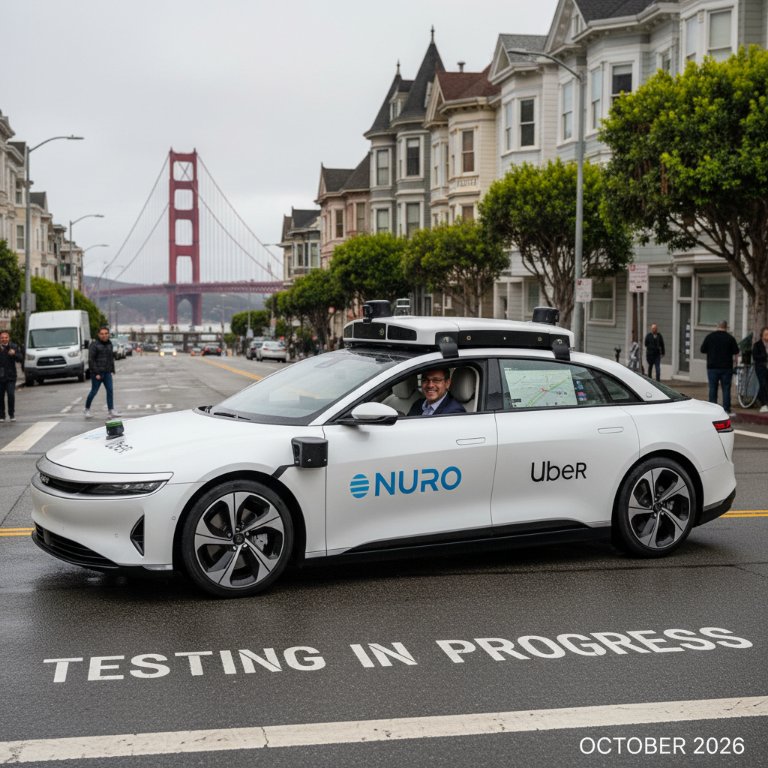
Lucid Motors, known for its ultra-luxury Air sedan, has taken a decisive step into the competitive autonomous vehicle landscape. A senior Lucid executive recently completed their inaugural ride in a Lucid x Nuro x Uber robotaxi, publicly confirming that this strategic partnership has progressed to real-world testing. This milestone signals a significant diversification for Lucid and sets the stage for a commercial robotaxi service launch in the San Francisco Bay Area later in 2026.
For years, Lucid has meticulously crafted its image around performance and opulence, directly challenging established luxury automakers and nascent EV giants alike. This foray into autonomous ride-hailing with Nuro and Uber, however, positions Lucid not just as a vehicle manufacturer, but as a critical technology enabler in the future of mobility. The executive's validation ride is more than a photo opportunity; it’s a tangible demonstration of progress after months of collaborative development, proving the system’s readiness for public road evaluation.
A Strategic Alliance in Action
This robotaxi initiative is a potent blend of specialized expertise, forming a formidable triple alliance:
- Lucid Motors: Contributes its advanced electric vehicle platform, sophisticated powertrain, and manufacturing prowess. The inherent safety and performance architecture of Lucid's vehicles provide a robust foundation for autonomous operations.
- Nuro: A leader in autonomous driving technology, particularly for goods delivery, Nuro brings its proven self-driving stack and operational experience to the passenger transport segment. Their track record in navigating complex urban environments is invaluable.
- Uber: The global ride-hailing behemoth provides its extensive network, operational logistics, and customer interface. Uber’s experience in scaling mobility services is critical for the eventual commercial deployment of the robotaxis.
The executive's first-hand experience underscores the maturation of the integrated hardware and software stack. This isn't merely a concept; it's a functional system undergoing rigorous real-world validation, moving beyond simulations and closed-course testing.
Targeting the Golden Gate: 2026 Rollout
The choice of the San Francisco Bay Area for the initial commercial deployment in late 2026 is highly strategic. This region serves as a crucible for autonomous technology, characterized by:
- Complex Urban Environments: San Francisco's diverse topography, dense traffic, and intricate street layouts offer an ideal challenge for honing autonomous driving systems.
- Tech-Savvy Early Adopters: The Bay Area population is historically receptive to new technologies, providing a fertile ground for early adoption and valuable user feedback.
- Robust Infrastructure: Existing charging infrastructure and a strong talent pool further support the operational rollout.
The planned launch in 2026 places the Lucid-Nuro-Uber partnership firmly in the race to scale robotaxi services, competing directly with established players and other ambitious newcomers aiming to capture a share of the burgeoning autonomous mobility market.
Why This Matters:
- For Lucid Motors: This move is a vital diversification strategy. It allows Lucid to leverage its substantial R&D investment in EV platforms and software beyond direct vehicle sales, opening new revenue streams as a technology and platform provider. It also enhances Lucid's brand perception, positioning it as an innovator not just in luxury, but in future mobility solutions. This strategic pivot could be crucial for long-term financial health and market valuation, signaling that Lucid isn't solely dependent on the volatile luxury EV market.
- For Nuro: Partnering with Lucid offers Nuro a premium, purpose-built electric platform to integrate its autonomous technology for passenger transport, a significant expansion from its established delivery focus. This partnership validates Nuro's technology for a broader application.
- For Uber: This alliance provides Uber with a pathway to offer autonomous ride-hailing services without bearing the immense capital expenditure and development risks associated with building AVs from scratch. It allows Uber to accelerate its autonomous strategy, potentially reducing per-mile costs and improving service consistency in the long run, positioning it competitively against rivals exploring similar AV integrations.
- For the Autonomous Vehicle Market: This partnership intensifies competition in the robotaxi space. It demonstrates that collaboration among specialized players is a viable, perhaps even preferred, model for bringing complex AV services to market faster and more efficiently. It puts increased pressure on companies attempting to go it alone or those with slower deployment timelines.
- For Consumers: The prospect of commercial robotaxis by 2026 in a major urban center signifies a tangible step towards a future of autonomous urban mobility. It promises new, potentially more efficient, and eventually more affordable, transportation options, albeit initially in a limited geographical scope.
The Road Ahead
Lucid's public confirmation of real-world testing and its commitment to a 2026 commercial launch with Nuro and Uber marks a pivotal moment for all parties involved. This collaborative model, pooling specialized strengths, could accelerate the widespread adoption of autonomous ride-hailing. As the San Francisco rollout approaches, the industry will be watching closely to see how this ambitious alliance navigates the complexities of commercial autonomous operations and redefines urban mobility.