Lucid’s Cash-Burn Crisis: Can a Sweeping 'Operational Reset' Save the EV Pioneer?
Lucid Group is trapped in a classic electric vehicle paradox: brilliant engineering and growing sales clashing with a punishingly expensive business m...
Editorial Team
World Of EV
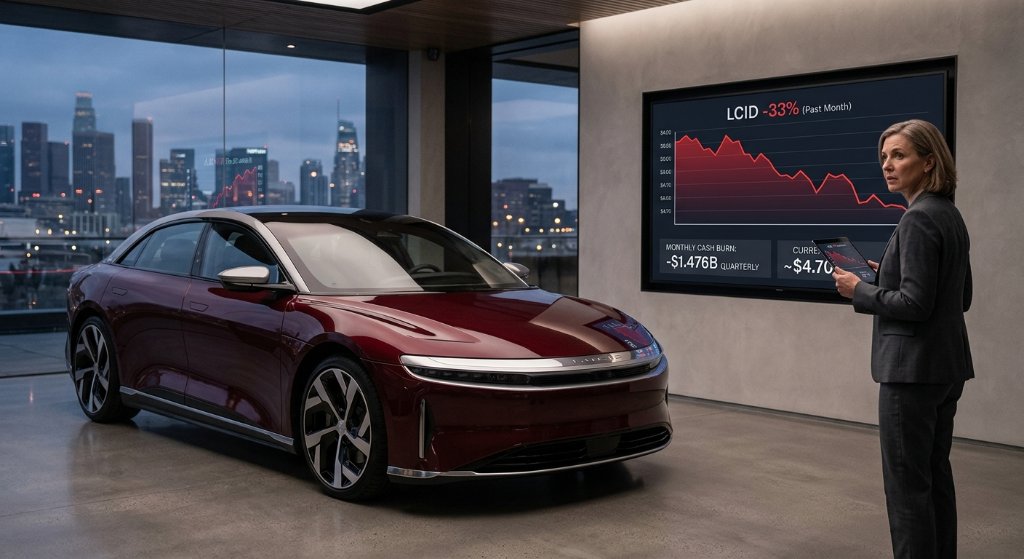
Lucid Group is trapped in a classic electric vehicle paradox: brilliant engineering and growing sales clashing with a punishingly expensive business model. Despite booking a massive 56% year-over-year revenue surge to $405 million and delivering 3,953 vehicles in the second quarter, Wall Street has run out of patience. Over the past month, Lucid’s stock (NASDAQ: LCID) has cratered by 33%, languishing at a near-historic low of approximately $4.70.
The primary culprit remains a staggering $1.476 billion quarterly free cash burn. This alarming financial drain has forced newly minted CEO Silvio Napoli to drastically trim production targets to conserve capital, proving that in the hyper-competitive EV landscape, having the world's most efficient drivetrain technology does not guarantee survival if you run out of money.
The Numbers Behind the Paradox
While the headline stock plunge paints a grim picture, Lucid's underlying customer demand actually shows signs of life. The 19% bump in deliveries and 56% revenue climb show that buyers still want the brilliant Lucid Air sedan, even in a sluggish luxury EV segment. However, the factory produced 4,774 vehicles in the quarter, meaning Lucid continues to build more cars than it can sell, exacerbating its inventory and capital issues.
To right the ship, Napoli has initiated a sweeping operational reset designed to unlock $1.4 billion in cash-flow improvements across 2026. Key targets of this emergency recovery plan include:
- Inventory Reduction: Slashing bloated inventory to free up $600 million to $800 million.
- CapEx Trimming: Cutting projected capital expenditures by approximately $500 million.
- Operational Savings: Stripping out $200 million in operating expenses, fueled in part by recent U.S. workforce reductions.
- C-Suite Restructuring: Halving the number of executives reporting directly to the CEO, bringing in new heavy hitters like incoming CFO Alexander De Bock (formerly of TI Automotive) and CTO Raja Ramana Macha (formerly of Eaton).
Slowing the Assembly Line to Save Cash
Historically, EV startups have focused on scaling production at all costs. But Lucid's new leadership is taking the opposite approach, intentionally moderating production in Arizona to stop bleeding cash. The goal is simple: let deliveries catch up to existing inventory, preventing the company from being forced into aggressive, brand-damaging price cuts.
Furthermore, Lucid is banking heavily on its next-generation vehicle programs and high-profile partnerships to diversify its revenue streams:
- The Gravity SUV: Currently running production-validation trials, the three-row SUV represents the make-or-break vehicle for Lucid’s mass-market appeal.
- The Robotaxi Play: Lucid has deepened its alliances with Uber and autonomous tech firm Nuro, actively testing early Gravity robotaxi fleets in Houston and the San Francisco Bay Area.
- The Midsize Platform: Engineers are already developing a $50,000 midsize crossover aimed directly at the heart of the mass market.
Why This Matters:
This is a defining "do-or-die" moment for Lucid. For years, the company coasted on its reputation as the premier engineering powerhouse. Yet, incredible engineering has not stopped Lucid from losing six-figure sums on every car it builds. The transition of leadership from engineering-focused Peter Rawlinson to operationally ruthless Silvio Napoli—the former Schindler Group CEO known for tight industrial discipline—signals that the board has finally accepted a hard truth: technology is meaningless without financial viability.
The Winners and Losers:
- The Winner (The Saudi PIF): As Lucid's majority shareholder, Saudi Arabia's Public Investment Fund holds the ultimate leverage. They recently injected another $550 million. They essentially own the intellectual property and the physical assets, ensuring that even if Lucid's public stock struggles, the Kingdom’s domestic EV ambitions remain fully backed by world-class tech.
- The Losers (Retail Investors): A 33% stock plunge in 30 days is a devastating blow. Anyone holding LCID today must brace for a bumpy ride. The stock currently trades at a distressed 0.45x price-to-revenue multiple, reflecting deep market skepticism compared to rivals like Rivian, which recently secured a massive $5 billion lifeline from Volkswagen to stabilize its own future.
- The Industry Signal: This cash-flow crisis is a warning shot to the entire EV startup ecosystem. Capital is no longer free, and patience from the Street is entirely gone.
Ultimately, Lucid has the mechanical and software prowess to compete with anyone, but the clock is ticking loudly. The $1.476 billion quarterly cash drain must shrink immediately, and the upcoming Gravity SUV launch cannot afford a single misstep. If Silvio Napoli's operational reset successfully trims the fat, Lucid could emerge as a leaner, highly profitable luxury brand. But if the cash burn continues to outpace the savings, not even the deepest pockets in Saudi Arabia may be enough to save Lucid from becoming a highly-engineered cautionary tale.