Mastering the EV Road Trip: How Smart Tech and NACS Adapters are Finally Killing 'Charger Anxiety'
For years, the dream of the seamless electric vehicle (EV) road trip was often cut short by a harsh reality: a fragmented public charging infrastructu...
Editorial Team
World Of EV
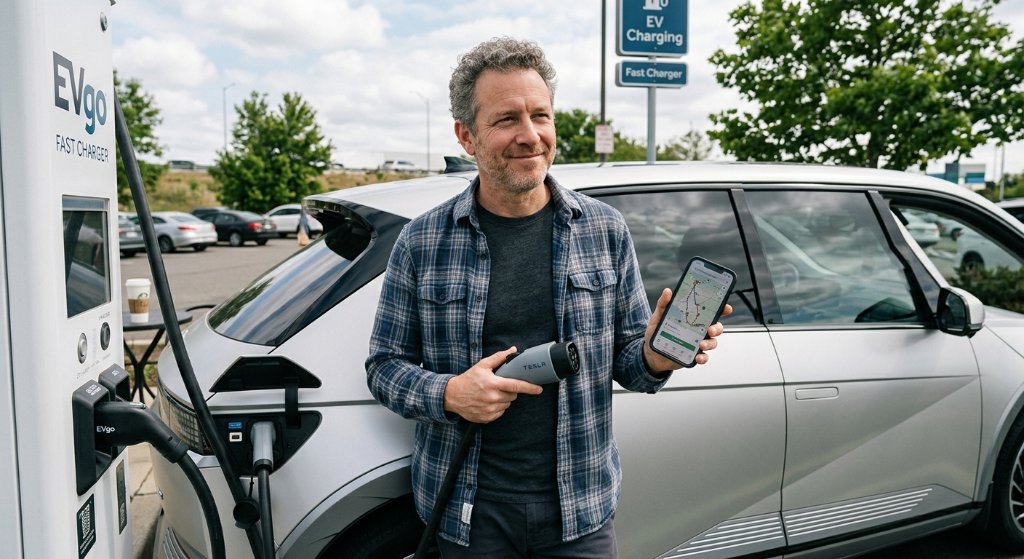
For years, the dream of the seamless electric vehicle (EV) road trip was often cut short by a harsh reality: a fragmented public charging infrastructure plagued by broken plugs, sluggish speeds, and a frustrating lack of cohesion. Even owners of the critically acclaimed Hyundai IONIQ 5—a vehicle revered for its class-leading 800-volt architecture and blisteringly fast 18-minute charging times—frequently found themselves planning trips with high degrees of anxiety. The non-Tesla CCS network simply wasn't reliable enough to support carefree long-distance travel.
But a paradigm shift is underway. A masterclass in strategic preparation shared by tech journalist and IONIQ 5 owner Adam Engst reveals that 'charger anxiety' is no longer an insurmountable hurdle. By combining cutting-edge navigation software with the physical keys to North America’s most robust charging network, savvy EV drivers are proving that long-distance electric travel has officially matched the convenience of gas-powered road trips.
The Three Pillars of a Frictionless EV Journey
Engst’s successful cross-country journey provides a blueprint for modern EV touring. Rather than relying on standard in-car navigation or basic mapping tools, he leveraged a targeted combination of software, hardware, and biological scheduling.
The core of this modern road-tripping strategy rests on three elements:
- Dynamic Routing with ABRP Premium: Instead of basic point-A-to-point-B GPS, 'A Better Route Planner' (ABRP) Premium uses live OBD-II data, real-time weather, elevation changes, and actual charger statuses to continuously recalculate the optimal path.
- Unlocking the Tesla Supercharger Empire: By leveraging a physical CCS-to-NACS adapter, non-Tesla drivers can plug into over 20,000 Tesla V3 and V4 Superchargers. This virtually doubles their DC fast-charging options on the highway.
- The 'Meal Break' Synchronization: Planning fast-charging stops around natural human intervals, such as lunch or dinner, eliminates the feeling of 'waiting to charge.' By the time drivers finish their meal, the car has finished its session.
Bridging the 800V Tech Gap with NACS Access
The integration of non-Tesla vehicles into the Supercharger network represents a massive shift. Historically, the Hyundai IONIQ 5 faced a unique challenge: its high-voltage e-GMP platform is optimized for 800-volt CCS fast chargers (where it can pull up to 230+ kW). At Tesla's 400-volt V3 Superchargers, the IONIQ 5 is limited to roughly 95 kW to 125 kW due to onboard voltage boosting.
Despite this technical bottleneck, the reliability and density of the Supercharger network far outweigh the slightly slower peak speeds. Having access to a working, available 100 kW charger at a highway exit is vastly superior to pulling up to a broken 350 kW CCS station.
Why This Matters:
- The Death of the 'Walled Garden': Tesla’s decision to open up its network—accelerated by major automakers officially transitioning to NACS—is a massive win for EV adoption. By eliminating exclusive networks, the industry is moving toward a gas-station-style universality.
- Software is the Real Differentiator: Automakers have spent billions on batteries, but this story highlights that software (like ABRP) and user experience are what truly make or break the ownership experience.
- A Wake-Up Call for Legacy CCS Networks: Electrify America, EVgo, and others are officially on notice. With Tesla’s network wide open, legacy networks must dramatically improve their uptime and reliability, or face total obsolescence.
- The Psychological Turning Point: Once mainstream buyers realize that road-tripping an EV is no more complex than planning a lunch stop, the final barrier to mass-market adoption will crumble.
The Final Takeaway
We are witnessing the maturity phase of the electric vehicle transition. What was once an exercise in high-stakes logistics is now a highly solvable, minor planning routine. With native NACS ports arriving on next-generation EVs and robust software tools optimizing every mile, the era of range anxiety has officially been replaced by the era of the seamless road trip.