Michigan’s Real-World Fleet Test Validates EV Savings, But Exposes America’s Lingering Charging Hurdles
Michigan—the historical home of the American internal combustion engine—has just dropped a truth bomb on EV skeptics. The Michigan Department of Envir...
Editorial Team
World Of EV
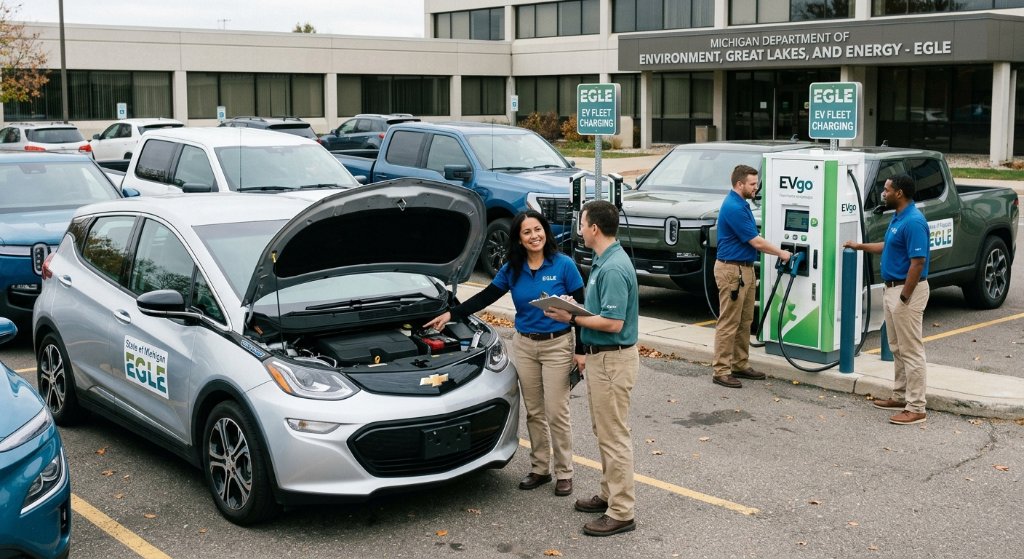
Michigan—the historical home of the American internal combustion engine—has just dropped a truth bomb on EV skeptics. The Michigan Department of Environment, Great Lakes, and Energy (EGLE) released the results of its real-world "ride and drive" fleet assessment, confirming that electric vehicles deliver on their promise of drastically lower operational costs. But the state's hands-on trial also unmasked a critical bottleneck: the steep learning curve of public charging.
For years, detractors have argued that EV savings are purely theoretical once real-world wear-and-tear is factored in. This study comes at a pivotal moment, as legacy Detroit automakers like Ford and GM scale back near-term EV targets due to slower-than-expected mainstream adoption. EGLE's findings provide hard, state-level data that could reshape how fleets and everyday buyers view the financial equation of going electric.
The Maintenance Advantage: Fewer Parts, Lower Costs
The core finding of the EGLE study validates what EV advocates have claimed for years: simpler drivetrains mean fewer headaches. Traditional ICE vehicles rely on complex engines with thousands of moving parts, whereas EVs utilize straightforward electric motors and battery packs.
Key maintenance takeaways from the report include:
- Drastically Reduced Downtime: Fleet managers reported fewer scheduled maintenance visits, keeping vehicles on the road longer.
- Drivetrain Simplicity: The elimination of oil changes, spark plugs, timing belts, and complex exhaust systems directly translates to lower operational overhead.
- Regenerative Braking Benefits: Mechanical brake wear was significantly lower thanks to regenerative braking systems, which use the electric motor to slow the vehicle while recapturing energy.
The Driving Experience vs. The Charging Reality
While EGLE staffers praised the quiet, smooth, and immediate torque of the EVs, the transition wasn't entirely seamless. The study highlighted that the "user experience" of fueling an EV is the single largest hurdle for new adopters.
The primary pain points identified during the real-world trials:
- The Speed Confusion: Staffers struggled to navigate the differences between Level 2 overnight charging and DC Fast Charging (DCFC) speeds, which can vary wildly depending on the vehicle's architecture (400V vs. 800V) and charger output.
- Logistical Friction: Planning routes around charger availability and dealing with broken or occupied public infrastructure remains a stressful endeavor for uninitiated drivers.
- The Software Curve: Adapting to various charging network apps, payment gateways, and pre-conditioning requirements represents a steep behavioral shift from the traditional "gas-and-go" mentality.
Why This Matters:
This report is a double-edged sword for the EV transition. On one hand, the financial victory is clear: Fleet operators and budget-conscious buyers win big. EGLE’s data proves that once an EV is integrated into a fleet or household, the total cost of ownership (TCO) plummets. This is a massive proof point for automakers like General Motors and Ford as they pitch commercial EV vans and trucks (like the E-Transit and Silverado EV) to corporate buyers who care strictly about the bottom line.
On the other hand, the charging infrastructure providers and automotive dealerships are losing the education war. The fact that government staffers—who are actively trying to adopt these vehicles—still struggle with charging speeds and logistics proves that the industry has failed to make charging intuitive. If the heartland of American automotive manufacturing cannot seamlessly navigate the public charging landscape, mainstream consumers won't either. What this signals to the market is that the "hardware" of EVs is ready, but the "software" and "education" ecosystems are lagging. The industry's rapid pivot to Tesla's NACS (North American Charging Standard) will solve some reliability issues, but only consumer education will solve the logistical friction.
Conclusion
Michigan's real-world trial proves that the economic and driving benefits of EVs are no longer up for debate—they are quantifiable facts. However, until charging a vehicle becomes as mindless as plugging in a smartphone, the mass transition will remain bottlenecked by user anxiety. To unlock the next wave of buyers, the automotive industry must shift its focus from building longer-range batteries to simplifying the charging experience.