Musk’s $16.8B ‘Terafab’ Breakout: Why Tesla and SpaceX are Building the Ultimate Chip Fortress
After years of relying on external silicon giants like NVIDIA and TSMC to power its self-driving ambitions, Tesla is making its ultimate play for abso...
Editorial Team
World Of EV
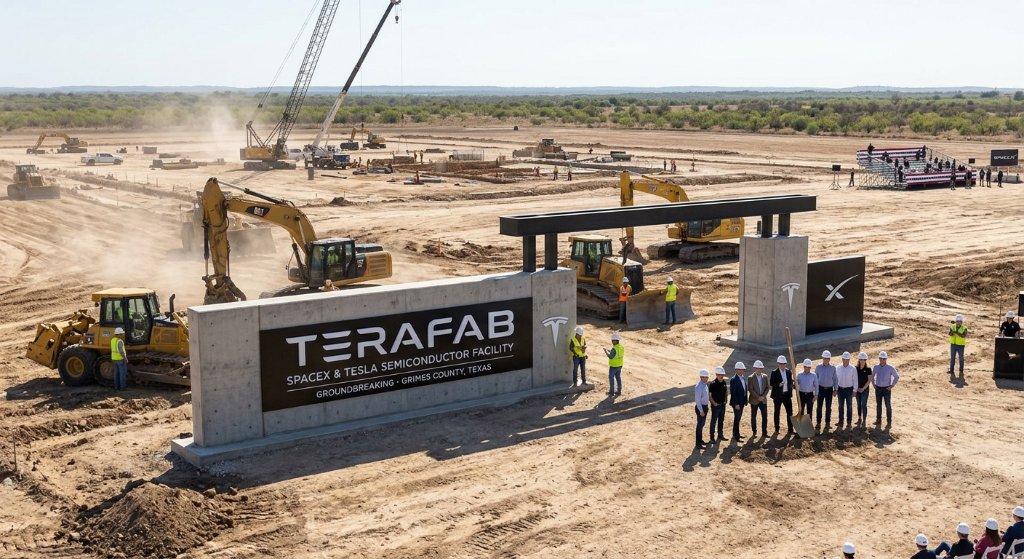
After years of relying on external silicon giants like NVIDIA and TSMC to power its self-driving ambitions, Tesla is making its ultimate play for absolute autonomy. In a move that redraws the boundaries of both the automotive and aerospace industries, Tesla and SpaceX have officially broken ground on "Terafab"—a jaw-dropping 100-million-square-foot vertically integrated semiconductor manufacturing facility in Grimes County, Texas. Backed by an initial $16.8 billion investment, this colossal facility is not just an expansion; it’s an aggressive, shield-like moat designed to secure Musk’s empire against the volatile global chip supply chain.
For Tesla, this is a massive evolution. We’ve watched the automaker struggle with compute bottlenecks for years, shifting from early NVIDIA hardware to its custom FSD (Full Self-Driving) chips fabricated by Samsung, while simultaneously pouring billions into its proprietary Dojo supercomputer. By teaming up with SpaceX and taking chip fabrication, advanced packaging, and testing completely in-house, Tesla is attempting what no other carmaker has ever dared: total vertical integration from raw silicon to autonomous edge intelligence.
The Blueprint: 100 Million Square Feet of Silicon Muscle
This is not your standard cleanroom facility. Located in rural Grimes County, about an hour outside Houston, the Terafab is slated to become one of the largest factories on earth. Under a single roof, the plant will unify the entire semiconductor pipeline. Key elements of the layout include:
- Total Vertical Integration: The facility will handle chip design, lithography, logic, memory production, advanced packaging, and testing—eliminating the need to ship fragile wafers across continents.
- Massive Investment & Scale: Supported by a $30 million Texas Enterprise Fund grant, the first phase alone represents a $16.8 billion capital injection, bringing 3,000 high-tech jobs to the region.
- The Terawatt Goal: The ultimate long-term goal is to manufacture more than one terawatt (one trillion watts) of AI compute capacity annually.
The Mission: Powering Cybercabs, Optimus, and the Cosmos
The custom silicon rolling off the Terafab line won't be destined for PCs or smartphones. These chips are hyper-optimized for low-latency, high-efficiency edge computing and inference. The output is earmarked for three revolutionary pillars:
- Tesla Cybercab: Next-generation autonomous robotaxis will require real-time vision processing and localized decision-making far exceeding the capabilities of today's HW4 platforms.
- Tesla Optimus: Humanoid robots require massive, power-sipping localized compute to handle complex spatial motor control and natural language processing without lagging.
- SpaceX Orbiting Data Centers: Space-hardened, high-power silicon will power SpaceX's next-generation orbital data hubs, routing massive global data pipelines through the Starlink network.
Why This Matters:
This is a declaration of war on the traditional semiconductor supply chain.
For NVIDIA, which currently dominates the AI compute landscape and has enjoyed massive margins from Tesla's insatiable hunger for H100 and Blackwell chips, this is a long-term threat. While Tesla will continue to use NVIDIA hardware for heavy cloud training in the near term, Terafab represents the eventual off-ramp from NVIDIA dependency. By building its own edge-inference chips, Tesla can optimize silicon specifically for its proprietary neural networks, bypassing the generic architectures of commercial chipmakers.
For the Automotive Industry, the gap between Tesla and legacy OEMs just became an abyss. While automakers like Ford, GM, and Volkswagen are still trying to figure out how to write basic software or source standard microcontrollers from Tier-1 suppliers, Tesla is building its own semiconductor foundry. Traditional OEMs have zero hope of matching this level of hardware-software co-design. If Terafab succeeds, Tesla will control its own compute destiny, completely insulated from future pandemic-style chip shortages or geopolitical disruptions in Taiwan.
The Risk: However, the road to silicon dominance is littered with multi-billion-dollar failures. Designing chips is hard; fabricating them at scale with high yields is arguably the most complex manufacturing challenge on Earth. Even with Intel assisting with fabrication processes and prototype operations already testing out at Giga Texas, Tesla is taking an enormous financial gamble. If yields are low or the technology lags, this $16.8 billion fortress could quickly turn into a capital-intensive anchor.
Furthermore, there is growing local friction. Grimes County residents have already launched petitions demanding stricter environmental oversight and tax-break accountability. Balancing cutting-edge chip fabrication—which requires massive amounts of pure water and energy—with rural Texas infrastructure will be the project's first major hurdle.
The Verdict
Terafab is the ultimate manifestation of Elon Musk's "first principles" engineering. By merging the compute demands of Tesla's self-driving fleet, Optimus humanoid robots, and SpaceX's orbital network, the two companies are creating a synthetic market of scale that justifies building their own foundry. If they pull it off, Terafab will not only power the next century of autonomous transport and robotics, but it will also solidify Texas as the undisputed global capital of edge-AI computing.