NHTSA Corners Tesla: Sworn Special Order Demands Proof That Pedal-Free Cybercab is Legally Allowed to Drive
Just hours after Tesla launched its highly anticipated commercial Cybercab robotaxi service in Austin on September 3, 2026, federal safety regulators ...
Editorial Team
World Of EV
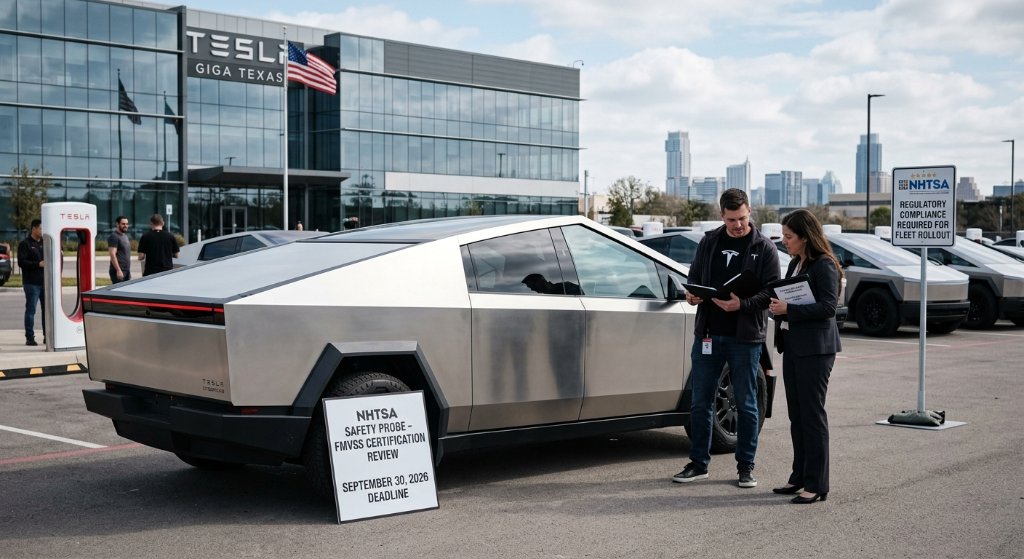
Just hours after Tesla launched its highly anticipated commercial Cybercab robotaxi service in Austin on September 3, 2026, federal safety regulators struck. What began as an audit has quickly escalated into a high-stakes legal showdown that threatens to derail Elon Musk’s autonomous ambitions.
In a newly publicized Special Order issued on September 10, the National Highway Traffic Safety Administration (NHTSA) gave Tesla an incredibly tight deadline of September 30, 2026, to defend—under oath—how its steering-wheel-free and pedal-free Cybercab complies with Federal Motor Vehicle Safety Standards (FMVSS). This is not a routine regulatory inquiry. Failure to answer the agency's 21 highly technical requests fully and truthfully could hit the EV giant with up to $139 million in civil penalties and freeze its commercial deployment before it can scale.
The Self-Certification Gamble
The core tension lies in the unique way vehicles are approved in the United States. Unlike European or Asian markets where government regulators pre-approve new automotive designs, the U.S. relies on a self-certification process. Manufacturers legally declare that their vehicles meet all federal safety standards, and NHTSA audits compliance after the fact. By certifying the Cybercab—a vehicle completely devoid of a steering wheel, accelerator, brake pedal, or side mirrors—Tesla took a massive gamble. Traditional FMVSS regulations explicitly assume a human driver is behind the wheel, down to specific wording requiring physical, foot-activated brake controls.
Inside NHTSA's 21 Demands
The escalated Special Order is a legally binding demand for technical data signed by NHTSA Chief Counsel Peter Simshauser. Regulators are pressing Tesla on three highly sensitive, critical fronts:
- The "Removable Controls" Trap: Requests 5 through 7 specifically investigate whether Tesla temporarily fitted the Cybercab with steering wheels and pedals to pass FMVSS compliance testing, only to strip them off for public deployment. Doing so would violate federal laws that prohibit manufacturers from making required safety equipment inoperative.
- The Missing Foot Brake: Request 19 points directly to FMVSS No. 135, which mandates that "service brakes shall be activated by means of a foot control." NHTSA is demanding to know how a pedal-free vehicle can legally claim compliance with this standard.
- Regulatory Exemption Sidestep: Unlike autonomous rivals like Alphabet's Waymo or General Motors' Cruise—which spent years petitioning for federal safety exemptions to test custom driverless platforms—Tesla opted to self-certify without an exemption. Request 10 forces Tesla to detail exactly which rules it believes do not apply to the Cybercab and provide the engineering logic behind those determinations.
Tesla's History of Regulatory Brinkmanship
Tesla has a long-standing history of pushing the regulatory envelope. From previous NHTSA recalls addressing "rolling stops" in Full Self-Driving (FSD) Beta to the massive Autopilot investigations that have spanned years, Tesla has consistently favored a "move fast and break things" approach to safety. However, bypassing the formal NHTSA exemption petition process for a vehicle lacking physical controls is a bold new frontier. By avoiding the exemption route, Tesla attempted to sidestep the annual cap of 2,500 vehicles typically imposed on exempted experimental fleets, hoping instead to rush straight to high-volume commercialization.
Why This Matters:
This is a do-or-die moment for Tesla’s entire stock market thesis. Wall Street prices Tesla not as a traditional automaker, but as an AI and robotics powerhouse. Elon Musk has staked the company's multi-billion-dollar valuation on the immediate deployment of the Cybercab and its autonomous ride-hailing network. If NHTSA rules that Tesla's self-certification is invalid or misleading, it won't just mean a massive $139 million fine; it will trigger an immediate halt to the Austin rollout and place a regulatory chokehold on future expansions.
Who wins? Alphabet's Waymo. By painstakingly building traditional vehicles with human controls intact, or navigating the slower, heavily regulated path to exemptions, Waymo's cautious, safety-first strategy has been validated as the only viable way forward.
Who loses? Tesla, its investors, and prospective buyers of the promised $30,000 autonomous vehicle. A negative ruling would force Tesla to either redesign the Cybercab with physical controls or face years of regulatory limbo petitioning for FMVSS exemptions, which would strictly limit fleet scale.
The Market Signal: The federal government is drawing a hard line. Autonomous technology, no matter how advanced, cannot simply bypass legacy laws because the hardware has evolved past them.
Looking to the Future
As the September 30, 2026 deadline looms, the regulatory clock is ticking loudly for Elon Musk. Tesla has spent years successfully shifting the boundaries of automotive tech, but in NHTSA, it has met an opponent armed with legacy laws designed for a different era. The answers Tesla files under oath this month will determine whether the Cybercab is the vanguard of a driverless revolution or a very expensive, highly illegal science project.