NHTSA Rejects Tesla’s Appeal to Bypass Safety Rules: Over 19,000 Model 3 and Y Vehicles Face Headlight Recall
Federal safety regulators are turning down the high beams on Tesla. In a definitive ruling, the National Highway Traffic Safety Administration (NHTSA)...
Editorial Team
World Of EV
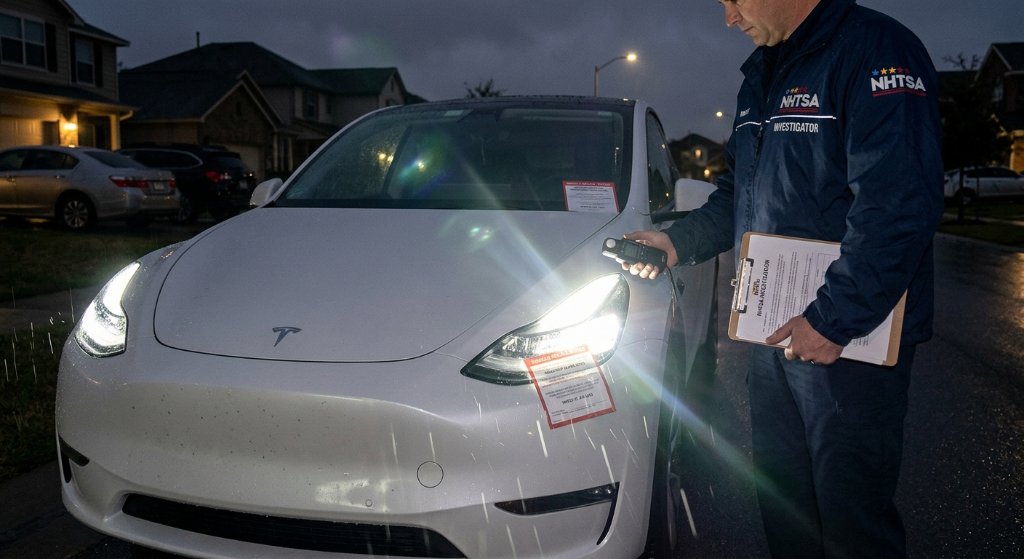
Federal safety regulators are turning down the high beams on Tesla. In a definitive ruling, the National Highway Traffic Safety Administration (NHTSA) officially denied Tesla's long-running petition to bypass a safety recall for nearly 20,000 Model 3 and Model Y vehicles. Tesla had aggressively lobbied the agency, claiming that headlights exceeding federal brightness limits were merely an "inconsequential" technicality. NHTSA's rejection forces the EV pioneer to face reality: it must now notify owners and resolve the glare issue free of charge.
This clash represents more than a minor compliance headache; it is the latest battle in an ongoing war between Tesla’s "move fast" software culture and traditional physical safety standards. For years, Tesla has relied on over-the-air (OTA) updates to sweep recall notices under the rug, frequently dismissing the word "recall" as an outdated term for digital fixes. But as NHTSA’s latest action proves, physical hardware defects cannot always be coded away, and the federal watchdog is no longer willing to hand Tesla a free pass.
The Core Issue: Blinding Brightness and Out-of-Spec Optics
The root of the issue lies in the physical hardware. Under Federal Motor Vehicle Safety Standard (FMVSS) No. 108, which dictates automotive lighting and reflectivity, vehicle low-beams must adhere to strict glare prevention limits. Specifically, the maximum photometric intensity aimed toward oncoming drivers in the upward zone is restricted to 125 candela (cd). However, testing conducted by Tesla’s headlamp supplier, Marelli Automotive Lighting, revealed that these older Model 3 and Model Y headlights significantly violated this standard.
The key takeaways from the compliance failure include:
- The Affected Fleet: Approximately 19,917 Model 3 and Model Y vehicles built between 2017 and 2023.
- The Violation: Low-beam headlights measured up to 230.1 cd in zones restricted to a 125 cd maximum—nearly double the legal threshold.
- The Risk: Excessively bright low-beams emit a blinding glare to oncoming traffic, a hazard that NHTSA notes is significantly worsened during adverse weather conditions like rain or fog.
- The Mandate: Tesla is legally obligated to issue formal recall notifications and perform physical or software calibration remedies at no cost to owners.
The Limits of Over-the-Air Adjustments
Tesla initially filed its noncompliance report in early 2024, hoping to secure an exemption by arguing that the real-world safety risk was negligible. After all, Tesla has successfully patched headlight issues via code in the past—most notably during a late-2025 recall of over 63,000 Cybertrucks where software-driven parking light glare was easily resolved via an OTA update.
But Marelli’s physical hardware variance presents a completely different challenge. If the physical orientation or lens geometry of these older assemblies is fundamentally flawed, Tesla cannot simply push a software patch to correct the physical angle of the light beam. If physical adjustments or complete headlamp replacements are required, Tesla's service centers—which are already notorious for long wait times—will face a massive logistical bottleneck.
Why This Matters:
- Who Loses? Tesla’s Service Network and Margins. If these headlights require physical adjustments or hardware replacements, Tesla is looking at a costly, labor-intensive logistical campaign. Sourcing replacement parts for older 2017–2023 vehicles and taking up physical service center bays eats directly into Tesla's operational efficiency and margins.
- Who Wins? Public Safety and Everyday Drivers. Driving at night has become increasingly hazardous due to the proliferation of blindingly bright LED headlights. By flatly rejecting Tesla’s petition (and previously denying similar requests from legacy automakers like GM), the NHTSA is drawing a hard line in the sand: oncoming driver safety and glare reduction are non-negotiable.
- The Regulatory Signal: No More Special Treatment. NHTSA is signaling that Tesla's era of self-regulation and "inconsequential" passes is officially over. Regulators are holding the EV maker to the same stringent hardware standards as Detroit’s legacy giants.
In short, this decision serves as a stark reminder that even the most advanced "computers on wheels" are still automobiles at their core. If you own a 2017–2023 Model 3 or Model Y, expect a recall notice in the near future. While Tesla has yet to detail whether this will require a physical service center visit or a highly precise software-based leveling adjustment, one thing is certain: you won't have to pay a single penny to get it fixed.