Nissan's 'EV? Easy!' Campaign Aims to Rebuild Buyer Trust and Fight the Chasm of EV Skepticism
On World EV Day, Nissan took a decisive step to address the single greatest bottleneck facing electric vehicle adoption today: consumer confusion and ...
Editorial Team
World Of EV
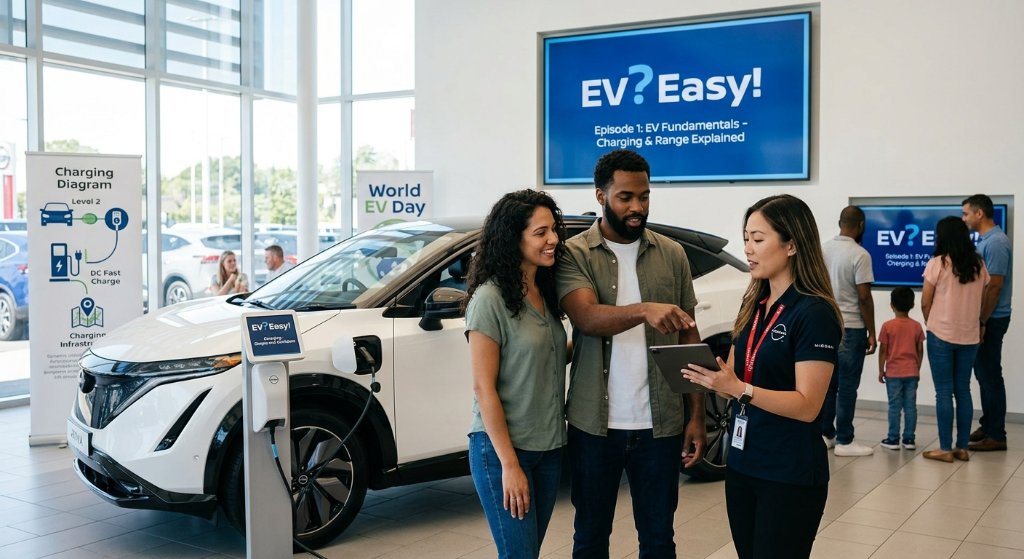
On World EV Day, Nissan took a decisive step to address the single greatest bottleneck facing electric vehicle adoption today: consumer confusion and lingering battery anxiety. By launching 'EV? Easy!', a five-part digital masterclass, the Japanese automaker is directly targeting the friction points that prevent mainstream drivers from making the switch.
This campaign arrives at a critical juncture for Nissan. As the brand that practically birthed the mass-market electric vehicle with the pioneering 2010 LEAF, Nissan has also had to live with the legacy of its early battery engineering. Early LEAF models suffered from passive air-cooling, which led to high-profile battery degradation concerns (often dubbed 'Rapidgate') and fueled a decade's worth of consumer skepticism. Today, as Nissan rolls out a highly ambitious, next-generation electric lineup—featuring the liquid-cooled Ariya, the newly redesigned 2026 LEAF crossover SUV, and the upcoming PIXO city car—the brand is using education to aggressively rewrite its narrative and build long-term buyer confidence.
Demystifying the EV Experience: What is 'EV? Easy!'?
The 'EV? Easy!' series is designed to act as a jargon-free blueprint for the hesitant mass-market buyer. Rather than focusing on performance metrics or tech-heavy spec sheets, the series uses clear, practical examples to address the foundational questions that keep internal combustion engine (ICE) drivers on the sidelines.
The five-part series breaks down ownership into digestible chapters:
- Going Electric? Easy!: Demystifies the core engineering of electric drivetrains, explaining how EVs convert stored energy into motion and why they require less maintenance than ICE cars.
- Battery Systems? Easy!: Directly tackles battery chemistry, thermal management, and longevity—a direct answer to historic consumer fears about battery degradation.
- Range Optimization: Offers practical driving strategies to maximize real-world mileage and explain the factors that impact daily range.
- Charging Infrastructure: Navigates the home and public charging landscape, explaining speed differences, connector types, and how to use modern charging networks.
- Energy Sharing: Explores advanced concepts like Vehicle-to-Grid (V2G) technology, showing how future EVs will integrate into home and municipal energy grids.
Shifting Focus to the Pragmatic Mainstream Buyer
We have reached the end of the early-adopter phase of EV sales. The tech enthusiasts have already bought their vehicles; the remaining consumer pool consists of pragmatists who view cars as appliances. These buyers do not care about 0-60 mph times—they care about highway range in winter, how long the battery will last before needing an expensive replacement, and whether charging will ruin their road trips.
Nissan's educational drive is a calculated maneuver to lower the barrier of entry for these pragmatic buyers. By providing simple, authoritative answers directly on public platforms like YouTube, the automaker is trying to make the transition to electric driving feel low-risk and entirely manageable.
Why This Matters:
- The Narrative Battle is the New Battleground: Performance specs are no longer a key differentiator in the EV market. The brand that wins the next wave of adoption will be the one that successfully minimizes customer anxiety. Nissan is proactively claiming this educational space, establishing itself as a trusted partner rather than just a hardware manufacturer.
- Rebuilding the Legacy of Nissan Batteries: Nissan must completely distance its new products from the air-cooled battery stigmas of the early 2010s. By explaining modern active thermal management systems in clear terms, they are quietly reassuring buyers that vehicles like the Ariya and the 2026 LEAF crossover are engineered for the long haul.
- A Shield for the Upcoming Product Offensive: This series isn't launching in a vacuum. Nissan is preparing a massive European product push, including the reveal of the all-electric PIXO city car on September 23, the all-new Micra EV, and an electric Juke. For these mainstream, price-sensitive models to succeed, Nissan must pre-emptively clear the path of any lingering EV skepticism.
- Dealers vs. Direct Education: Legacy dealerships have historically struggled to sell EVs because sales staff often lack the training to answer complex battery and charging questions. By taking the educational reins directly, Nissan bypasses the dealership bottleneck, arming the consumer with knowledge before they ever step onto a showroom floor.
Navigating the Road Ahead
Ultimately, Nissan's 'EV? Easy!' campaign proves that the hardest part of the EV transition is no longer the engineering—it is the psychology. By offering clear, direct, and authoritative solutions to the public's deepest anxieties, Nissan is working to turn hesitant skeptics into confident buyers. As the automaker prepares to launch its next wave of affordable, mass-market electric vehicles, this educational initiative may well be the secret weapon that helps it reclaim its throne as a dominant force in the electric era.