No More Waiting Rooms: How Tesla and Rivian’s Mobile Service Playbook is Forcing Legacy Dealers to Adapt
For decades, the traditional dealership service department was a reliable, albeit frustrating, cornerstone of car ownership: long waits, stale coffee,...
Editorial Team
World Of EV
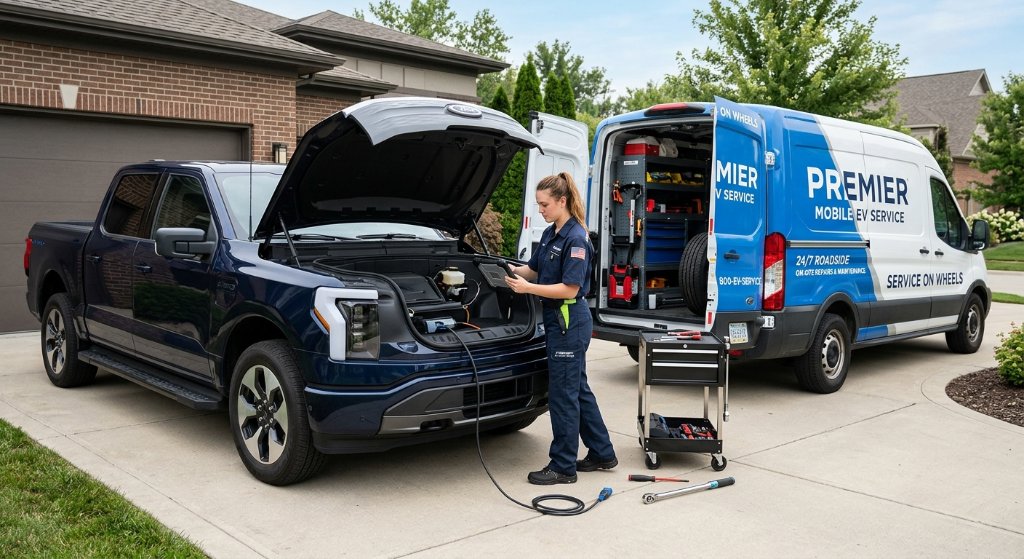
For decades, the traditional dealership service department was a reliable, albeit frustrating, cornerstone of car ownership: long waits, stale coffee, and the inevitable upsell. But as electric vehicles redefine automotive architecture, they are also dismantling the legacy service model. Led by direct-sales giants like Tesla and Rivian, a massive shift toward mobile vehicle servicing is underway, forcing traditional franchised dealers to either mobilize their operations or risk losing EV buyers entirely.
This shift is not merely about convenience; it is a structural necessity. Tesla and Rivian launched with a major operational challenge: a lack of established, coast-to-coast physical dealership networks. To turn this weakness into a competitive advantage, they pioneered mobile servicing. Today, direct-sales EV makers perform up to 30% of their maintenance on-site via mobile service fleets, proving that a massive physical footprint is no longer a prerequisite for customer satisfaction.
The Direct-Sales Blueprint: Convenience Over Concrete
Tesla and Rivian have fundamentally rewritten the service playbook. By eliminating the overhead of massive, multi-bay physical facilities in every market, they have set a new standard for customer-centric maintenance. Technicians equipped with specialized, connected vans can diagnose and repair a significant portion of the vehicle's issues without the car ever leaving the owner's driveway.
Key advantages of this direct-to-consumer mobile model include:
- App-Integrated Experience: Diagnostics, scheduling, technician tracking, and payments are handled entirely through a single smartphone app.
- Reduced Overhead: Direct-sales OEMs avoid the capital-intensive demands of prime real estate, shifting investments toward logistics and mobile toolkits.
- Unprecedented Convenience: Customers reclaim their time, avoiding the hassle of arranging alternative transportation or waiting in dealership lounges.
Legacy Franchises Pivot to Defend Their Turf
This direct-to-consumer convenience has put immense pressure on traditional franchise dealerships. Historically, dealers relied heavily on "fixed operations"—parts and service—to generate their highest profit margins. With EVs requiring roughly 35% less maintenance over their lifetime compared to internal combustion engine (ICE) vehicles, and direct-sales brands bypassing dealers entirely, legacy franchises are facing a double threat.
To survive, traditional dealers are increasingly adopting mobile service programs. They are deploying custom-outfitted transit vans to handle routine maintenance, software updates, and minor safety recalls directly at the customer's location. By doing so, they hope to protect their customer retention rates and capture a share of the evolving EV service market.
To win back EV owners, legacy dealers are prioritizing:
- Local Software and Diagnostics Support: Handling physical component flashes and sensor calibrations on-site for vehicles that cannot be updated remotely via Over-the-Air (OTA) software.
- Targeted Recall Campaigns: Dispatched mobile vans can address high-volume, low-complexity safety recalls on-site, keeping dealership bays clear for complex mechanical repairs.
- Premium Retention Perks: Offering mobile service as a complimentary convenience to premium EV buyers to foster brand loyalty.
Why This Matters:
This shift represents a fundamental realignment of the automotive retail and ownership experience.
- The Winners: EV owners and direct-sales OEMs. Consumers win because they reclaim their most valuable asset—time. Tesla and Rivian win because this validates their lean, agile operational model, proving they can support a growing global fleet without a massive physical dealer network.
- The Losers: Legacy dealers who refuse to adapt. Dealerships that continue to insist on the rigid "bring it to the shop" model will face rapid customer defection. The traditional service bay is no longer a captive market.
- The Industry Signal: This is a "do-or-die" moment for dealership profitability. As EVs dominate the market, the volume of traditional mechanical repairs (like oil changes and transmission flushes) will plummet. Mobile servicing is not just a luxury perk; it is the new battleground for customer retention. Dealers must transition from real-estate-heavy businesses to agile, logistics-driven service networks to survive the next decade.
Conclusion
The golden era of the dealership waiting room is drawing to a close. As Tesla and Rivian continue to prove that nearly a third of all EV service can happen in a driveway, the rest of the automotive industry is being forced to follow suit. For the modern EV driver, the future of car maintenance is no longer a destination—it is an on-demand service that comes directly to them.