No Permission Needed: Tesla's New FSD v14.3.9 Grabs the Wheel to Dodge Crashes—And v15 Is Next
Imagine driving your Tesla manually, a vehicle suddenly blowing through a stop sign directly in your path. Before your foot can even hover over the br...
Editorial Team
World Of EV
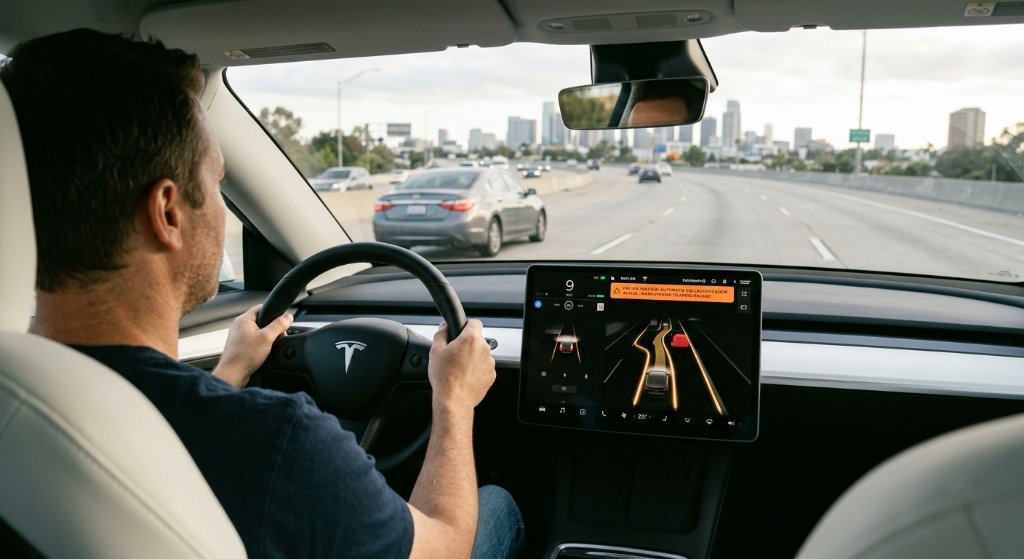
Imagine driving your Tesla manually, a vehicle suddenly blowing through a stop sign directly in your path. Before your foot can even hover over the brake pedal, the steering wheel pulls out of your hands, the car swerves into an open shoulder, accelerates past the hazard, and then seamlessly continues driving down the road on its own. This is no longer a sci-fi concept—it is the reality of Tesla’s newly released Full Self-Driving (FSD) Supervised version 14.3.9, which introduces a game-changing safety feature called "Automatic Collision Evasion" (ACE).
Historically, automotive active safety has been static and one-dimensional, limited to Autonomous Emergency Braking (AEB) systems that simply slam on the brakes to mitigate an impact. By shifting from reactive braking to proactive, multi-dimensional steering and acceleration using the car’s camera-only "Tesla Vision" stack, Tesla is crossing an unprecedented rubicon: allowing its autonomous software to override human manual steering. This controversial leap arrives just as Tesla's VP of AI, Ashok Elluswamy, officially previewed FSD v15—an upcoming "architectural leap" designed to scale neural networks tenfold and unlock 24/7 driverless operations.
How Automatic Collision Evasion Rewrites the Safety Rulebook
Unlike standard AEB, which operates purely in one dimension (deceleration), Automatic Collision Evasion (ACE) acts as an active, real-time copilot. When the FSD computer determines that a front-end crash is mathematically unavoidable through braking alone, it seizes directional control—steering, braking, and accelerating as needed—to navigate around the obstacle.
- Active Steering Intervention: The system actively overrides manual steering inputs during manual drives to execute complex swerves, lane-changes, or shoulder maneuvers to avoid road hazards.
- Post-Intervention Autonomy: In a massive departure from standard safety features that disengage after an emergency, ACE actually engages FSD (Supervised) to keep driving the vehicle safely down the road after avoiding the hazard.
- Two-Pronged Triggers: The system initiates either when a collision is imminent on dry freeways (at speeds under 85 mph), or when cabin cameras detect severe driver distraction (such as reaching into the backseat) while a hazard is approaching.
The Hardware Divide: HW4 Claims Dominance as HW3 Faces Obsolescence
While ACE marks a historic milestone for consumer vehicle safety, it also highlights an increasingly bitter divide within the Tesla owner community. This cutting-edge active safety suite is strictly exclusive to Hardware 4 (HW4 / AI4) vehicles, leaving older models in the dust.
- HW4 Exclusive: Only vehicles equipped with Tesla’s latest, high-performance Hardware 4 computer possess the necessary processing power to run the high-frequency neural-network cycles required for split-second evasive steering.
- HW3 Left Behind: Legacy Hardware 3 vehicles, once marketed as fully capable of unsupervised self-driving, are being relegated to "v14 Lite" software branches, entirely missing out on these critical safety upgrades.
- Subscription Prerequisite: To benefit from ACE, owners must have FSD available and enabled on their vehicles, meaning the feature is gated behind Tesla's monthly FSD subscription or outright purchase.
FSD v15: The 10x Neural Leap to 24/7 Autonomy
The launch of FSD v14.3.9 acts as a precursor to FSD v15, which Tesla’s AI lead Ashok Elluswamy calls a massive "architectural upgrade". Internally, v15 boasts roughly ten times the parameter size of the current system, integrating prediction and control systems into a single, cohesive neural network. This architectural shift is designed to expand Tesla’s active Robotaxi network—which recently surpassed 1 million unsupervised miles in cities like Austin—to full, round-the-clock 24/7 operations.
Why This Matters:
Tesla’s transition to Automatic Collision Evasion marks a seismic shift in how we define vehicle control, liability, and safety. By granting FSD the authority to actively take the wheel from a human driver during manual operation, Tesla has crossed a major psychological and legal boundary.
The Winners: Tesla and the safety-conscious consumer. If ACE lives up to its promise, it could virtually eliminate high-speed rear-end collisions and distracted-driving fatalities, proving the unrivaled utility of a unified end-to-end neural network. Insurance underwriters will inevitably look favorably on vehicles that can actively steer away from danger, potentially driving down premiums for FSD-enabled Tesla owners. Furthermore, Tesla’s ability to run these complex systems purely on cameras—eschewing expensive LiDAR and radar—cements its massive cost advantage in the autonomous race.
The Losers: Legacy Hardware 3 owners. Many of these customers paid upwards of $15,000 for FSD years ago under the promise of full autonomy, only to find their hardware incapable of running the latest safety innovations. Additionally, Tesla’s aggressive safety posture will almost certainly draw intense scrutiny from regulators like the NHTSA, which is already investigating the company's driver-assist suites. A system that can unilaterally seize steering control from a manual driver is bound to raise intense legal questions regarding liability if an evasive swerve inadvertently causes a different collision.
The Market Signal: This update is a direct shot across the bow of autonomous competitors like Alphabet's Waymo and premium legacy automakers like Mercedes-Benz. While others restrict their autonomous efforts to geofenced, highly mapped metropolitan zones, Tesla is deploying a scalable, camera-only "guardian angel" that operates on any road, anytime. It signals that Tesla is no longer just building a hands-free convenience feature; it is building a foundational, omnipresent safety shield designed to make human error obsolete.
FSD v14.3.9 and the impending release of v15 represent a watershed moment in automotive history. By transforming FSD from a passive driver aid into an active, protective shield, Tesla is fundamentally redefining the relationship between man and machine. While regulators and ethicists will undoubtedly debate the safety of a vehicle that overrides its driver, Tesla's trajectory is clear: the transition to a fully unsupervised, 24/7 autonomous future is no longer a distant dream, but a rapidly unfolding reality.