No Steering Wheel, No Pedals, No Waiting: Tesla Doubles Austin Cybercab Fleet as Autonomous Ride-Hailing War Escalates
Tesla is turning up the heat in the autonomous vehicle race. In a rapid, unannounced expansion in Austin, Texas, the automaker more than doubled its a...
Editorial Team
World Of EV
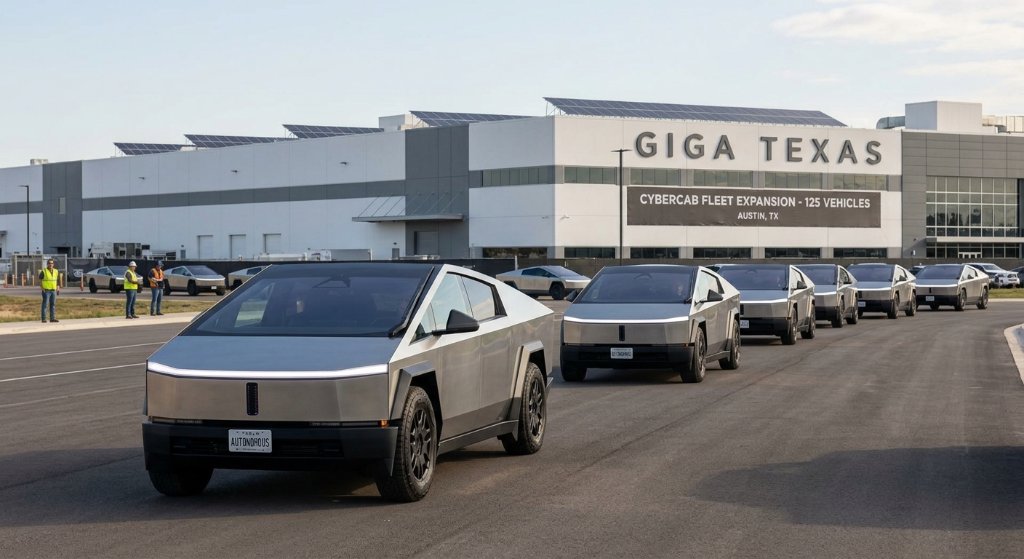
Tesla is turning up the heat in the autonomous vehicle race. In a rapid, unannounced expansion in Austin, Texas, the automaker more than doubled its active driverless Cybercab fleet, boosting the number of steering-wheel-free and pedal-free vehicles on the road from 58 to 125. By pushing more of these purpose-built autonomous vehicles into service, Tesla aims to slash passenger wait times and refine its Robotaxi platform as it gears up for a highly anticipated commercial expansion into other major U.S. cities.
This rapid deployment represents a critical pivot point. For years, skeptics dismissed Elon Musk's promises of a driverless future as mere vaporware. However, this sudden scale-up proves that Tesla’s vision-only autonomous ecosystem is rapidly transitioning from a localized experiment into a high-utilization commercial service.
Scaling the Purpose-Built Machine
While rivals convert existing consumer vehicles with bulky, aftermarket hardware, the Cybercab is built from the ground up on a dedicated production line. This design choice is finally paying dividends in deployment speed. According to recent Texas DMV registration data, Tesla registered 56 new Cybercabs in a single day, bringing its total state registrations to 126. The fact that 125 of those 126 registered vehicles are currently active on Austin streets points to an astronomical fleet-utilization rate.
Key details of the expanded Austin pilot include:
- Rapid Scale-Up: Active vehicles surged from 58 to 125 in under a week, dramatically reducing wait times for Austin passengers.
- Zero Controls: Unlike standard Tesla models, the gold-painted Cybercab operates with absolutely no steering wheel, pedals, or rearview glass.
- High Asset Utilization: Unlike Tesla's Model Y robotaxis, which frequently sit idle, virtually every registered Cybercab is actively hauling passengers on Austin’s public roads.
- Integrated App Control: Passengers hail rides, adjust climate settings, and control the audio system directly through Tesla’s proprietary Robotaxi application.
A Hard-Fought Evolution: From Model Y to Pure Autonomy
To understand why this matters, one must look at how Tesla reached this point. The company’s journey to a driverless network in Austin began in June 2025 with a highly restricted pilot utilizing modified Model Ys carrying safety drivers. By January 2026, Tesla gained enough confidence in its Full Self-Driving (FSD) software to completely remove those safety monitors from select vehicles.
The September 2026 launch of the dedicated, two-seat Cybercab was the next logical step. Unlike the Model Y, which serves double duty as a passenger vehicle and a robotaxi, the Cybercab is stripped of all human interfaces. It relies entirely on Tesla’s vision-only FSD suite, utilizing an array of external cameras and end-to-end neural networks rather than the expensive sensor arrays preferred by competitors.
Vision-Only vs. The LiDAR Establishment
Tesla’s aggressive scaling highlights the fundamental ideological rift in the autonomous driving sector. Alphabet’s Waymo—the current market leader in driverless miles—relies on a hardware-heavy stack comprising LiDAR, radar, and highly detailed, pre-mapped 3D geofences. While Waymo's approach has earned it high safety marks, the hardware is incredibly expensive, costing tens of thousands of dollars per vehicle to build and maintain.
Tesla, by contrast, relies purely on optical cameras and software artificial intelligence. If Tesla can prove that its camera-only Cybercab can operate safely at scale in Austin, it completely undercuts the economic model of every other autonomous player on earth.
Why This Matters:
- Who Wins: Tesla and the consumer. For Tesla, this fleet expansion is a major proof-of-concept for its manufacturing scale. By bypassing human safety monitors and expensive LiDAR hardware, Tesla can theoretically offer rides at a fraction of the cost of Uber or Waymo. For consumers, this scaling means shorter wait times and the immediate promise of cheaper, highly accessible urban transportation.
- Who Loses: Legacy ride-hailing networks and high-cost autonomy developers. If Tesla successfully scales the Cybercab, traditional ride-hailing services like Uber and Lyft face an existential threat unless they can integrate these vehicles into their own platforms. Meanwhile, competitors like Waymo and Zoox are put on notice: they must find a way to radically drive down the hardware cost of their sensor suites, or risk being out-scaled by Tesla's manufacturing machine.
- What It Signals to the Market: This is a "do-or-die" moment for Tesla’s AI thesis. By unleashing over a hundred steering-wheel-free vehicles onto complex public streets, Tesla is betting the company’s reputation on the safety of its FSD software. The scaling also draws massive regulatory attention. The National Highway Traffic Safety Administration (NHTSA) is already monitoring the deployment. Any high-profile accident could freeze Tesla’s autonomy goals for years, while a successful, accident-free pilot will pave the way for rapid regulatory approval in other U.S. states.
Looking Ahead
Tesla’s rapid doubling of its Cybercab fleet in Austin is the strongest signal yet that the company is done with passive testing. This is real-world validation of a controversial, vision-only autonomous platform. As the company irons out the operational wrinkles in Texas, the industry must prepare for the next phase: a nationwide rollout that could permanently alter the landscape of urban mobility.