No Steering Wheel, No Pedals: Tesla Deploys First Fleet of Custom Cybercabs in Texas Ahead of Landmark Launch
The rubber is finally meeting the driverless road. Just days before its highly anticipated September 3 launch event in Austin, Texas, Tesla has offici...
Editorial Team
World Of EV
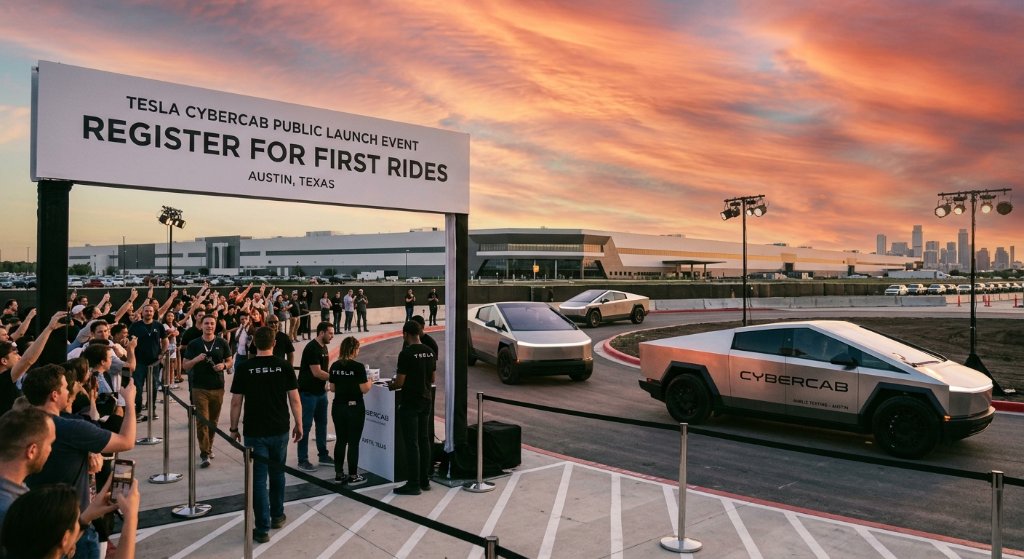
The rubber is finally meeting the driverless road. Just days before its highly anticipated September 3 launch event in Austin, Texas, Tesla has officially registered 45 purpose-built "Cybercab" robotaxis with state regulators. This is not just another minor Full Self-Driving (FSD) software update or an incremental feature tweak; it is the physical manifestation of Elon Musk’s long-promised, steering-wheel-free autonomous future.
For years, Tesla has faced intense skepticism from the automotive establishment. Critics have repeatedly pointed to the company’s reliance on adapted passenger vehicles—like the Model Y—to test its autonomous software, while rivals like Alphabet’s Waymo and Amazon’s Zoox designed bespoke, ground-up driverless pods. By registering its first official fleet of custom-built, pedal-less two-seaters, Tesla is taking a massive leap from offering supervised driver-assist programs to establishing a dedicated, commercial-grade Level 4 driverless network.
Decoupling From the Steering Wheel
According to official records from the Texas Motor Carrier Credentialing System (TxMCCS), Tesla Robotaxi LLC's registered fleet jumped from seven to 45 Cybercabs in a single afternoon. These vehicles carry the distinct "5YJA" VIN prefix, signifying they are purpose-built Cybercabs rather than retrofitted consumer models.
Unlike the 269 Model Y robotaxis currently listed on Tesla’s Texas registry, these Cybercabs operate without traditional manual controls. This fleet expansion is designed to facilitate real-world public rides during the Austin launch, serving as a physical proof of concept for Tesla’s autonomous ride-hailing business model.
Key specs and details of the newly registered Cybercab fleet include:
- The No-Control Cabin: Designed entirely without a steering wheel, accelerator, or brake pedals, offering a spacious, futuristic two-seat cabin with dramatic upward-swinging butterfly doors.
- Vision-Only Autonomy: Relying strictly on Tesla's camera-based neural network architecture, completely bypassing the expensive LiDAR and radar sensors utilized by virtually all of its robotaxi competitors.
- L4 Regulatory Compliance: Registered under Texas’s progressive Senate Bill 2807 framework, which allows self-certification for Level 4 commercial driverless operations.
The Real-World Test Begins
The registration of these 45 vehicles is far more than a legal formality; it is a permission slip to begin rolling out unsupervised passenger rides. In recent days, empty Cybercabs have been spotted navigating the public streets of Austin, completing simulated passenger pickups and handling complex intersections autonomously.
During the upcoming launch event, select members of the public will have their first opportunity to experience rides in these completely driverless cabins on open Texas roads. This rollout transitions Tesla from a company that sells highly advanced driver-assist software to a direct operator of a public transportation utility.
Why This Matters:
This is a defining, do-or-die moment for Tesla. CEO Elon Musk has repeatedly told Wall Street that Tesla’s staggering market valuation is not built on its manufacturing capacity for standard EVs, but on its ability to solve autonomy. If the Cybercab rollouts suffer from highly publicized safety interventions, or if the vision-only FSD software struggles in complex urban environments, the entire premise of Tesla as an AI powerhouse could be fundamentally compromised.
Who Wins: Tesla’s margins and bulls. If this rollout is successful, Tesla’s cost-per-mile operational math becomes incredibly disruptive. While competitors like Waymo must absorb the massive upfront hardware costs of LiDAR, radar, and constant high-definition mapping, Tesla’s camera-only approach is highly scalable and dirt-cheap by comparison.
Who Loses: Traditional ride-hailing networks and slower-moving EV competitors. If Tesla can scale a $30,000 purpose-built autonomous vehicle that runs 24/7, legacy automakers still struggling to make profitable, human-driven EVs will find themselves competing against a radically cheaper cost-per-mile transport alternative.
The Regulatory Tightrope: Despite the regulatory green light in Texas, Tesla faces a looming battle with federal authorities. The National Highway Traffic Safety Administration (NHTSA) currently enforces Federal Motor Vehicle Safety Standards (FMVSS) that mandate physical mirrors and foot controls. How Tesla navigates these federal requirements with a vehicle that lacks a brake pedal entirely will determine whether the Cybercab remains a localized Texas experiment or becomes a national phenomenon.
Conclusion
The arrival of the Cybercab fleet on Texas registries marks the transition of autonomous ride-hailing from a speculative Silicon Valley promise to a tangible commercial reality. Whether Tesla’s vision-only system can safely navigate the chaos of public roads without a human safety driver—and without the safety net of LiDAR—is the ultimate multi-billion-dollar gamble. But as these 45 custom pods take to the streets of Austin, it is clear that the driverless future has officially arrived.