Power Surge: Tesla's Supercharger Network Shatters Records With 2.0 TWh Q2 as Charging Arm Transforms Into National Utility
At a time when Tesla's vehicle deliveries are showing signs of plateauing, the company's energy-dispensing crown jewel is doing the exact opposite. In...
Editorial Team
World Of EV
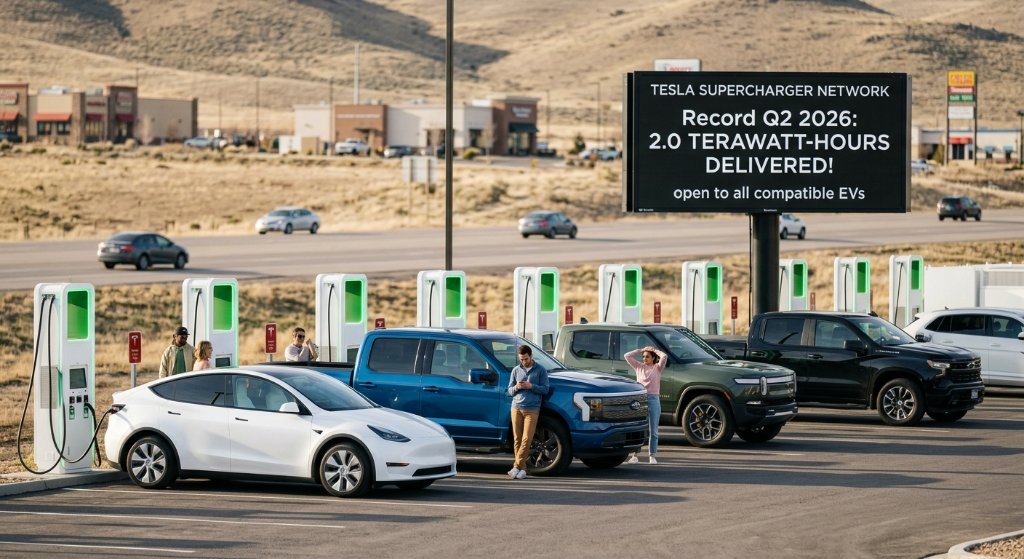
At a time when Tesla's vehicle deliveries are showing signs of plateauing, the company's energy-dispensing crown jewel is doing the exact opposite. In the second quarter of 2026, Tesla’s Supercharger network reached an unprecedented milestone, delivering a record-shattering 2.0 terawatt-hours (TWh) of electricity globally. This represents a massive 30% year-over-year surge compared to Q2 2025. It is a stunning redemption story for a division that many wrote off in mid-2024, when CEO Elon Musk abruptly fired the entire Supercharger team, sending shockwaves through the industry and casting serious doubt on the network's future expansion.
Today, those existential fears have been thoroughly laid to rest. Tesla has not only stabilized its charging operations but has successfully transitioned from an exclusive, brand-specific ecosystem into a massive, multi-brand public utility. This 2.0 TWh milestone was achieved even as Tesla executed a rapid rollout of next-generation hardware and absorbed millions of new non-Tesla EV drivers from rival automakers like Ford, GM, and Rivian.
The Operational Masterclass: High Utilization, Zero Congestion
Historically, the greatest fear among Tesla loyalists was that opening the network to other manufacturers would result in nightmare-inducing queues and broken stalls. Instead, Tesla's Q2 2026 data reveals an operational masterpiece: the network is working harder than ever, yet congestion has actually plummeted.
Key performance statistics from Tesla’s record-breaking Q2 2026 include:
- Energy Delivered: 2.0 TWh, representing a 30% increase over Q2 2025 (1.6 TWh).
- Total Sessions: 60 million charging sessions over the 90-day period, a 32% year-over-year jump.
- Physical Footprint Expansion: Added approximately 2,700 new stalls globally, a 17% year-over-year growth rate.
- Frictionless Charging: Despite massive fleet expansion, the share of charging sessions requiring any wait time for an open stall was kept under 1% globally.
The V4 Hardware Revolution Drives Efficiency
This performance is not merely a logistical fluke; it is the direct result of a major technological overhaul. In March 2026, Tesla’s Gigafactory New York completed its transition away from legacy V3 charger production, dedicating its lines entirely to the new V4 Supercharger cabinet. The V4 rollouts have solved several key pain points:
- 800-Volt Architecture Support: Unlike the 400V limits of older V3 models, V4 cabinets operate up to 1,000V, allowing vehicles like the Hyundai Ioniq 5, Kia EV6, Porsche Taycan, and Tesla's own Cybertruck to charge at their maximum advertised speeds.
- Power Output Leap: V4 dispensers deliver up to 500 kW of peak power for passenger cars and up to 1.2 MW for the Tesla Semi.
- Smaller Footprint, Faster Deployment: A single V4 cabinet can now support up to eight stalls—double the capacity of V3 cabinets. This radically simplifies site permitting, speeds up grid integration, and reduces hardware overhead.
Why This Matters:
Tesla is quietly executing the most lucrative pivot in EV history. For over a decade, the Supercharger network was treated as Tesla's ultimate sales moat. Today, that moat has officially transformed into a high-margin toll bridge.
While Wall Street frets over plateauing vehicle sales—with Q2 2026 delivery numbers projected to grow a modest ~5.7%—Tesla's charging division is posting hyper-growth. By opening more than 27,500 stalls to rival brands, Tesla has positioned itself as the 'ExxonMobil of the EV Era'. Non-Tesla drivers win massive gains in charging reliability, while Tesla captures a massive recurring revenue stream that is completely decoupled from its own car manufacturing volumes.
Conversely, third-party network operators like Electrify America and EVgo are the clear losers. For years, these networks survived simply because non-Tesla drivers had no other high-speed charging options. With Tesla’s unmatched reliability and sub-1% wait times now open to the public, competitors are facing an existential crisis. If they cannot immediately scale their reliability and plug-and-play user experience, they risk being squeezed out of the market entirely.
Conclusion
As the electric vehicle market matures, the competitive battlefield is shifting from who builds the best car to who owns the infrastructure that powers them. Tesla's blockbusting Q2 2026 charging data demonstrates that the transition to the North American Charging Standard (NACS) is paying immense dividends. By successfully scaling utilization without sacrificing the user experience, Tesla has cemented the Supercharger network as the undisputed backbone of the EV revolution—and potentially its most valuable asset for the decade to come.