Range Anxiety is Dead, Enter 'Hot Dog Anxiety': How a Psychological Quirk is Inflating Modern EV Costs
After navigating a rocky road marked by EX30 delays and software hurdles on the flagship EX90, Volvo is betting big on its all-new 2027 EX60 midsize S...
Editorial Team
World Of EV
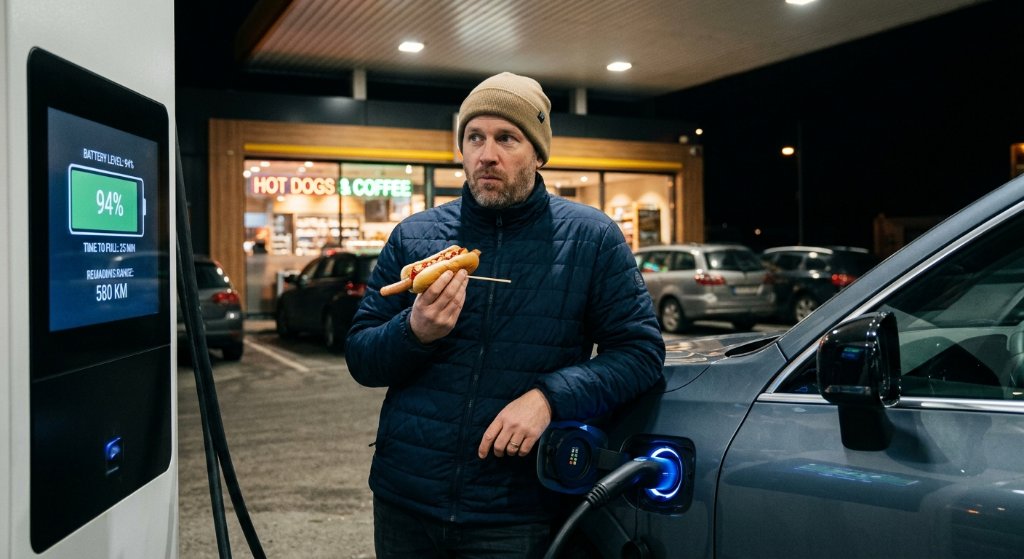
After navigating a rocky road marked by EX30 delays and software hurdles on the flagship EX90, Volvo is betting big on its all-new 2027 EX60 midsize SUV to capture the heart of the premium EV market. Priced from an aggressive $58,400, the EX60 made its North American debut at New York's Oculus World Trade Center, showing off cutting-edge 800-volt SPA3 architecture. Yet, it wasn't the vehicle's Scandinavian design or its 400-mile maximum range that stole the headlines. Instead, Volvo’s head of engineering and technology, Anders Bell, issued a fascinating warning about a newly discovered psychological phenomenon shifting consumer habits: "hot dog anxiety".
According to Bell, the industry's traditional boogeyman—range anxiety—is officially dead, replaced by a bizarre consumer habit. Drivers stop at a fast-charging station, plug in, and head inside to grab a snack or use the restroom. Because next-generation EVs charge at blinding speeds, the battery tops up far quicker than the driver can finish their food. The result? Drivers leave their vehicles plugged in too long, rack up steep fast-charging bills for electricity they don't actually need, and block critical infrastructure.
The Fast-Charging Paradigm Shift
The root of this problem lies in a massive disconnect between modern charging capabilities and legacy refueling habits. Older EVs required prolonged, tedious stops. Today's architectures, however, make the 10-to-80 percent sprint almost negligible.
Consider how the latest crop of luxury EVs compares when it comes to replenishing range on a road trip:
- Volvo EX60: Leveraging its native NACS port and 800V SPA3 platform, it pulls up to 370 kW, charging from 10-80% in just 16 minutes.
- BMW iX3: Accepts up to 400 kW of DC fast-charging, adding roughly 185 miles of range in a mere 10 minutes.
- Mercedes-AMG GT EV: Boasts a mind-boggling 600 kW charging rate, completing a 10-80% cycle in 11 minutes.
At these speeds, a charging stop is no longer a destination where you sit and eat lunch; it is a brief pitstop. When drivers treat an ultra-fast charger like a slow-speed AC station, they pay premium public utility rates for excess range they'll likely just discharge at home overnight.
The Heavy Cost of 'Just-In-Case' Engineering
This psychological barrier goes beyond the charging stall. Because drivers still fear running out of juice, they demand oversized batteries capable of 400-plus miles (600+ km) of range, even though the average daily commute in both the US and Europe remains under 40 miles.
To satisfy this irrational demand, manufacturers are forced to build vehicles with massive, heavy battery packs. These packs—often exceeding 100 kWh—add substantial curb weight, degrade handling, and, most importantly, jack up MSRPs. A typical 100 kWh battery pack can add upwards of $20,000 to the build cost of an EV. If consumers could overcome the mental hurdle of "just-in-case" range, automakers could build lighter, cheaper, and more efficient EVs with smaller 60-to-70 kWh batteries.
Why This Matters:
This is a critical turning point for the EV transition. We have solved the hardware problem; now we have to solve the human behavior problem.
The winners of this paradigm shift will be automakers like Volvo and Hyundai-Kia, who are successfully deploying 800-volt architectures. If they can educate consumers to trust fast-charging speeds rather than raw battery capacity, they can transition buyers to smaller, higher-margin battery packs. This, in turn, will allow them to lower vehicle prices and boost mass-market adoption.
The losers, however, are twofold. First, legacy charging networks will continue to struggle with bottlenecked stations as drivers leave fully charged cars plugged in while finishing their errands. Second, the consumer loses. Until buyers stop demanding "security blanket" batteries for daily commutes, they will continue to pay a massive price premium for heavy, inefficient vehicles. This isn't just a marketing challenge for Volvo; it’s a do-or-die structural challenge for the entire automotive industry's profitability.
Conclusion
As Volvo opens the order books for the 2027 EX60, the Swedish brand is proving that the technological pieces of the EV puzzle are finally falling into place. The SPA3 platform delivers the charging speeds and range that make gas-powered road trips look slow. Now, the ball is in the consumer's court. To unlock the true cost and environmental benefits of electric driving, buyers must shed their legacy range fears, skip the long snack breaks at the charger, and learn to embrace the ultra-fast pit stop.