Range Rover Electric Fights Reliability Demons With Real-Time 'Battery Digital Twin' Tech
For decades, Land Rover has built some of the world’s most capable and desirable luxury SUVs, but it has simultaneously struggled with a nagging Achil...
Editorial Team
World Of EV
For decades, Land Rover has built some of the world’s most capable and desirable luxury SUVs, but it has simultaneously struggled with a nagging Achilles' heel: reliability. This anxiety became even more acute during Jaguar Land Rover’s (JLR) early electric transition, culminating in high-profile battery overheating recalls and eventual buybacks of the Jaguar I-Pace. Now, as the brand prepares to launch its highly anticipated flagship Range Rover Electric, JLR is taking a massive preemptive strike against those reliability demons.
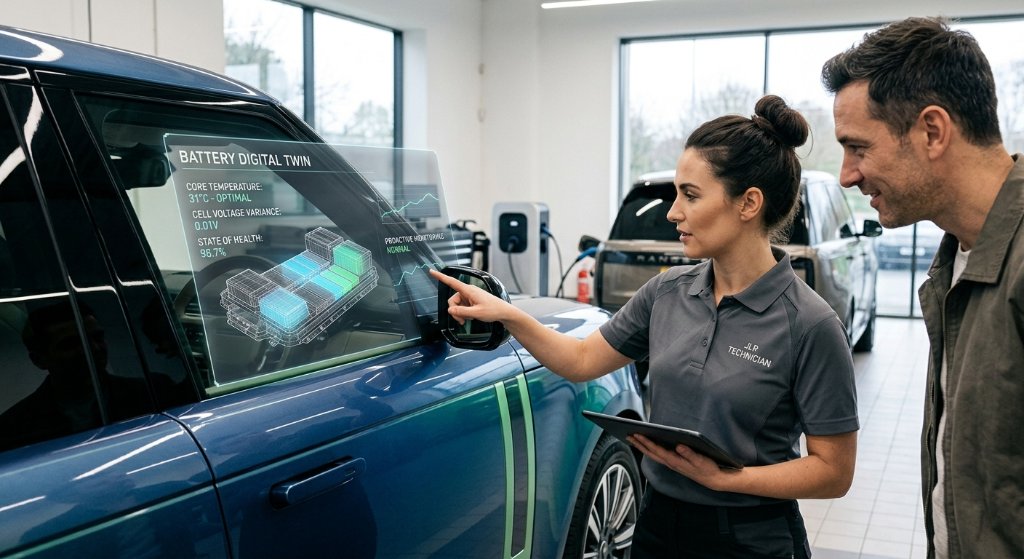
The automaker has revealed that the upcoming Range Rover Electric will feature a groundbreaking 'Battery Digital Twin' technology. Rather than waiting for a warning light to blink on the dashboard, JLR will continuously monitor the heartbeat of its electric luxury liner in real-time, aiming to fix issues before the driver even knows they exist.
Over 900 Data Points: A Virtual Guardian in the Cloud
Instead of relying on basic battery management systems, JLR’s new architecture creates a virtual replica of each individual vehicle's battery pack in the cloud. This 'Battery Digital Twin' tracks more than 900 diagnostic data points in real-time to ensure seamless vehicle operation.
- Proactive Diagnostics: The cloud system runs continuous algorithms to analyze battery health, cell temperatures, and degradation rates.
- SOTA Integration: When paired with JLR's software-over-the-air (SOTA) capability, the vehicle can receive background patches to optimize performance or flag the need for preemptive dealer service.
- Seamless Ownership: The goal is to eliminate the 'stranded-by-the-roadside' scenario entirely. If a single cell shows anomalous behavior, JLR's backend can alert the owner and the dealer to schedule a quick, stress-free fix before a failure occurs.
Uncompromised Flagship Performance
JLR is clear that the electric powertrain must enhance, not compromise, the classic Range Rover experience. The engineering specifications indicate that this is a highly capable, no-excuses luxury machine:
- Massive Energy Reserve: An 800-volt, double-stacked 118.5 kWh battery powers twin electric motors.
- V8-Rivalling Power: Delivering 550 PS (542 hp) and 850 Nm of torque, it rockets from 0-60 mph in just 4.3 seconds.
- Rapid Charging: 800V architecture allows the massive pack to fast charge from 10% to 80% in just 22 minutes.
- Go-Anywhere Capability: It retains a full 900mm (35-inch) wading depth, matches the off-road geometry of internal combustion engine (ICE) variants, and introduces a single-pedal drive mode capable of crawling up steep 45-degree slopes.
Why This Matters:
For JLR, the success of the Range Rover Electric is nothing short of a make-or-break moment. Under its 'Reimagine' strategy, JLR is pivoting to become an ultra-luxury house, positioning the Range Rover Electric at a premium starting price of over £154,070 (approx. $138,000 USD in North America). When customers pay supercar money for an electric SUV, their tolerance for software glitches or thermal faults is zero.
By debuting the Battery Digital Twin, JLR is signaling a massive shift in how automakers manage vehicle lifecycles. It is a direct response to lessons learned from the Jaguar I-Pace’s high-voltage battery recalls. If JLR can use predictive modeling to ensure this flagship remains bulletproof, they win back the narrative on reliability and establish a new benchmark for luxury EV ownership. However, if the digital twin fails to catch early software gremlins, JLR risks cementing its old reputation in the electric era. The stakes couldn't be higher.
With the order books officially open, the Range Rover Electric represents more than just a zero-emissions powertrain; it is JLR's bold bid to redefine luxury vehicle endurance. By turning to cloud-based predictive maintenance, the British brand isn't just embracing electrification—it's attempting to perfect it.