Reality Check in Vegas: Regulators Slash Tesla's 5,000-Vehicle Robotaxi Ambitions to a Tiny Fleet of 10
### Nevada Curbs Tesla's Grandiose Robotaxi Ambitions Tesla wanted a fleet of 5,000 autonomous robotaxis dominating the Las Vegas Strip and local air...
Editorial Team
World Of EV
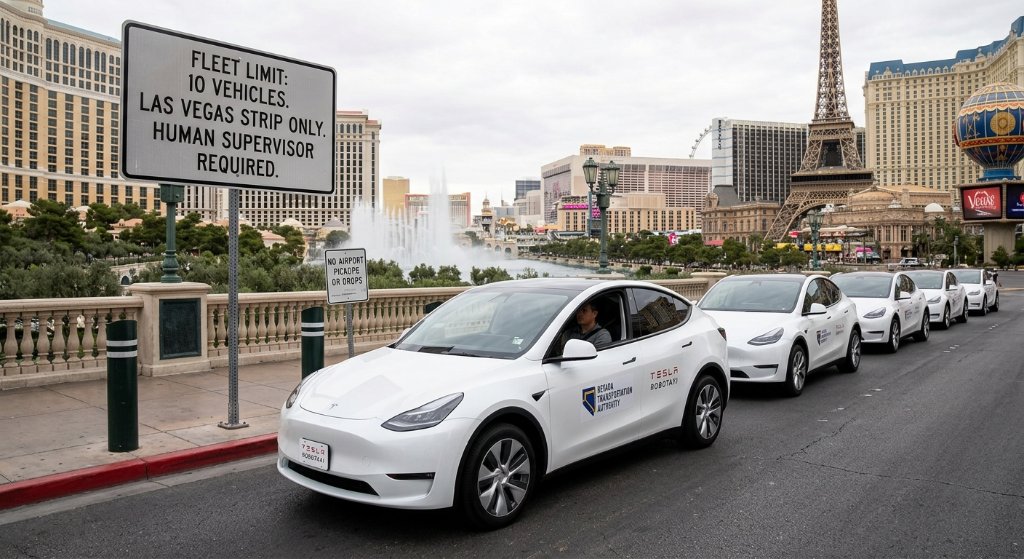
Nevada Curbs Tesla's Grandiose Robotaxi Ambitions
Tesla wanted a fleet of 5,000 autonomous robotaxis dominating the Las Vegas Strip and local airports. Instead, Nevada regulators handed them a cold, hard dose of reality. The Nevada Transportation Authority (NTA) recently approved Tesla's application but clamped down with severe restrictions, capping the fleet at just 10 vehicles, demanding human supervision, and completely banning airport operations. This regulatory bottleneck comes at a critical juncture for Tesla. CEO Elon Musk has fundamentally staked Tesla’s future valuation on robotaxis and autonomous driving, eyeing a rapid commercial rollout of the company's Full Self-Driving (FSD) technology. Yet, just as competitors like Amazon’s Zoox and Alphabet’s Waymo are hitting their stride in Southern Nevada, the NTA’s strict interim order serves as a stark reminder: technology is only half the battle, and local regulators hold the ultimate veto.
The Great Regulatory Scale-Back
In June 2026, Tesla Robotaxi, LLC submitted its permit application, boldly requesting authorization to operate up to 5,000 driverless vehicles across Clark County within its first 12 months. The plan explicitly targeted high-value hubs like Harry Reid International Airport and Henderson Executive Airport. Instead, the NTA’s July 27 order returned a drastically limited, heavily monitored pilot program. Here is how Nevada regulators systematically dismantled Tesla's grand launch plans:
- The Fleet Cap: Tesla's requested 5,000 vehicles were slashed to a maximum of just 10 fully autonomous cars.
- Geofenced Confinement: Operation is strictly limited to an approved, tight corridor along the Las Vegas Strip rather than the entirety of Clark County.
- Airport Ban: Pickups and drop-offs at or within a quarter-mile of Harry Reid International Airport are completely prohibited.
- Speed Ceiling: Vehicles are barred from operating on any road with a speed limit exceeding 45 mph.
- Mandatory Human Supervision: Contrary to Tesla's push for fully driverless, unsupervised operations, the permit mandates "appropriate human supervision" under SAE standards, meaning safety drivers must remain in the loop.
- Strict Labeling and Reporting: Every vehicle must be explicitly marked "Robotaxi," passengers must be informed they are riding in an autonomous vehicle, and any crash, system failure, or stranded vehicle must be reported within five business days.
How Tesla Compares to the Competition
This micro-fleet approval puts Tesla at a distinct disadvantage in a city that is rapidly becoming the epicenter of the robotaxi wars. While Tesla has operated supervised rides in Texas, other players have spent years building relationships and proving their safety cases to Nevada regulators:
- Zoox (Amazon): Holds Nevada's first Autonomous Vehicle Network Company permit. It was recently approved to scale its purpose-built, steering-wheel-less vehicles to a fleet of 100 on the Strip, and is actively charging for rides.
- Waymo (Alphabet): Went fully driverless in Las Vegas in early July, leveraging millions of commercial autonomous miles logged nationwide.
- Motional & Uber: Actively pursuing and expanding their own regional networks, leveraging established ride-hail integrations.
Why This Matters:
- The Illusion of Immediate Scale: Elon Musk’s investment thesis rests heavily on the narrative of "unsupervised FSD" transforming millions of customer cars into a cash-generating autonomous network overnight. Nevada’s ruling is a sobering reminder of reality. If Tesla cannot get more than 10 cars approved in Las Vegas—historically one of the most AV-friendly jurisdictions in the country—the path to national scale will be painfully slow, localized, and capital-intensive.
- The Winner: Waymo and Zoox: By taking a slow-and-steady, lidar-heavy, geographically mapped approach, Waymo and Zoox have built regulatory trust. They are allowed larger fleets because they played by the traditional testing rules. Tesla's "vision-only" approach, combined with its history of regulatory friction, is being treated with extreme caution by state authorities.
- The Loser: The "Cybercab" Business Model: Building a dedicated robotaxi like the Cybercab (which lacks steering wheels and pedals) is a massive financial gamble if local authorities insist on "appropriate human supervision" and strict speed caps. If safety drivers are required, the economics of a cheap, driverless rideshare network completely collapse.
- A Do-or-Die Regulatory Reality: This is a wake-up call for EV and autonomy investors. The technology might be getting closer, but the fragmented, city-by-city, state-by-state regulatory landscape is the true bottleneck. Tesla must learn to cooperate with regulators rather than bypass them, or risk being permanently sidelined by competitors who are willing to play the slow game.
Conclusion
Ultimately, Nevada's decision to hand Tesla a leash instead of a license is a major speed bump for the EV giant. While a 10-car pilot along the Strip will allow Tesla to gather valuable local data and officially launch its brand in Las Vegas, it represents a fraction of the immediate footprint Tesla needs to justify its lofty AI valuation. The road to autonomy is not a drag race of software releases; it is a marathon of regulatory compliance, and right now, Tesla is starting from the back of the grid.