Regulatory Headwinds and Skyrocketing Capex Slam Tesla Stock, Clouding Autonomy Vision
Tesla Inc. (TSLA) stock plunged by 3.19% on May 19, a sharp decline reflecting mounting investor anxieties over intensified regulatory scrutiny of its...
Editorial Team
World Of EV
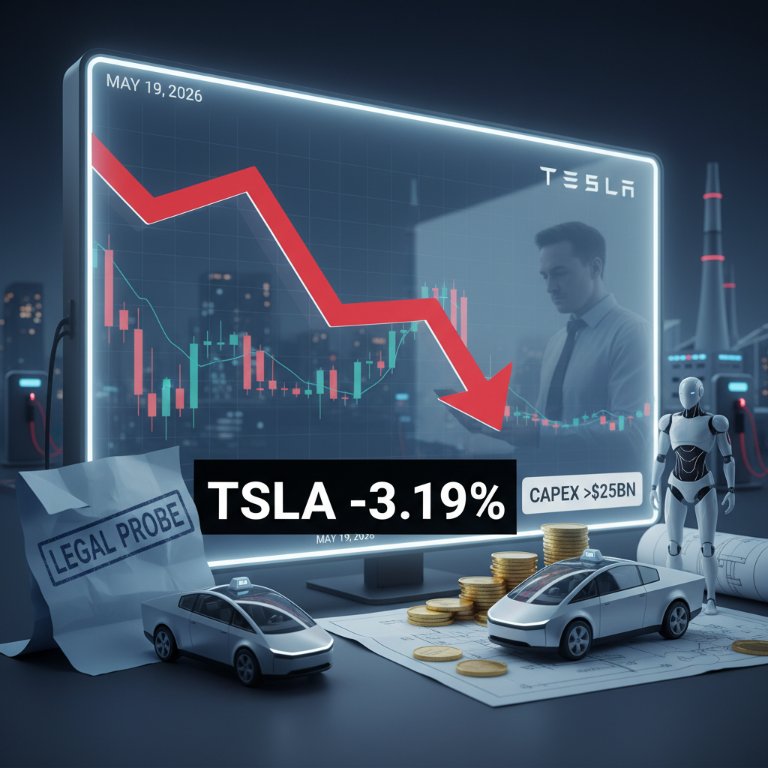
Tesla Inc. (TSLA) stock plunged by 3.19% on May 19, a sharp decline reflecting mounting investor anxieties over intensified regulatory scrutiny of its ambitious Full Self-Driving (FSD) and Robotaxi technologies, alongside a substantial increase in projected capital expenditures. This downturn underscores a critical juncture for the EV giant, whose valuation increasingly hinges on the successful, and compliant, deployment of its autonomous driving solutions and next-generation projects.
Regulatory Gauntlet Tightens for FSD and Robotaxi
The National Highway Traffic Safety Administration (NHTSA) has escalated its probe into Tesla's FSD and Robotaxi safety and capabilities, transforming an initial review into a more serious engineering analysis. This investigation, which now covers approximately 3.2 million vehicles equipped with FSD, concerns potential flaws in the system's ability to detect and warn drivers when camera visibility is degraded, and follows reports of crashes linked to the system's performance in reduced-visibility conditions. The NHTSA's initial investigation began in 2024, prompted by four incidents, but has since expanded to include nine crashes and is re-examining Tesla's 2021 shift to a camera-only 'Tesla Vision' system. Historically, the NHTSA has launched multiple probes into Tesla's driver-assistance systems, including a recall of nearly 2 million vehicles in late 2023 following an investigation into approximately 1,000 Autopilot-related crashes. The agency's intensifying scrutiny highlights ongoing concerns about the real-world safety and performance of Tesla's advanced driver-assistance systems.
Concurrently, an Australian court has publicly criticized Tesla's cooperation in a collective lawsuit. This lawsuit, brought by around 10,000 Australian owners, alleges that Tesla misled consumers about various vehicle functionalities, including 'phantom braking,' battery range, and autonomous driving capabilities. The court specifically questioned the limited submission of documents—only about 2,000 over eight months—by Tesla, raising concerns about the company's transparency and adherence to legal obligations. Judge Tom Thawley issued a warning that continued non-compliance could lead to severe consequences for the automaker.
The $25 Billion Gamble and Looming Negative Free Cash Flow
Adding to investor unease, Tesla has forecast negative free cash flow for the remainder of 2026. This projection stems directly from a massive planned tripling of capital expenditures (CapEx) to over $25 billion for the year. This unprecedented level of investment, significantly higher than the roughly $8.5 billion spent in 2025, is earmarked for ambitious, capital-intensive projects.
Key initiatives driving this colossal CapEx include:
- Cybercab development and production: A fully autonomous, two-passenger robotaxi designed for the Tesla Robotaxi service, which began production in February 2026 with a goal of 2 million units annually at full capacity.
- Robotaxi infrastructure and deployment: Expanding unsupervised robotaxi services, which moved beyond Austin to Dallas and Houston in Q1 2026.
- Optimus humanoid robot development: Aiming for initial deployment in internal factory tasks before broader commercial applications, with CEO Elon Musk suggesting it could be 'useful outside of Tesla sometime next year,' meaning 2027.
- Six new factories and AI compute build-out: Laying the groundwork for significantly increased manufacturing capacity and advanced AI infrastructure.
While Tesla's Q1 2026 results unexpectedly delivered $1.4 billion in positive free cash flow and a 16% year-over-year revenue increase, the market remains fixated on the projected negative cash flow for the rest of the year due to this aggressive spending. Some analysts had previously forecasted a swing to negative free cash flow for 2026 as early as January, with one projecting a $43.9 billion shift from positive to negative.
Why This Matters: A High-Stakes Bet on an Autonomous Future
This confluence of escalating regulatory challenges and a massive capital expenditure surge signals a pivotal, high-stakes moment for Tesla. The company's long-term valuation fundamentally rests on its ability to deliver on the promise of Full Self-Driving and the subsequent Robotaxi network, which many analysts view as the core of Tesla's future revenue streams beyond traditional vehicle sales.
Who Wins and Who Loses?
- Tesla's Long-Term Vision: This situation tests the very foundation of Tesla's 'AI story.' If regulatory hurdles prove too formidable or the technical challenges of achieving truly unsupervised autonomy become too costly and time-consuming, the ambitious visions for Cybercab and Optimus could face significant delays, eroding investor confidence.
- The Industry at Large: Heightened regulatory scrutiny on Tesla sets a precedent for the entire autonomous vehicle industry. Competitors are observing closely; robust, transparent, and provably safe deployments by other players could gain a significant advantage if Tesla struggles to navigate this complex landscape. Conversely, if regulations become excessively restrictive across the board, it could slow down the entire sector's progress.
- Investors: Short-term investors focused on profitability and stable cash flow will likely continue to punish TSLA stock. For long-term 'believers' in Tesla's AI and robotics future, this period represents a crucial test of their patience and conviction. The aggressive CapEx, while a gamble, is essential for Tesla to execute its multi-year investment cycle, which Musk believes will generate 'significant future revenue growth.'
This isn't just about a stock dip; it's about the viability of Tesla's audacious pivot from a car manufacturer to a robotics and AI company. The projected negative free cash flow is a direct consequence of this bold strategy, diverting resources from immediate profitability into speculative, albeit potentially transformative, ventures. The question for the market is whether these investments will yield the 'much much larger stream of future revenue' that Musk envisions, or if the regulatory and technical quagmires will drown the company in its own ambition.
Conclusion
Tesla faces a formidable dual challenge: appeasing increasingly assertive regulators while simultaneously funding a colossal, multi-year investment in its autonomous and robotics future. The immediate market reaction reflects profound skepticism about the execution risks and regulatory headwinds ahead. While Tesla possesses significant cash reserves, the path to monetizing its next-generation technologies is fraught with uncertainty, making the remainder of 2026 a critical period for the company to demonstrate tangible progress and assuage investor concerns about its cash burn and the ultimate realization of its transformative vision.