Reuters Investigation Rips Apart Tesla's FSD Safety Claims, Exposing Deep Methodological Flaws and Internal Distrust
A bombshell Reuters investigation, published today, has delivered a significant blow to Tesla's much-lauded Full Self-Driving (FSD) program, revealing...
Editorial Team
World Of EV
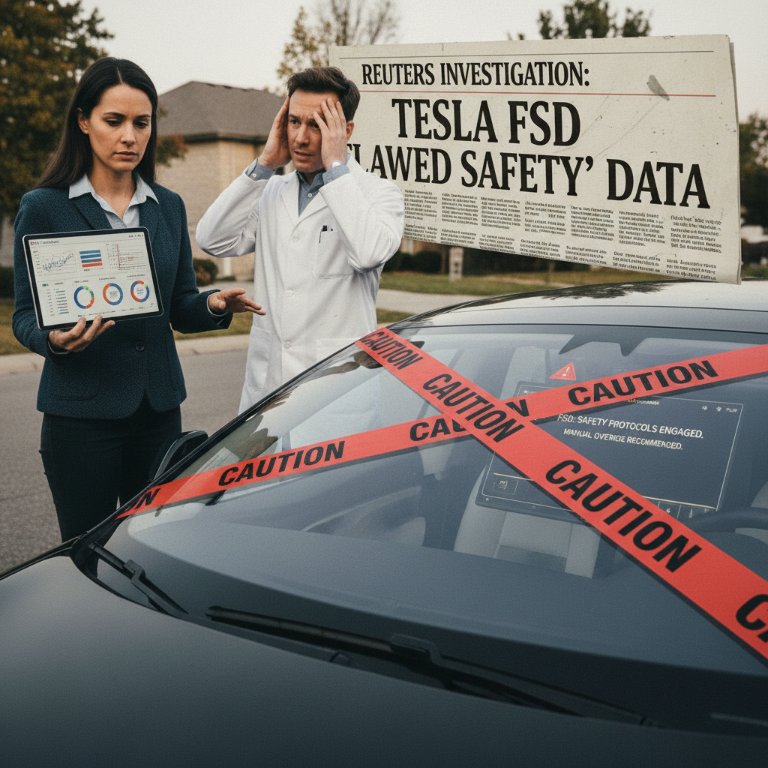
A bombshell Reuters investigation, published today, has delivered a significant blow to Tesla's much-lauded Full Self-Driving (FSD) program, revealing that the company's vaunted safety statistics are built upon what the report terms "deeply flawed methodology." This exposé, which includes candid interviews with former Tesla data labelers, a former self-driving engineer, and respected traffic-safety researchers, paints a stark picture: even those tasked with refining Tesla's AI do not trust FSD to safely navigate the roads on its own. The findings underscore a critical and potentially dangerous chasm between Tesla's aggressive marketing of its autonomous capabilities and the sobering reality of its current program.
For years, Tesla has positioned FSD as the vanguard of automotive autonomy, promising a future where vehicles self-drive with unparalleled safety and efficiency. This narrative has been a cornerstone of Elon Musk's vision and a significant revenue stream for the company, with customers paying thousands for the FSD software. However, the Reuters report casts a long shadow over these claims, suggesting that the very data used to validate FSD's safety is compromised, leading to an inflated sense of the system's reliability. This comes at a time when regulatory bodies like the National Highway Traffic Safety Administration (NHTSA) have increasingly scrutinized FSD's real-world performance and its role in numerous incidents.
The Reuters Revelation: Unpacking the Flawed Methodology
The investigation's core revelations stem from a deep dive into Tesla's data handling and the internal perceptions of those closest to the FSD development. Key findings include:
- Internal Distrust: Perhaps the most damning revelation is that former Tesla AI trainers, individuals directly responsible for labeling and refining the data that FSD learns from, expressed a profound lack of trust in the system's ability to drive autonomously. This internal skepticism highlights a fundamental disconnect within the company regarding FSD's actual capabilities versus its public-facing image.
- Flawed Data Foundation: The report meticulously details how the methodologies used to collect and process safety data for FSD are fundamentally flawed. While specific details of the flaws were not extensively described in the summary, the implication is clear: the reported safety metrics may not accurately reflect FSD's true risk profile due to biases or incompleteness in the data collection and analysis.
- Expert Concerns Echoed: Traffic-safety researchers interviewed for the investigation corroborated these internal concerns, raising serious questions about the validity of Tesla's claims and the potential for FSD to pose risks on public roads.
The Reuters investigation starkly contrasts Tesla's persistent marketing of FSD as a revolutionary, near-perfect autonomous system with the internal doubts and methodological issues now brought to light. Tesla has consistently pushed the boundaries of what consumers expect from driver-assist systems, often framing FSD as a significant leap towards Level 5 autonomy. Yet, the report suggests this ambitious narrative is built on shakier ground than previously understood, reinforcing criticisms from those who argue that Tesla has overpromised and underdelivered on its autonomous driving aspirations. The financial implications are also considerable, with many consumers having invested thousands into a system whose underlying safety assurances are now in question.
Why This Matters:
This Reuters investigation is far more than a technical expose; it's a critical moment for Tesla and the broader autonomous vehicle industry. Its implications resonate deeply for consumers, regulators, and competitors alike.
- For Tesla's Credibility: This report strikes at the heart of Tesla's long-cultivated image as an innovative leader unafraid to challenge norms. The revelation of deeply flawed safety methodologies and internal distrust severely erodes consumer confidence and validates long-standing criticisms from safety advocates and regulators. This could lead to a significant slowdown in FSD adoption and potentially trigger increased scrutiny from governmental bodies, including NHTSA, which could lead to further investigations, recalls, or even restrictions on FSD's deployment. This isn't just a technical glitch; it's a crisis of trust.
- For the Autonomous Vehicle Industry: The ripple effects will extend beyond Tesla. If a perceived frontrunner like Tesla is found to be operating with questionable safety data, it casts a shadow over the entire industry. It will likely empower regulators to demand greater transparency and more rigorous, standardized testing and reporting methodologies for all autonomous driving systems. This could slow the overall progress of autonomous vehicle development by increasing compliance burdens, but ultimately, it could foster a safer and more trustworthy ecosystem.
- For Consumers: For the thousands who have paid for FSD, this report raises critical questions about the value and safety of their investment. It underscores the vital importance of understanding the true capabilities and limitations of advanced driver-assist systems and not relying solely on manufacturer claims. Consumers will likely become more skeptical, demanding verifiable, third-party validated safety data before committing to such technologies.
- Who Wins and Who Loses: Tesla's brand undoubtedly takes a hit, and its FSD revenue stream may suffer. Regulatory bodies gain stronger footing, and competitors adopting more conservative, meticulously validated approaches to autonomy (like Waymo or Cruise) might find their cautious strategies vindicated, potentially gaining market share in the trust economy. Public safety, while potentially benefiting from increased scrutiny, also loses when trust in foundational safety claims is undermined.
The Reuters investigation serves as a potent reminder that in the race for autonomy, robust safety validation and unwavering transparency are paramount. For Tesla, addressing these systemic issues will be crucial not just for the future of FSD, but for the company's long-term reputation and its standing as an automotive innovator. The path forward demands more than just software updates; it requires a fundamental re-evaluation of its data practices and a renewed commitment to verifiable safety. The coming months will reveal if Tesla can navigate this significant setback and rebuild the trust essential for true autonomous leadership.