Rivian Beats Q2 Estimates, Slashes $250M in Capex as R2 SUV Launch Drives Path to Profit
Rivian Automotive has spent the last few years fighting off the "cash incinerator" label that plagues almost every ambitious EV startup. Relying on it...
Editorial Team
World Of EV
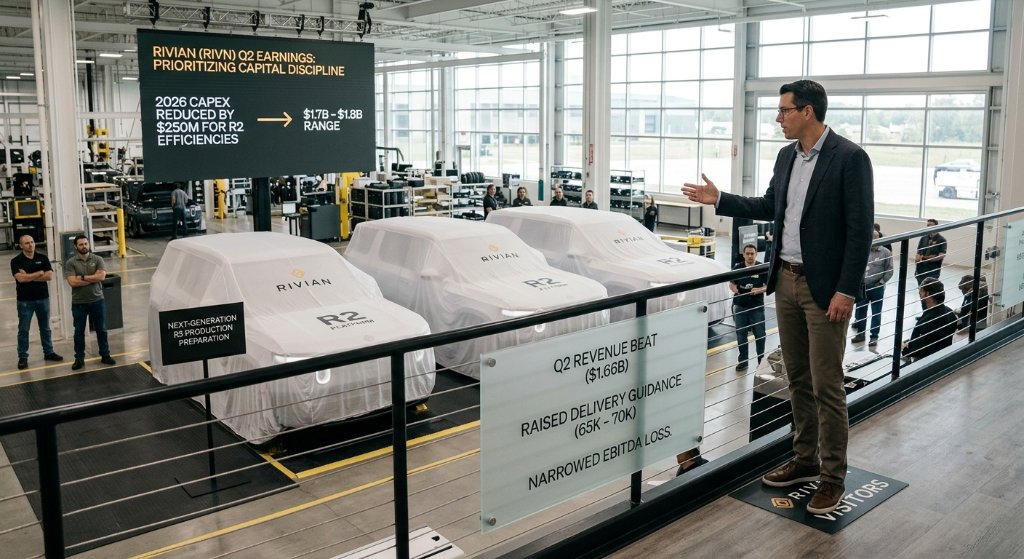
Rivian Automotive has spent the last few years fighting off the "cash incinerator" label that plagues almost every ambitious EV startup. Relying on its highly acclaimed but expensive R1 platform, the company proved it could build exceptional adventure vehicles—but doing so profitably remained an elusive goal. Today, Rivian's Q2 2026 financial results signal a massive shift in strategy. By beating Wall Street estimates, raising delivery guidance, and aggressively trimming its capital expenditures, the Irvine-based EV maker is showing the industry how to transition from survival mode to scaling mode.
The big news isn't just that Rivian beat expectations; it’s how they did it. Rivian trimmed its 2026 capital expenditure (capex) forecast by a substantial $250 million, settling into a leaner $1.7 billion to $1.8 billion range, citing major project efficiencies. Simultaneously, the company narrowed its full-year adjusted EBITDA loss guidance to between $1.8 billion and $2 billion and reported a robust $1.66 billion in Q2 revenue, comfortably beating the $1.51 billion consensus from Wall Street analysts.
Capital Discipline Meets the R2 Ramp
This capital efficiency comes at a critical juncture. On June 9, 2026, Rivian officially began external deliveries of its make-or-break vehicle: the R2 SUV. Priced under $50,000, the R2 is designed to go head-to-head with the dominant Tesla Model Y. By squeezing out $250 million in capital efficiencies, Rivian is proving it can prepare its Normal, Illinois manufacturing lines for high-volume production without draining its cash reserves.
Here are the key financial and operational takeaways from Rivian's Q2 2026 report:
- Revenue Outperformance: Pulled in $1.66 billion (a 27% year-over-year increase), outpacing the $1.51 billion expected by analysts.
- Capex Reductions: Capital expenditure guidance slashed by $250 million to a new target of $1.7 billion to $1.8 billion.
- Narrowed Losses: Full-year adjusted EBITDA loss guidance narrowed to between $1.8 billion and $2 billion.
- Delivery Boost: Upwardly revised full-year delivery guidance to between 65,000 and 70,000 vehicles.
- Unprecedented Gross Profit: Achieved a record consolidated gross profit of $179 million, translating to an 11% gross margin.
The Financial Engine Under the Hood
While the headline consolidated gross profit of $179 million looks like an outright victory, a closer look at the balance sheet reveals a more complex reality. Rivian's core automotive division still operated at a negative gross profit of $36 million for the quarter. While this is a massive leap forward from the painful $335 million automotive loss recorded in the same period last year, it highlights that vehicle assembly is not yet profitable on its own.
The savior of this quarter's balance sheet was a mix of regulatory credits ($108 million) and a massive surge in software and services revenue, which brought in $515 million at a staggering 42% margin. Crucially, $308 million of that high-margin service revenue flowed directly from Rivian's joint venture with Volkswagen Group. This strategic partnership is quickly turning into Rivian's secret weapon, giving the startup the financial runway it desperately needs while it scales up the R2.
Why This Matters:
This Q2 report is a definitive turning point for Rivian. In the hyper-competitive EV market, survival depends on moving downmarket to capture mainstream buyers. Rivian's past reliance on $80,000-plus luxury off-roaders was never going to support a mass-market business. With the R2 now officially rolling out to customers, Rivian has finally entered the volume game.
Who wins? Rivian's prospective buyers and long-term shareholders. The $250 million capex cut proves management is serious about fiscal discipline, while the Volkswagen JV software revenue shows that Rivian's intellectual property has immense commercial value beyond selling physical sheet metal.
Who loses? Legacy automakers struggling to find a software-first identity. By leveraging its electrical architecture to bring in hundreds of millions in licensing revenue from VW, Rivian has established a high-margin business model that rivals struggle to replicate.
This is a "do-or-die" moment. The R2 is the vehicle that must transition Rivian from a niche luxury brand into a household name. If the company can maintain this level of capital discipline while ramping production of the R2 in Illinois and eventually breaking ground on its Georgia plant, it will cement its place as the premier American alternative to Tesla. If it fumbles this execution phase, the financial safety net provided by the VW deal won't protect it forever.
The Bottom Line
Rivian's Q2 2026 results show a company that is finally maturing. By driving down costs, squeezing licensing revenue from its software, and beating expectations on both the top and bottom lines, Rivian is positioning itself to successfully scale the R2. The road ahead remains challenging, but the adventure brand has officially proven it has the financial road map to navigate the journey.