Rivian Ditches 2027 Profit Target to Play the Long Game: Why the R2 and Autonomy Ramp is Worth the Wait
Rivian is choosing growth over immediate gratification. In a bold strategic shift highlighted in recent market and financial analyses, the Irvine-base...
Editorial Team
World Of EV
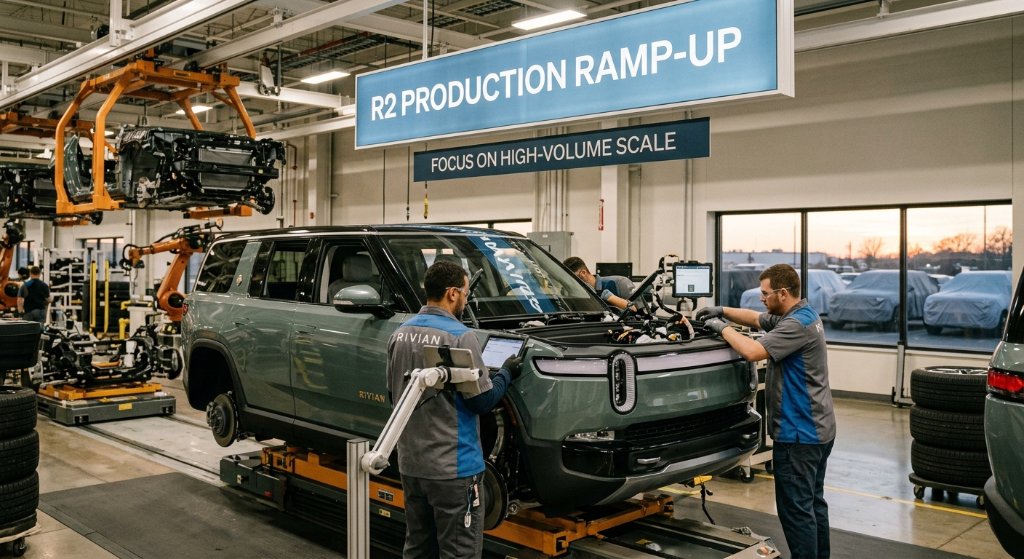
Rivian is choosing growth over immediate gratification. In a bold strategic shift highlighted in recent market and financial analyses, the Irvine-based EV maker has officially sacrificed its previously guided 2027 adjusted EBITDA profitability timeline. Instead, CEO RJ Scaringe and his executive team are reallocating capital and resources toward what truly matters for the brand's survival: the aggressive scaling of its high-volume, mid-sized R2 platform and its advanced autonomy roadmap.
This pivot marks a stark departure from the conservative, margin-focused path outlined during its 2024 investor day. However, for a company that has spent years burning through cash with its premium, low-volume R1T and R1S flagships—which, despite critical acclaim, failed to achieve the mass scale needed to fund self-sustaining operations—this transition is a necessary dose of realism. By focusing squarely on the mass-market R2, Rivian is positioning itself to capture critical market share from incumbents like the Tesla Model Y.
Doubling Down on the R2 Scaling Engine
The cornerstone of Rivian's pivot is the rapid industrialization of its R2 SUV. Having kicked off initial deliveries to customers in June 2026, the company is now in a race against time to ramp up production at its plant in Normal, Illinois. While the R2 launch introduced roughly $100 million in incremental startup costs and temporary supply chain friction in Q2, the long-term unit economics of this platform are radically different from the R1:
- Halved Production Costs: Materials and components for the R2 are expected to cost up to 50% less than the R1 platform, dramatically improving unit economics once scaled.
- Mass-Market Appeal: Priced at a highly competitive $45,000 to $58,000, the R2 is already seeing reservation conversion rates that far outpace internal expectations, attracting a massive wave of first-time EV buyers and defecting Tesla owners.
- Production Ramping: Rivian is preparing to introduce a second production shift in Normal by the end of Q3 2026, aiming to unlock the necessary volume to achieve positive automotive gross margins on an exit-rate basis by the end of Q4.
The Autonomy and Uber Factor
But scaling a mid-size SUV is only half the battle. Rivian's decision to push back its EBITDA timeline is also driven by a dramatic increase in R&D spending focused on autonomous vehicle (AV) capabilities. Rivian is convinced that proprietary self-driving software will be the ultimate differentiator in the next decade.
- The Uber Alliance: Earlier in 2026, Uber committed up to $1.25 billion in funding to Rivian, alongside a pledge to acquire 10,000 fully autonomous R2 vehicles to act as robotaxis.
- Software-Driven Revenue: With a multi-year partnership with Volkswagen already fueling cash flow and technical collaboration, Rivian is leveraging custom Gen 3 silicon to launch supervised point-to-point driving in late 2026, with an eye toward "eyes-off" level 3 autonomy by 2027.
Why This Matters:
This is a classic "do-or-die" moment for Rivian, and walking away from the arbitrary 2027 profitability milestone is the smartest move management could make.
- The Winners: Consumers and long-term shareholders. By prioritizing volume over immediate paper profits, Rivian is ensuring that the R2 gets the focus, capital, and engineering refinement it needs to be a world-class product. Furthermore, the partnership with Uber guarantees a high-margin, high-volume commercial outlet for its upcoming AV fleet.
- The Losers: Short-term speculative investors who were hoping for a quick financial turnaround, as well as mid-tier EV startups without the capital reserves to weather an extended cash-burn phase.
- The Market Signal: This pivot signals that the EV landscape has fundamentally shifted. It is no longer enough to just build a great electric car; software, autonomous capability, and massive scale are now the price of entry. Rivian is acknowledging that it cannot compete as a niche luxury player like Lucid. It must scale rapidly to match Tesla's volume, or risk being squeezed out.
Conclusion
By delaying its short-term profit target, Rivian is trading a minor Wall Street victory today for a shot at market dominance tomorrow. It is a high-stakes gamble that will test the patience of investors as cash burn continues to loom large, but scaling the R2 and perfecting its autonomous tech is the only viable path forward. If Rivian can successfully navigate the manufacturing gauntlet in Normal over the next year, it won't just survive—it will secure its place as a cornerstone of the next-generation automotive industry.