Rivian Kills Entry-Level R1 Models: Why a $7,000 Price Hike is a Strategic Masterstroke
Rivian is officially closing the book on its cheapest R1 models. The electric adventure brand has quietly discontinued the entry-level Dual Motor, Sta...
Editorial Team
World Of EV
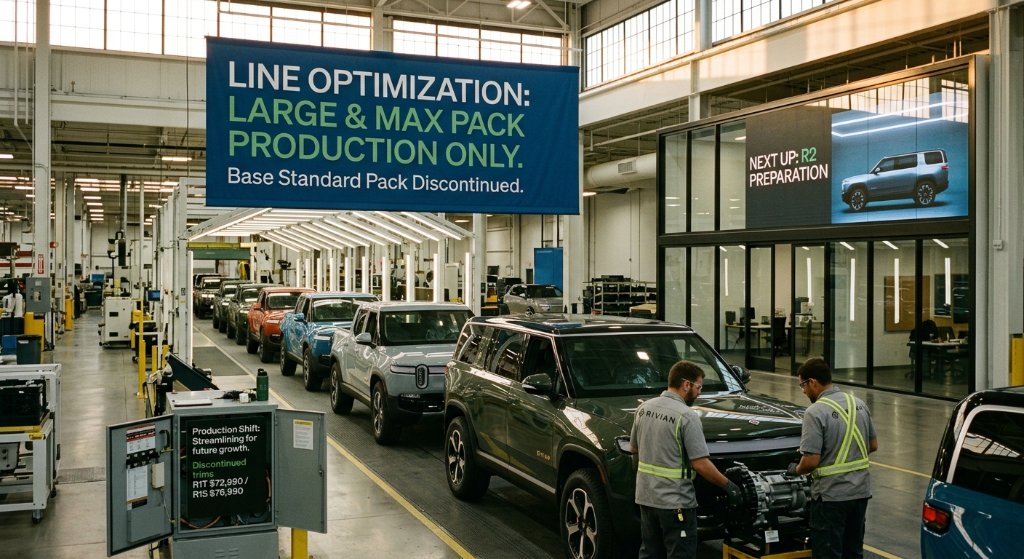
Rivian is officially closing the book on its cheapest R1 models. The electric adventure brand has quietly discontinued the entry-level Dual Motor, Standard Pack configurations for both the R1S SUV and the R1T pickup. By establishing the larger, more capable Large battery pack as the new baseline, Rivian has effectively raised the entry price of its flagship vehicles by $7,000—pushing the starting price of the R1T to $79,990 and the R1S to $90,990.
While a $7,000 price hike might sound like a gut-punch to prospective buyers, it is a highly calculated move. For years, Rivian struggled to balance premium appeal with profitability, introducing lower-cost Lithium Iron Phosphate (LFP) chemistry to capture entry-level interest. Now, as the brand gears up for the massive rollout of its mid-size, mass-market R2 SUV, the automaker is aggressively streamlining its production lines and repositioning the R1 lineup to sit squarely in the premium tier where it belongs.
A Shift From LFP to Premium Chemistry
The elimination of the Standard Pack means the end of the 92.5-kWh Lithium Iron Phosphate (LFP) battery in the R1 family. While LFP is celebrated for its durability and lower production costs, it came with real-world drawbacks for an overlanding brand, including sluggish cold-weather charging and frustrating state-of-charge calibration issues. The transition to the Large Pack (utilizing superior Nickel Manganese Cobalt, or NMC, chemistry) ensures that every R1 leaving the factory is a high-performance long-hauler.
- Baseline Range Boost: The defunct Standard Pack offered an EPA-estimated 270 miles. The new base Large Pack pushes range to a far healthier 329 miles on a single charge.
- New Price Floor: The R1T Dual Large now starts at $79,990, while the three-row R1S Dual Large baseline starts at $90,990 (prices exclude destination charges).
- Under-the-Hood Power: Both vehicles retain the robust Dual-Motor setup producing 533 horsepower and 610 lb-ft of torque, with the Performance upgrade option still available.
Cutting Assembly Line Complexity
Rivian CEO RJ Scaringe has previously noted that the company sells very few entry-spec models, with most buyers opting for premium upgrades. Maintaining a low-margin, specialized LFP battery pack exclusively for a small fraction of R1 buyers made little financial sense. By standardizing the remaining battery options to the Large and Max packs, Rivian eliminates manufacturing complexity at its Normal, Illinois facility. This simplifies battery sourcing, reduces assembly line bottlenecks, and optimizes manufacturing efficiency as the plant transitions to high-volume multi-platform output.
Why This Matters:
This is not just a pricing adjustment; it is a critical milestone in Rivian's corporate evolution.
Creating Room for the R2: The most immediate benefit is the pricing delta it establishes between the premium R1 line and the upcoming mid-size R2. The R2 is slated to start around $45,000, scaling up to nearly $60,000 for top-tier Performance trims. Had the R1 Dual Standard remained at its lower price point, it would have created a muddy, overlapping price-to-performance matrix. Now, there is a clear $20,000 chasm separating the most expensive R2 and the cheapest R1, eliminating any threat of internal product cannibalization.
Who Wins and Who Loses:
- The Winners: Rivian's balance sheet. Shifting customers toward the higher-margin Large and Max battery packs is a vital step toward achieving long-term profitability. Furthermore, R1 buyers get a vastly superior ownership experience, avoiding the cold-weather range penalties and slow charging curves associated with the LFP Standard Pack.
- The Losers: Budget-conscious buyers who wanted the prestigious R1 badge and large-vehicle footprint without the $80,000+ price tag. Those buyers must now either dig deeper into their pockets, browse remaining dealer inventory, or wait for the smaller R2.
A Crucial Pivot to Survive the EV Winter: Rivian is signaling that it will no longer chase unprofitable volume with its flagship models. By leaving the mass-market volume play to the highly anticipated R2, the R1 lineup can confidently step back into its true identity: a high-end, premium luxury adventure platform designed to compete with the likes of the Porsche Cayenne, Range Rover Sport, and high-end Mercedes-Benz EQ models.
Rivian's decision to sunset the Dual Standard R1 trims is a necessary growing pain for an EV startup transitioning into a mature, multi-vehicle global brand. By trading a low-cost, compromise-heavy entry model for manufacturing simplicity and a highly profitable luxury tier, Rivian is placing its chips on a two-pronged strategy. The R1 will remain the premium halo, while the R2 carries the weight of mass-market volume. For EV enthusiasts, this means the R1 lineup is now faster, longer-ranged, and more exclusive than ever—proving that sometimes, you have to raise the floor to reach new heights.