Rivian Partners With ChargeScape to Turn Its Giant Batteries Into Grid-Saving Cash Cows
As electric vehicle adoption hits record highs, the strain on local power grids has moved from a theoretical worry to an immediate logistical headache...
Editorial Team
World Of EV
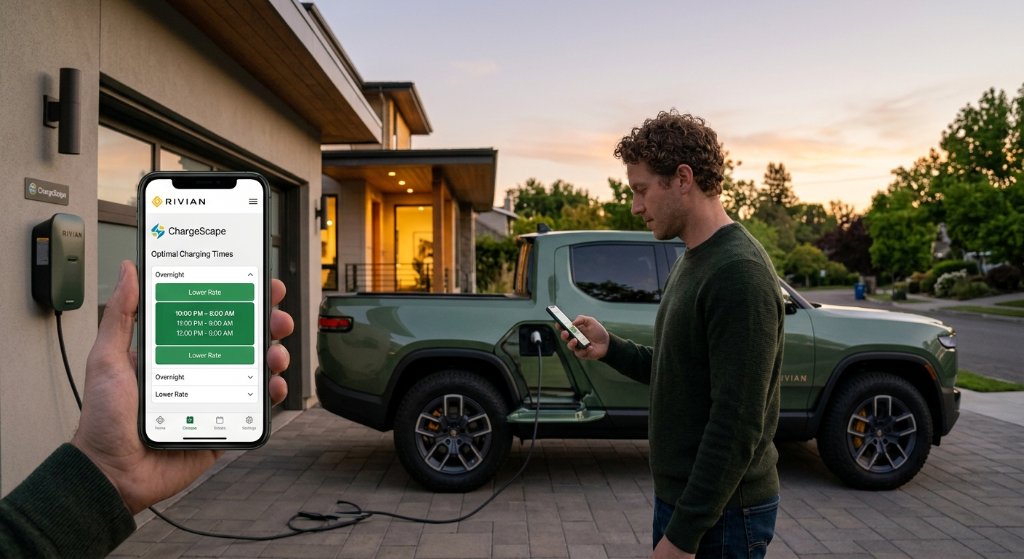
As electric vehicle adoption hits record highs, the strain on local power grids has moved from a theoretical worry to an immediate logistical headache. For Rivian, however, this challenge represents an untapped goldmine. The California-based EV maker has officially partnered with ChargeScape, the automaker-owned vehicle-to-grid (V2G) integration platform, to seamlessly connect Rivian's massive battery packs directly to North American utility companies.
Instead of navigating complex third-party software, Rivian owners can now enroll in managed charging programs directly through their native vehicle app. This partnership marks a massive milestone in the maturation of smart charging. Originally founded in late 2023 as a joint venture between BMW, Ford, and Honda (and later joined by Nissan), ChargeScape serves as a single, unified bridge between automotive manufacturers and utility companies. By bringing Rivian into the fold, the platform now gains access to some of the largest energy storage reservoirs on wheels.
Seamless Integration and Instant Savings for Owners
The immediate draw for Rivian owners is financial. Under the new agreement, owners of existing R1T and R1S vehicles (spanning both first and second generations) can opt into ChargeScape-managed utility programs directly from the Rivian app. The vehicle will communicate with the local electric utility to automatically schedule charging during off-peak hours when electricity is cheapest and cleanest. This "smart charging" (V1G) functionality requires no additional hardware or settings modifications on the owner's part.
The Bidirectional Future: Enter the Rivian R2
But the real game-changer lies on the horizon. While current programs focus on smart scheduling, the partnership is laying the foundation for true bidirectional vehicle-to-grid (V2G) energy sharing. The highly anticipated, mass-market Rivian R2 is engineered with bidirectional charging capabilities right out of the box. Through a planned over-the-air (OTA) software update, R2 owners will eventually be able to export power back to the grid when demand—and energy prices—are at their peak, essentially allowing drivers to sell power back to the utility company for a profit.
Key features and benefits of the Rivian-ChargeScape partnership include:
- Direct App Enrollment: No third-party hardware or clunky secondary apps; everything is handled natively in the Rivian user interface.
- Massive Grid Buffers: Rivian's large battery packs offer utilities unparalleled capacity to absorb excess renewable energy during the day.
- Optimized Charging Rates: Smart scheduling automatically aligns charging with times when renewable wind and solar power are abundant and cheap.
- Future Bidirectional Capability: Built-in hardware on the upcoming Rivian R2 will turn the vehicle into a mobile power plant capable of feeding energy back into the grid.
Why This Matters:
This partnership is a masterstroke for Rivian, signaling its transition from a niche adventure brand into a sophisticated player in the broader energy ecosystem. In the EV market, the battle is no longer just about range or 0-60 mph times; it is about the total cost of ownership (TCO). By offering an easy way to slash home charging bills, Rivian makes its premium vehicles far more financially attractive to everyday buyers.
Who Wins:
- Rivian Owners: Drivers stand to save hundreds—or potentially thousands—of dollars annually by simply plugging in and letting the algorithm find the cheapest electrons.
- Utility Providers: Power grids get a massive, highly flexible virtual power plant (VPP) to help shave peak demand, reducing the need to fire up dirty, expensive fossil-fuel peaker plants.
- The ChargeScape Consortium: With Rivian joining BMW, Ford, Honda, and Nissan, ChargeScape is successfully establishing itself as the de facto industry standard for vehicle-grid integration, locking out independent third-party energy aggregators.
Who Loses:
- Tesla and Slow-Moving Rivals: While Tesla has its own proprietary virtual power plant ecosystem, it remains closed. Automakers who refuse to participate in shared infrastructure platforms like ChargeScape risk leaving their owners isolated from lucrative utility incentives. Furthermore, competitors lacking bidirectional charging hardware will look increasingly outdated as consumers realize their cars can actively make them money when parked.
The Strategic Risk:
However, this isn't a completely free lunch. Bidirectional V2G charging subjects EV batteries to additional charge cycles. If owners frequently cycle their massive battery packs to feed the grid, they could accelerate battery degradation. How Rivian balances this wear-and-tear against its standard battery warranty will be a critical space to watch. Nevertheless, this partnership is a clear signal that the vehicle is no longer just a mode of transport—it is a vital node in our future energy grid.
Conclusion
The alliance between Rivian and ChargeScape represents a vital evolutionary step for the electric vehicle industry, demonstrating how clean transport can actively heal, rather than hurt, the power grid. As we look ahead to the launch of the R2, the ability to turn a parked vehicle into an active revenue stream will redefine consumer expectations of EV ownership. Far from being just clean cars, Rivian's vehicles are officially becoming essential infrastructure for a more resilient, renewable future.