Rivian Resurrects $5B Georgia Megafactory with a Bold Twist: An EV Assembly Plant You Can Camp At
Rivian is officially back in the Peach State, and they aren't just building an electric vehicle factory—they are building a first-of-its-kind EV pilgr...
Editorial Team
World Of EV
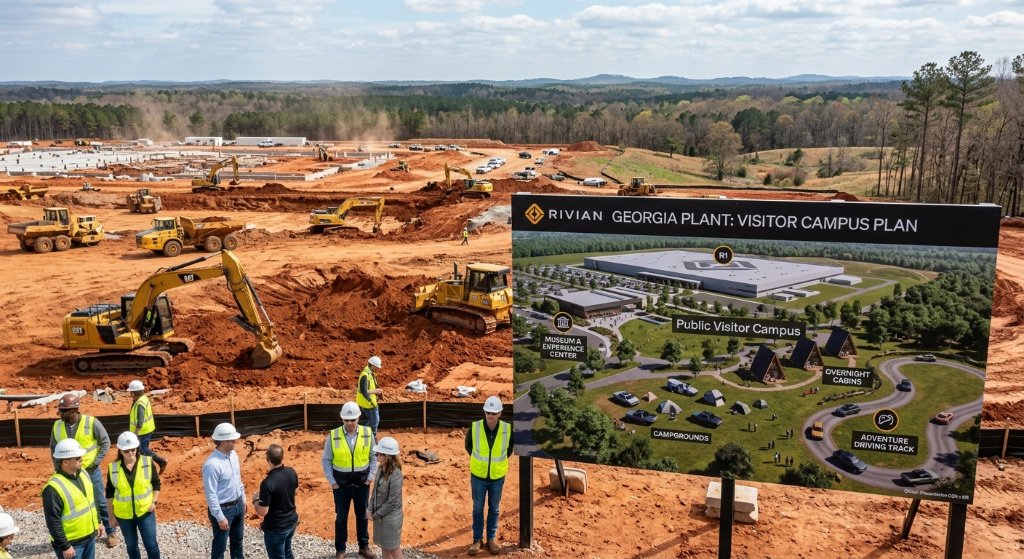
Rivian is officially back in the Peach State, and they aren't just building an electric vehicle factory—they are building a first-of-its-kind EV pilgrimage site. At a press briefing held at its brand-new East Coast headquarters in Atlanta, the California-based EV maker revealed detailed, ultra-ambitious site plans for its upcoming $5 billion manufacturing facility in Stanton Springs, Georgia. Ground preparation is already giving way to heavy excavation on the 2,000-acre property as the company prepares for vertical construction, targeting a late-2028 vehicle production launch.
This announcement represents a triumphant, high-stakes turnaround for Rivian. Just two years ago, in March 2024, the automaker shocked the industry—and Georgia lawmakers—by halting construction on the site to conserve precious cash, redirecting the launch of its highly anticipated midsize R2 SUV platform to its existing facility in Normal, Illinois. Today, backed by a massive, restructured $4.5 billion U.S. Department of Energy (DOE) loan, Rivian is signaling to Wall Street and competitors alike that its scaling crisis is firmly in the rearview mirror.
An EV Megafactory Meets Outdoor Adventure Camp
Rivian has long marketed itself as the "adventure" brand of the EV revolution, and the Stanton Springs site plans double down on that identity in spectacular fashion. Rather than shielding its industrial heart behind miles of razor wire, Rivian is wrapping the entire manufacturing complex in a public-facing visitor campus.
- The Public Experience: The 2,000-acre site will feature a dedicated public museum showcasing Rivian's history and clean energy tech, alongside miles of eco-conscious walking trails.
- Glamping with your EV: The site plans include public campgrounds and overnight eco-cabins, allowing prospective buyers and brand enthusiasts to sleep on-site.
- The Adventure Driving Track: For those who want to push Rivian's legendary off-road capabilities to the limit, the facility will feature an on-site, off-road adventure test track.
Under the Hood of Stanton Springs: Production & Timelines
Behind the lifestyle marketing lies a serious, high-output industrial operation. While the public campgrounds will draw the headlines, the real action is happening underground. Rivian’s engineering teams are currently executing massive subterranean excavation to lay the foundations for the plant's metal stamping presses—the single most complex and capital-intensive buildings on the campus.
Key specifications and milestones for the Georgia project include:
- Optimized Target Capacity: Boosted in early 2026 to an impressive 300,000 vehicles annually for Phase One (a 50% increase from the original 200,000-unit projection) to optimize per-unit production costs.
- The Construction Timeline: Vertical construction is slated to rise out of the Georgia clay through 2026 and 2027, with heavy tooling and production equipment landing shortly after.
- Economic Impact: The facility is expected to bring roughly 7,500 high-paying manufacturing and technology jobs to the region, utilizing an advanced local apprenticeship program.
- First Deliveries: The first sellable vehicles are slated to roll off the Stanton Springs assembly line in late 2028.
Why This Matters:
This is a do-or-die moment for Rivian, and the Georgia factory is the ultimate linchpin of its survival strategy. The EV startup graveyard is well-populated, and Rivian itself barely escaped its post-IPO cash burn. Shifting the initial R2 production to Illinois was a brilliant, cost-saving survival move, but the Normal plant lacks the physical footprint to support Rivian’s true high-volume, global aspirations.
By scaling up the Stanton Springs Phase One capacity to 300,000 units, Rivian is aiming for the critical mass needed to rival the manufacturing efficiency of Tesla and BYD. The true genius of the "visitor campus" design, however, is brand moat-building. While legacy automakers like Ford and General Motors build sterile, closed-off factories, Rivian is building a cultural monument. By inviting buyers to camp at the factory and drive on its tracks, Rivian is fostering a level of brand loyalty that legacy OEMs simply cannot buy.
Furthermore, this is a massive win for the State of Georgia, which had previously extended a historic $1.5 billion incentives package only to watch construction freeze in 2024. With Hyundai’s multi-billion dollar "Metaplant" online near Savannah and now Rivian restarting in Stanton Springs, Georgia is cementing its status as the Detroit of the South.
With heavy excavation underway and an ambitious visitor experience mapped out, Rivian’s $5 billion Stanton Springs plant is shaping up to be much more than an assembly line; it is a physical manifesto of the brand's adventurous DNA. If RJ Scaringe and his team can successfully execute this monumental build while keeping costs under control, the late-2028 launch of the Georgia plant could very well mark the moment Rivian cements its place as a permanent, dominant force in the global automotive landscape.