Rivian Shockwave: CFO Claire McDonough Departs for GE Vernova at Make-or-Break Moment for R2 Ramp
Rivian Automotive has hit a sudden bump on its road to mass-market profitability. Chief Financial Officer Claire McDonough, the chief architect of the...
Editorial Team
World Of EV
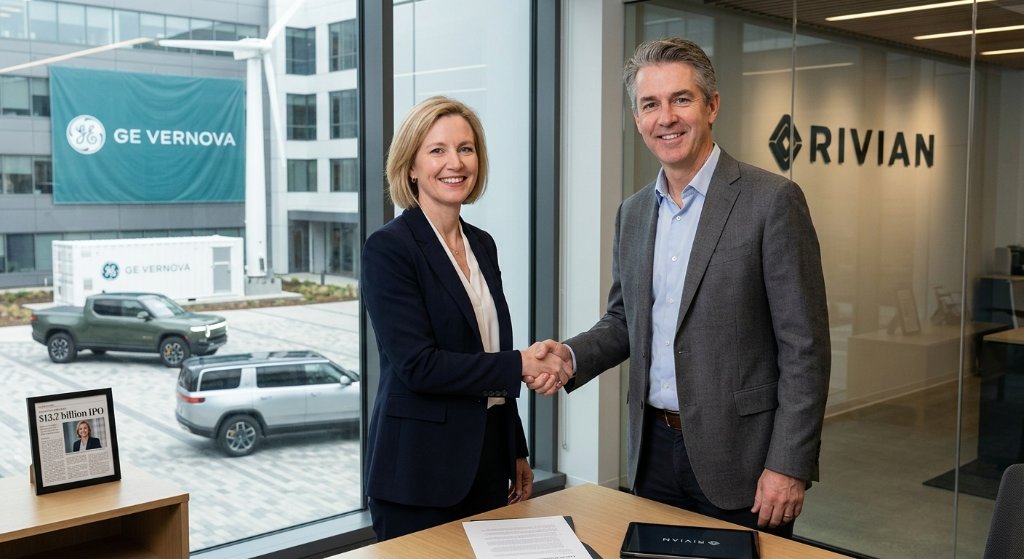
Rivian Automotive has hit a sudden bump on its road to mass-market profitability. Chief Financial Officer Claire McDonough, the chief architect of the company’s capital strategy, is stepping down on October 30, 2026. McDonough is leaving the Irvine, California-based EV maker to take the CFO reins at industrial energy giant GE Vernova. Derek Mulvey, Rivian’s Vice President of Finance, will step in as interim CFO while the company conducts a thorough internal and external search for a permanent successor.
The timing of the departure could not be more delicate. Rivian is currently in the early, highly volatile stages of ramping up its high-volume, lower-priced R2 SUV, which began customer deliveries in June 2026. For an automaker that has spent years burning through cash while trying to transition from a niche luxury player to a mainstream powerhouse, losing its financial guiding star mid-ramp has sent immediate tremors through the market, causing Rivian stock to slide over 6% following the announcement.
A Legacy of Multi-Billion-Dollar Lifelines
McDonough’s nearly six-year tenure at Rivian was defined by navigating some of the most complex financial waters in modern automotive history. Her exit leaves behind massive shoes to fill, characterized by several key milestones:
- The Historic IPO: In November 2021, McDonough successfully steered Rivian through its $13.7 billion Wall Street debut—one of the largest IPOs in U.S. history—providing the initial financial runway to scale the R1T and R1S platforms.
- The Volkswagen Joint Venture: Just months ago, she finalized a monumental $5.8 billion technology partnership with Volkswagen Group. This deal not only validated Rivian's industry-leading software and electrical architecture but also injected indispensable capital to secure the company’s near-term survival.
- Cost-Cutting and Efficiency: Under her watch, Rivian systematically redesigned its production lines, restructured supplier agreements, and shaved thousands of dollars of cost off every R1 vehicle produced in its Normal, Illinois plant.
The Anatomy of a High-Profile Poach
McDonough’s exit is not a story of internal executive discord, but rather a classic high-profile corporate raid. GE Vernova, a booming player in the global energy transition whose stock has surged in recent years, lured McDonough with a jaw-dropping $19.5 million "make-whole" compensation package to offset her forfeited Rivian equity.
Stepping into the breach is Derek Mulvey, a former J.P. Morgan Vice President who has worked side-by-side with McDonough and CEO RJ Scaringe since 2021. While Mulvey’s deep institutional knowledge of Rivian’s capital allocation and investor relations will provide much-needed operational continuity, an interim tag always brings a degree of Wall Street anxiety during a manufacturing ramp-up.
Why This Matters:
This executive transition is a watershed moment for Rivian and the broader EV industry, carrying deep implications:
- Perilous Timing for the R2: Historically, scaling a high-volume EV platform is the most dangerous phase for an automotive startup (Tesla famously went through "production hell" with the Model 3). The R2 is Rivian’s "do-or-die" product, priced to appeal to mainstream buyers. Losing the hand on the financial tiller during this capital-intensive scale-up phase increases operational risk significantly.
- Who Wins and Who Loses: GE Vernova is the clear winner, acquiring a seasoned, battle-tested financial leader with deep capital markets experience. Rivian is the temporary loser, facing leadership uncertainty at a time when they must maintain absolute financial discipline to reach positive gross margins.
- A Market Signal on the EV Talent War: This move highlights a shifting tide in executive recruitment. The pure-play EV market remains financially fragile, with high interest rates and cooled consumer demand squeezing startups. Meanwhile, established energy infrastructure companies are cash-rich and highly stable, making them incredibly attractive landing pads for top-tier EV talent.
While McDonough’s departure is undoubtedly a blow to investor confidence, she leaves Rivian in a far more stable position than it was a year ago. The multi-billion-dollar VW lifeline she negotiated ensures the company has the liquidity to absorb this executive transition. Ultimately, it is now up to RJ Scaringe and interim CFO Derek Mulvey to prove they can execute the R2 scale-up and finally steer Rivian into the black.