Rivian Slashes Customer Support Staff Days After R2 Launch: A Risky Gamble in the Race for Profit
Rivian is playing a high-stakes game of financial chicken. Just one week after delivering the first units of its make-or-break R2 SUV, the Irvine-base...
Editorial Team
World Of EV
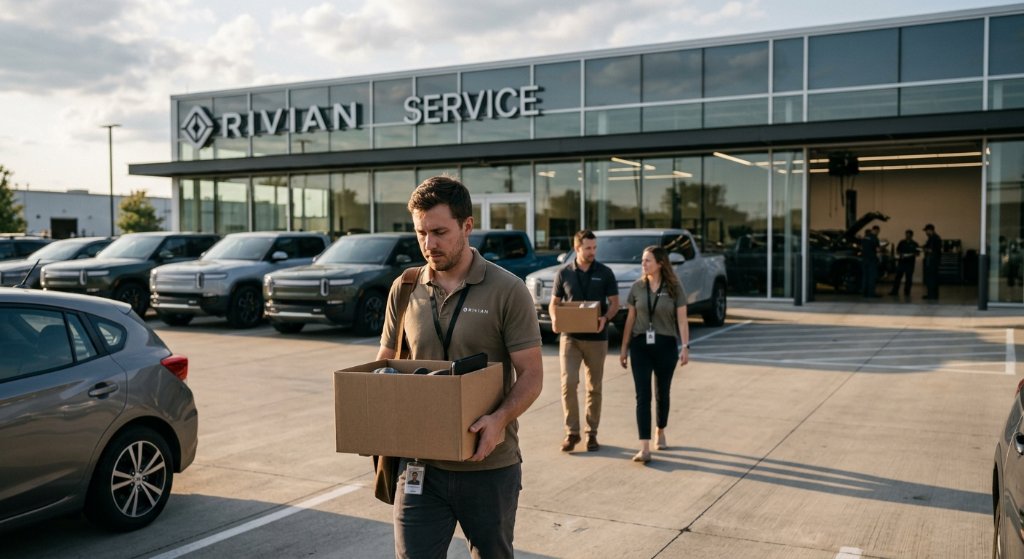
Rivian is playing a high-stakes game of financial chicken. Just one week after delivering the first units of its make-or-break R2 SUV, the Irvine-based automaker laid off roughly 300 employees—representing under 2% of its workforce—targeting its critical service, sales, marketing, and customer operations teams. It is a jarring strategic move that comes at a precarious moment for customer confidence, raising serious questions about how the young EV manufacturer plans to support a massive wave of new vehicle owners.
For years, Rivian has relied on its premium R1T and R1S models to establish itself as a darling of the luxury outdoor crowd. But premium brands cannot survive indefinitely on cool branding and multi-billion-dollar losses; Rivian burned through more than $3.6 billion in 2025 alone. The midsize, mass-market R2 is meant to be Rivian’s "Tesla Model Y" moment—the high-volume vehicle designed to finally drag the company into the black. Yet, cutting the very people who facilitate deliveries and handle maintenance right as this high-volume savior hits the streets is a counterintuitive pivot that signals intense pressure from Wall Street.
Trimming the Front Line of Direct Sales
Unlike legacy automakers that lean on franchised dealership networks to manage maintenance and consumer relations, Rivian operates a pure direct-to-consumer model. This means that when a Rivian owner needs a software fix, a replacement part, or a diagnostic check, they must deal directly with Rivian's corporate-managed service and customer organization.
- The Target of the Cuts: Rivian eliminated approximately 300 jobs, specifically hitting service operations, customer support, and go-to-market roles.
- History of Reductions: This round marks at least the fourth wave of layoffs since early 2024, following a larger 4.5% staff reduction (about 600 workers) in October 2025.
- The Scale-Up Paradox: While Rivian hired roughly 1,800 manufacturing and R&D workers earlier this year to ramp up R2 production, it is simultaneously lean-scaling the customer-facing infrastructure needed to support those very vehicles.
The Critical Mission of the R2 SUV
The R2 represents a profound shift for Rivian. Transitioning from the high-end, six-figure R1 platform to a midsize SUV requires flawless execution. If the R2 succeeds, Rivian cements its place alongside EV giants; if it falters, the company faces an existential threat.
- The R2 Pricing Structure: The newly launched R2 Performance with the Launch Package starts at $57,990, with a mid-tier Premium trim ($53,990) and a budget-friendly Standard variant ($48,490) slated for later release.
- Ambitious Delivery Targets: Rivian aims to deliver between 20,000 and 25,000 R2 units this year, scaling to a projected 300,000-unit annual capacity once its multi-billion-dollar Georgia manufacturing facility opens.
- Service Bottleneck Concerns: Because every R2 is routed to local Service and Demo Centers for final customer delivery rather than the factory, trimming service personnel threatens to create an immediate logjam.
Why This Matters:
This is a classic "do-or-die" moment for Rivian, and this restructuring represents a dangerous trade-off. By laying off diagnostic specialists and support teams, Rivian is prioritizing immediate balance-sheet optimization over the long-term customer experience. Wall Street wants to see Rivian reach positive gross margins, and cutting overhead provides the fastest route to get there. However, this move risks alienating the very early adopters who built the brand's cult status.
Who Wins:
- Tesla and Legacy Rivals: Tesla’s established Model Y service network—though itself often criticized for long wait times—now looks far more stable than a downsized Rivian network. Legacy brands like Ford and Hyundai, which have massive dealer footprints, will weaponize Rivian’s service bottlenecks to pull hesitant EV buyers back to traditional brands.
- Short-term Balance Sheets: Rivian's financial team will see immediate operational expense (OpEx) relief, helping the company march closer to its elusive gross-profitability goal.
Who Loses:
- The New R2 Owners: Buyers taking delivery of a brand-new, first-generation EV platform are highly likely to encounter software bugs and early production quirks. They will now face fewer customer service agents, potentially longer hold times, and delayed service appointments.
- Brand Reputation: Rivian built its reputation on stellar customer satisfaction. If the "direct-to-consumer" dream devolves into a nightmare of unanswered phone calls and months-long waits for simple repairs, the brand equity will evaporate rapidly.
Ultimately, Rivian is walking a razor-thin tightrope between financial survival and customer satisfaction. While streamlining operations makes sense on a corporate spreadsheet, the timing of these service-network cuts—arriving in the exact same week as the R2’s maiden deliveries—suggests a level of financial urgency that should make prospective buyers pause. To survive the EV transition, Rivian must prove it can build great cars; to thrive, it must prove it can actually service them.