Rivian Unveils Aggressive Autonomy Push and R2 Production Surge, Signaling Major Market Disruption
Rivian, the celebrated electric vehicle innovator, is accelerating its trajectory on two critical fronts: an ambitious autonomous driving roadmap and ...
Editorial Team
World Of EV
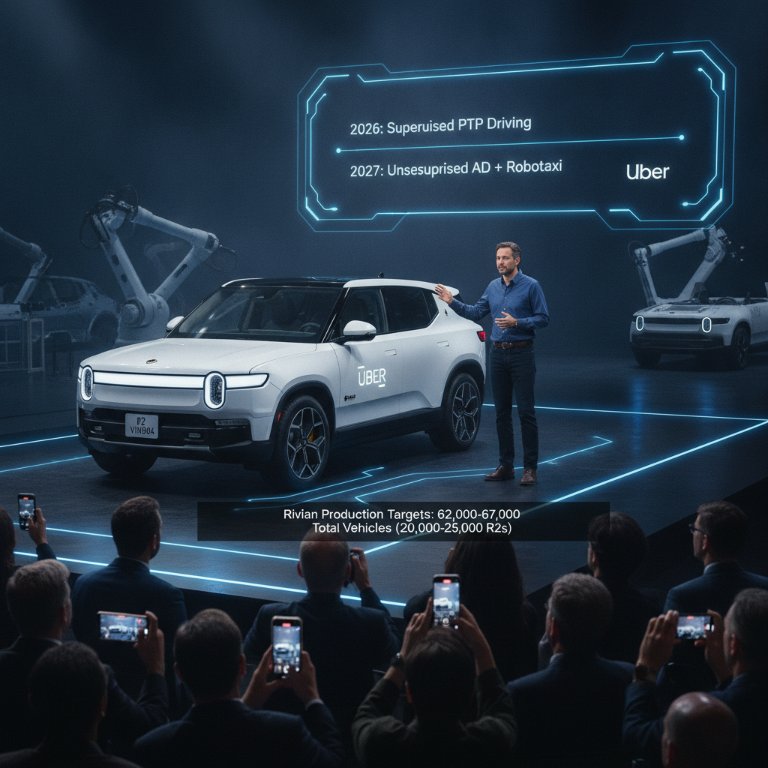
Rivian, the celebrated electric vehicle innovator, is accelerating its trajectory on two critical fronts: an ambitious autonomous driving roadmap and the highly anticipated mass production of its R2 platform. CEO RJ Scaringe has outlined a definitive strategy that positions Rivian not just as a premium EV manufacturer, but as a formidable challenger in the advanced driver-assistance systems (ADAS) space and a burgeoning player in the mainstream EV market. This dual thrust marks a pivotal moment for the company, indicating a serious intent to expand its technological prowess and market footprint beyond its successful, albeit niche, R1 series.
Rivian's Ambitious Autonomous Driving Blueprint
Rivian is making a bold statement in the race for autonomous vehicle supremacy. CEO Scaringe confirmed plans for an aggressive rollout, with a supervised point-to-point driving system expected to launch in late 2026. This offering aims to rival established systems like Tesla’s Full Self-Driving (FSD), promising a similar level of hands-on, eyes-on autonomy for highway and potentially urban navigation. The company’s ambitions don't stop there; Rivian targets an unsupervised mode for 2027, a significant leap that would allow vehicles to operate without human intervention in defined conditions.
Crucially, Rivian is also eyeing the lucrative robotaxi market, projecting a robotaxi-like experience by 2027. This includes a strategic partnership with ride-sharing giant Uber Technologies for distribution, a move that could fast-track Rivian’s entry into urban mobility services. This timeline is exceptionally aggressive, placing Rivian in direct competition with established players and dedicated autonomous vehicle companies like Waymo and Cruise, as well as Tesla's long-stated robotaxi ambitions. For a relatively young OEM, this signals a profound commitment to becoming a full-stack technology company.
R2 Production Hits Stride, Signaling Mass Market Intent
While pushing the boundaries of autonomy, Rivian is simultaneously scaling its manufacturing capabilities for the R2 platform, a crucial component of its long-term growth strategy. Production of the R2 is reportedly ramping up, with VIN 904 of the R2 unit already sighted, indicating tangible progress beyond prototypes. The company has set an aggressive target for R2 deliveries, aiming for 20,000 to 25,000 units in 2026. This figure contributes significantly to Rivian's total vehicle guidance for the year, projected at 62,000 to 67,000 vehicles, a substantial increase that underscores the R2’s importance in expanding Rivian's market presence beyond its premium R1T and R1S models.
This production ramp-up is critical. The R2 represents Rivian's entry into the higher-volume, more accessible mid-size SUV segment, directly challenging popular models like the Tesla Model Y and upcoming electric SUVs from legacy automakers. Successfully bringing the R2 to market at scale is essential for Rivian to achieve profitability and establish itself as a mainstream EV brand, moving beyond its initial niche appeal.
Why This Matters:
- Autonomous Driving as a Differentiator: If Rivian successfully executes its autonomous driving roadmap, particularly the unsupervised mode and Uber partnership, it positions itself as a top-tier innovator. This could be a game-changer, attracting a new segment of buyers who prioritize cutting-edge ADAS and potential mobility services. Rivian, not historically at the forefront of the ADAS conversation compared to Tesla or Google's Waymo, now aims to leapfrog competitors. Success here could cement Rivian as a tech-forward OEM, increasing its valuation and market appeal. Failure, however, could be a costly distraction given the immense R&D investment required.
- R2: The Profitability Engine: The R2’s rapid production ramp-up is perhaps even more critical for Rivian’s immediate financial health and long-term viability. The R1 platform, while acclaimed, serves a premium, lower-volume segment. The R2 is Rivian's pathway to economies of scale, broader market adoption, and ultimately, sustained profitability. Hitting delivery targets for the R2 will prove Rivian's manufacturing maturity and ability to compete in a highly competitive segment. For consumers, the R2 promises a compelling, adventure-focused EV at a more accessible price point, potentially shaking up the mid-size electric SUV market where competition is heating up significantly. Investors will be watching these production numbers closely as a key indicator of Rivian’s operational efficiency and market acceptance.
- Industry Disruption: Rivian’s aggressive moves put pressure on both established automakers and other EV startups. By committing to an advanced autonomy roadmap and simultaneously expanding into high-volume production, Rivian signals its aspiration to be a dominant force, not just a niche player. The partnership with Uber for robotaxi distribution is a particularly astute move, potentially bypassing the need to build an entire mobility network from scratch. This could redefine partnerships in the autonomous space, where traditional OEMs have largely struggled to establish viable robotaxi businesses.
In essence, Rivian is entering a critical do-or-die period. The coming 18-24 months will be crucial for the company to demonstrate its ability to deliver on these ambitious promises, solidifying its position as a leading innovator and a significant player in the evolving EV and autonomous mobility landscape.
Rivian's strategic push on both autonomy and volume production marks a decisive inflection point for the company. The coming years will undoubtedly test its execution capabilities, but if successful, these moves will firmly establish Rivian as a technological frontrunner and a formidable force in the global EV market.