Rivian’s Massive RivianOS 2 Update Unifies Entire Fleet—And Early Adopters Win Big
Rivian has officially rolled out its highly anticipated "RivianOS 2" software update (version 2026.31) to its R1S and R1T vehicles. Far more than a st...
Editorial Team
World Of EV
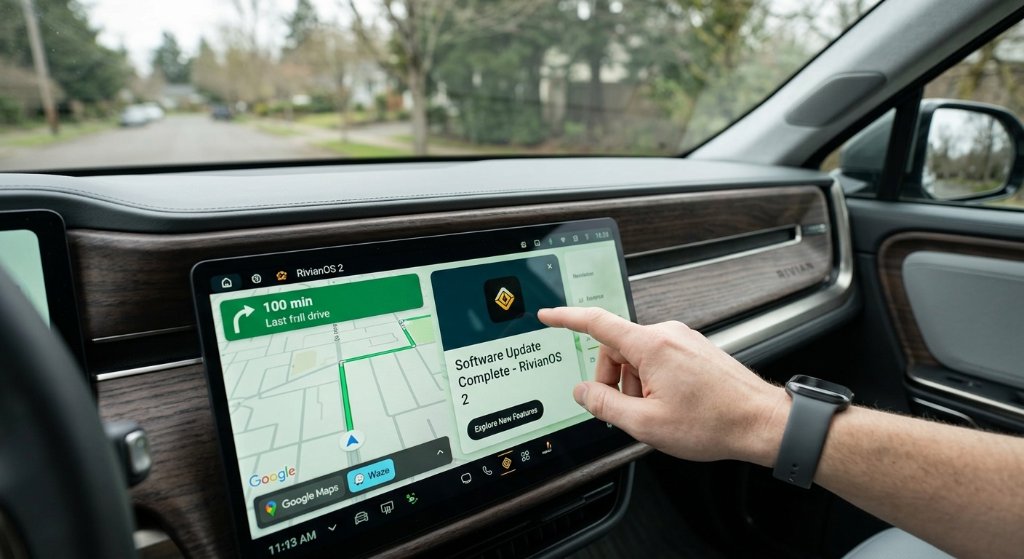
Rivian has officially rolled out its highly anticipated "RivianOS 2" software update (version 2026.31) to its R1S and R1T vehicles. Far more than a standard over-the-air (OTA) patch, this landmark update represents a fundamental paradigm shift for the Normal, Illinois-based EV manufacturer. For the first time, Rivian is unifying its software platform across both its flagship R1 series (covering both Gen 1 and Gen 2 architectures) and its upcoming high-volume R2 passenger vehicle line.
Historically, legacy automakers have famously struggled with software fragmentation. Brands like Volkswagen, for instance, stumbled significantly during the early launch of their ID. series because of immature, un-upgradable software ecosystems. Tesla, by contrast, has set the industry's gold standard by maintaining a unified operating system across virtually its entire fleet. By bringing RivianOS 2 to Gen 1 vehicles, Rivian is demonstrating a software-first maturity that many legacy OEMs can still only dream of, ensuring that early buyers are not left behind as the brand prepares to launch its critically important R2 platform to the mass market.
A Complete Visual and Functional Redesign
The centerpiece of RivianOS 2 is a fully reimagined user interface designed to maximize ergonomics and speed up navigation. The center display layout has been overhauled with dynamic layouts, moving away from a rigid structure to one that puts the user in control. Key updates include:
- Dynamic Quick Controls & Media: Users can now reposition quick controls and the media player on either the driver or passenger side of the screen, greatly improving ergonomic access.
- Redesigned Status Bar: A new vertical status bar keeps essential vehicle functions within easy reach, minimizing distraction while driving.
- Settings 2.0: Built from the ground up, the updated settings application introduces context-aware controls and a universal search tool to find settings instantly.
- Enhanced Media App: The overhauled media experience now supports Apple Music, Spotify, TuneIn, and TIDAL with richer, dynamic colors and an optimized list view for long-form content like podcasts and audiobooks.
Unreal Engine 5 and Smart Navigation Integration
Rivian is leveraging its computing hardware to its absolute limit, deploying advanced gaming engines to render stunning real-time visualizations. However, they are doing so intelligently depending on the vehicle's hardware generation:
- Unreal Engine 5 for R2 and Gen 2 R1: The latest-generation vehicles utilize Epic Games’ Unreal Engine 5 to display ultra-responsive, real-time 3D visualizations of the car and its environment.
- Unreal Engine 4 for Gen 1 R1: To ensure early adopters do not suffer from screen lag, Rivian has wisely kept Gen 1 vehicles on Unreal Engine 4. This keeps the experience snappy while still offering the visual refresh.
- Real-Time Waze and Google Maps Alerts: The native navigation system now integrates real-time user-reported data from Google Maps and Waze, warning drivers of upcoming speed cameras, police presence, and other road hazards.
- Connect+ Weather App: A new weather application displays real-time air quality index (AQI) and 10-day forecasts on the center screen.
Micro-Improvements that Matter
Beyond the major operating system overhaul, version 2026.31 brings several quality-of-life improvements that directly address long-standing owner requests:
- Auto-Tilting Side Mirrors: Mirrors now automatically tilt downward when shifting into reverse, offering a clear view of curbs, and return to normal in drive.
- Dual Glove Box Locking: Owners can now lock the dual glove boxes automatically when locking the vehicle or manually via quick controls.
- Driver-Focused Climate Venting: A new driver focus vent control allows the front passenger vents to redirect toward the driver or shut down passenger-side venting entirely to optimize comfort and efficiency.
Why This Matters:
This update is a strategic masterstroke that signals Rivian's readiness to play in the big leagues. By unifying its software stack across R1 (Gen 1 and Gen 2) and R2, Rivian is drastically reducing its software development overhead. In the EV world, maintaining separate software branches for different hardware generations is a resource sink that has historically crippled legacy players. By consolidating their operating systems, Rivian can develop features once and deploy them across their entire lineup.
The clear winners here are the consumers, specifically first-generation R1T and R1S owners. In an era where legacy auto brands routinely abandon vehicles software-wise the moment they leave the dealer lot, Rivian's commitment to early adopters builds immense brand equity. Conversely, legacy carmakers are the big losers. This update demonstrates that Rivian is capable of delivering Tesla-level software updates, rendering traditional, dealership-reliant brands increasingly obsolete in the eyes of tech-savvy buyers. With the R2 positioned as Rivian’s "make-or-break" mass-market vehicle, launching it with a mature, unified, and highly polished OS that has already been battle-tested on the R1 fleet is the ultimate risk-mitigation strategy.
Ultimately, RivianOS 2 is a defining moment for the company, proving that it is not just a hardware manufacturer, but a world-class software company. By successfully bridging its past and its future under a single, cohesive operating system, Rivian has elevated the ownership experience of every vehicle it has ever built. As the R2 prepares to enter the highly competitive mid-sized EV market, it does so backed by a robust, mature, and stunningly designed digital backbone that positions Rivian as a formidable force for years to come.