Rivian’s Upcoming R2 Halves Its Carbon Footprint, Crushing 2030 Climate Targets Four Years Early
Rivian’s upcoming high-volume R2 SUV isn't just designed to rescue the automaker's balance sheet—it is poised to redefine how the industry measures en...
Editorial Team
World Of EV
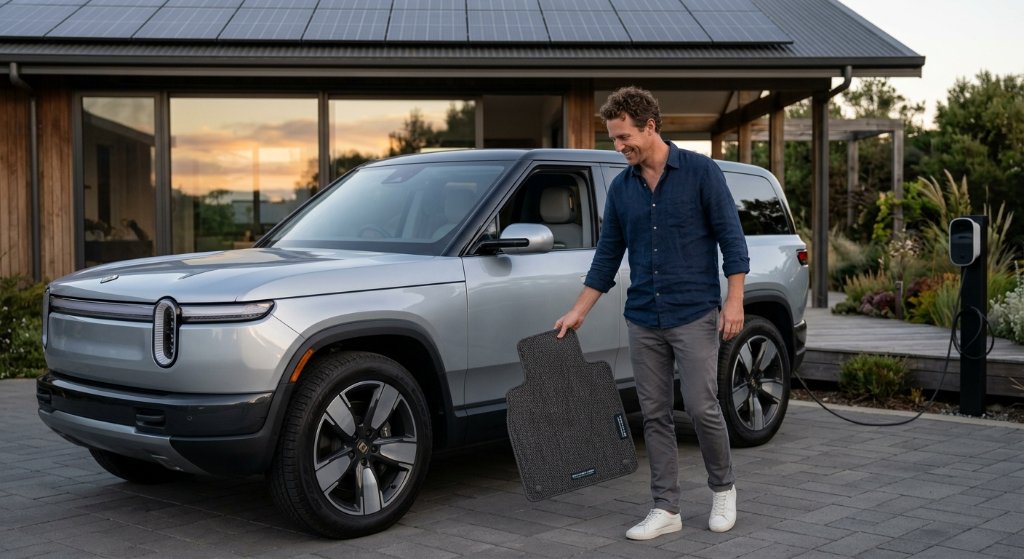
Rivian’s upcoming high-volume R2 SUV isn't just designed to rescue the automaker's balance sheet—it is poised to redefine how the industry measures environmental impact. In its newly released R2 Circularity, Energy, & Carbon Footprint report, the California-based EV maker revealed that the R2 has sliced its lifecycle carbon footprint in half compared to the original R1S Launch Edition. This milestone successfully hits Rivian's internal 2030 sustainability goal a full four years ahead of schedule.
For a brand built entirely on the rugged promise of "keeping the world adventurous forever," the massive physical scale and 7,000-pound curb weight of its early flagship R1 vehicles always presented an awkward ecological paradox. Up until now, critics could easily point to the heavy carbon debt incurred during the manufacturing of these oversized premium haulers. By introducing a highly efficient, midsize platform that targets the mass market, Rivian is proving that high-volume scale and deep decarbonization can—and must—go hand-in-hand.
Shaving Mass and Embracing Circular Materials
The R2's dramatic footprint reduction is not just a byproduct of its smaller physical footprint; it is the result of rigorous engineering discipline and a radical rethinking of supply chain materials. By weight, one-quarter of the entire R2 is composed of recycled or bio-based materials.
Key engineering and material highlights include:
- Second-Gen Adventex Seating: Rivian has replaced legacy leather and traditional synthetics with a highly durable material derived from wood-pulp and paper-industry byproducts sourced from responsibly managed Nordic forests.
- Ocean-Waste Flooring: The interior floor mats are constructed from 99% ocean-waste plastics, directly tackling marine pollution.
- Post-Consumer Recycled Plastics: The vehicle's front trunk (frunk) and interior trim elements are made from 85% post-consumer recycled plastics, while the battery pack's resin cell trays are 100% recycled.
- Aero and Propulsion Optimization: Beyond cabin materials, the R2 benefits from optimized aerodynamics, lower rolling resistance, and highly efficient, in-house developed next-generation drive units.
The Math Behind the Milestone
Skeptics will naturally scrutinize the math behind any corporate sustainability claim, and Rivian is meeting that skepticism head-on. The automaker has become the first in the automotive industry to publish a Life Cycle Assessment (LCA) adopting the new SAE J3341 disclosure standard for carbon footprint reporting, establishing a new benchmark for transparency.
While the R2 Performance Launch Package registers a stellar 211 grams of CO2-equivalent per mile over an assumed 200,000-mile lifetime, critics will note that the baseline R1S was evaluated over a shorter 155,000-mile lifespan. However, even when normalizing the R2 to that shorter 155,000-mile scale, it still achieves an undeniable 43% reduction (242g CO2e/mile). This represents a massive leap forward in manufacturing efficiency, proving that Rivian's factory in Normal, Illinois, is operating with drastically reduced energy overhead per vehicle produced.
Why This Matters:
The R2 is a "do-or-die" vehicle for Rivian. In an era where EV startups face immense financial strain and legacy giants are scaling back their electrification plans, Rivian's survival hinges on its ability to profitably mass-produce a $45,000 crossover that can challenge the dominant Tesla Model Y.
This footprint report reveals how Rivian plans to win that battle. By baking extreme circularity and sustainability directly into the R2's architecture, Rivian is solidifying its brand equity. While competitors like Tesla focus almost purely on manufacturing cost-downs and vertical integration, and others like Volvo push boundaries with the EX30, Rivian is carving out a unique space: the guilt-free, highly capable adventure vehicle.
Furthermore, by adopting the SAE J3341 standard, Rivian has thrown down the gauntlet to the rest of the industry. It effectively calls out competitors who rely on vague, self-styled green metrics. For the conscious consumer—the exact demographic Rivian needs to win over—this level of verifiable, ocean-plastic-utilizing circularity is a massive selling point. It transforms the purchase from a compromise into a badge of honor.
Conclusion
With the R2, Rivian is demonstrating that transitioning to a mass-market price point does not require abandoning its environmental soul. By achieving its 2030 carbon goals four years early, the company has proven that its engineering teams can optimize for both cost and climate. As the R2 transition accelerates, it stands not just as a lifeline for Rivian's business, but as a blueprint for the future of sustainable automotive manufacturing.