Sacramento Strikes Back: California's $3,500 'MyFirstEV' Rebate Handcuffs Tesla and Rewards Local Loyalty
California Governor Gavin Newsom has fired a highly targeted, multi-million-dollar salvo in the ongoing electric vehicle wars. By signing Senate Bill ...
Editorial Team
World Of EV
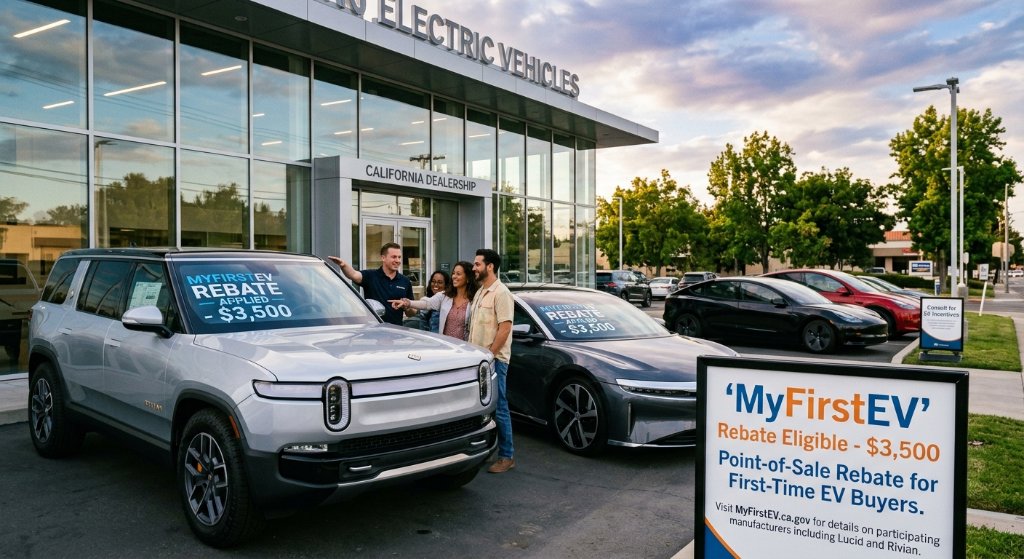
California Governor Gavin Newsom has fired a highly targeted, multi-million-dollar salvo in the ongoing electric vehicle wars. By signing Senate Bill 168 into law, the state has launched the 'MyFirstEV' program, providing a $3,500 point-of-sale instant rebate for first-time zero-emission vehicle buyers. While the program represents a crucial regional buffer following Congress's abrupt repeal of the federal EV tax credit in late 2025, the real shockwave lies in the fine print: a protectionist 'headquarters loophole' designed to reward companies that stay local and punish those that stray.
Under the newly minted rules, California-headquartered, EV-only manufacturers—specifically Rivian and Lucid—are completely exempt from the program's strict $50,000 retail price cap. Meanwhile, Tesla, which famously relocated its corporate headquarters to Austin, Texas, in 2021, receives no such luxury. Elon Musk's brand is left out in the cold on its premium lineups, qualifying for the rebate only on its entry-level vehicles.
The Anatomy of 'MyFirstEV'
The program is backed by an initial $135.5 million state allocation, which participating automakers can match to unleash a combined $270 million in consumer savings. Crucially, this is an instant rebate applied directly at the dealership, bypassing the sluggish paperwork and tax-season delays of previous initiatives like the Clean Vehicle Rebate Project. Here is how the basic eligibility breaks down:
- New EVs: A $3,500 instant rebate for qualifying vehicles under an MSRP of $50,000.
- Used EVs: A $1,750 discount for pre-owned electric cars priced under $25,000.
- The In-State HQ Loophole: Zero MSRP restrictions for first-time buyers purchasing from EV-only brands headquartered in California.
California Loyalty Pays Off for Rivian and Lucid
By structuring the law this way, Sacramento has handed an enormous competitive advantage to Irvine-based Rivian and Newark-based Lucid. First-time buyers looking to pick up a premium Rivian R1T truck, R1S SUV, or a luxury Lucid Air sedan—most of which comfortably exceed the $50,000 ceiling—can still walk away with $3,500 off at purchase. This is an incredibly timely boost for two startups that have struggled with high production costs, negative margins, and scaling premium vehicle lines in a high-interest-rate environment.
Tesla's Texas Penalty
For Tesla, the math is far less forgiving. Because the automaker's primary headquarters is legally situated in Texas, its premium offerings like the Model S, Model X, and the headline-grabbing Cybertruck are completely locked out of the program. Only Tesla's entry-level Model 3 and basic Model Y variants will qualify, forcing premium-market buyers to look elsewhere if they want state-funded assistance. This targeted exclusion feels like a direct political retaliation following Elon Musk's highly publicized departures from California.
Why This Matters:
This is more than just an environmental incentive program; it is a masterclass in economic protectionism and political warfare wrapped in a green bow. By waiving the price cap for in-state manufacturers, California has fundamentally altered the playing field.
- The Winners: Rivian and Lucid are the undisputed beneficiaries. Lucid, which has spent years burning through capital trying to sell its ultra-luxurious, six-figure Air sedans, gets a rare government-backed discount to lure hesitant premium buyers. Rivian, currently trying to build momentum and improve margins before scaling its next-gen R2 platform, receives an immediate shot in the arm for its premium R1 series. For these companies, this isn't just about extra sales—it's a critical lifeline to boost margins in their most profitable, high-end segments.
- The Losers: Tesla and out-of-state legacy OEMs. Tesla remains the undisputed EV king of California, but this bill chips away at its armor. Denying Cybertruck, Model S, and Model X buyers the same $3,500 discount that a Rivian R1T buyer receives is a deliberate middle finger to Elon Musk from Governor Newsom. Furthermore, out-of-state traditional giants like Ford, GM, and Hyundai—which are investing billions into high-end EV trucks and SUVs—find their vehicles over $50,000 completely excluded, giving California-native startups an artificial moat.
- The Market Signal: This program establishes a controversial precedent of state-level protectionism. It sends a chilling warning to green tech firms: if you leave California, the state will weaponize its massive consumer market against you. For buyers, it creates a bizarre market distortion where an $80,000 Lucid Air is subsidized by taxpayers, but a $55,000 Ford F-150 Lightning is not. Expect this loophole to face legal challenges regarding interstate commerce laws in the near future.
Ultimately, the MyFirstEV program represents a desperate but calculated attempt by California to retain its title as the nation's clean-tech capital while nursing its wounded pride. While first-time EV buyers looking at budget vehicles or local premium offerings will celebrate, the blatant targeting of out-of-state automakers like Tesla injects a toxic dose of politics into the transition to clean energy. Whether this legal maneuver survives the inevitable court battles remains to be seen, but for now, Rivian and Lucid are laughing all the way to the bank.