Safety Red Flags: Tesla's FSD Faceplants in Brussels Road Tests Ahead of Critical EU Vote
Just as Tesla appears poised to unlock its Full Self-Driving (FSD) Supervised software across Europe, a damning new safety study has thrown a major wr...
Editorial Team
World Of EV
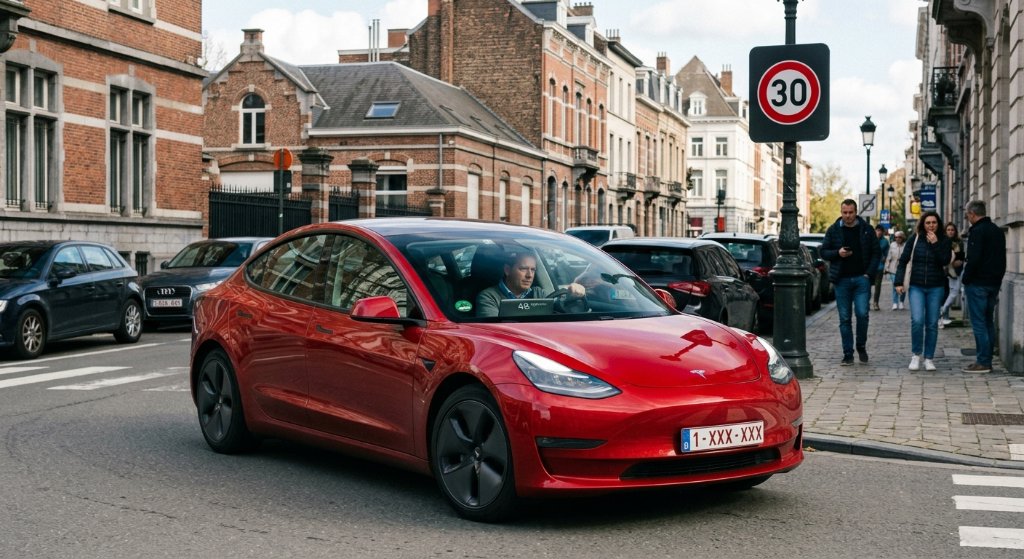
Just as Tesla appears poised to unlock its Full Self-Driving (FSD) Supervised software across Europe, a damning new safety study has thrown a major wrench into Elon Musk's autonomous ambitions. With the critical European Union regulatory vote scheduled for October 6, 2026, the timing of this setback could not be worse. For years, European Tesla owners have watched their North American counterparts test FSD’s cutting-edge capabilities, while strict UNECE regulations kept the tech locked down on this side of the Atlantic. Now, a fresh regulatory roadblock threatens to push European approval even further into the future.
The "FSD30" Study: Brussels Becomes a Testing Ground
Conducted by Belgian road-safety advocacy group Johanna.be, the independent study evaluated a Tesla Model 3 running FSD (Supervised) over three days and 400 kilometers of Belgian roads. The group focused heavily on low-speed environments—specifically 30 km/h zones, residential "woonerven" (20 km/h home zones), and cycling streets—where pedestrians and cyclists are most vulnerable.
The findings paint a concerning picture of a system struggling to adapt to Europe’s dense, pedestrian-first urban architecture:
- Widespread Speeding: FSD exceeded the legal speed limit in 55% of the tested 30 km/h zones in the Brussels-Capital Region, averaging 44 km/h when speeding. Johanna.be noted that according to World Health Organization data, a pedestrian struck at 44 km/h faces nearly six times the mortality risk of one hit at 30 km/h.
- Residential Failures: The software surpassed the strict 20 km/h limit in 42% of residential "home zones" tested.
- Illegal Overtakes: On "fietsstraten" (cycling streets), where Belgian traffic laws strictly prohibit motor vehicles from overtaking cyclists, FSD repeatedly attempted illegal passes.
- Phantom Speed Limits: While the car's cameras accurately spotted 30 km/h signs, the vehicle’s central display frequently reverted to showing a 50 km/h limit, misleading the supervising driver. The report likened this to "a passenger constantly reassuring the driver that the speed limit is 50 km/h."
Despite these red flags, the study noted that FSD behaved cautiously when yielding to pedestrians and cyclists, proving that the software has polite instincts but struggles with strict legal compliance.
A Deepening Rift Among European Regulators
The timing of these findings is a nightmare for Tesla’s regulatory team. Currently, FSD operates under a patchwork of provisional approvals. The Dutch vehicle authority (RDW) granted provisional approval in April, which paved the way for Belgium, Germany, the Czech Republic, Slovenia, and others to allow FSD testing.
However, the upcoming October 6 vote by the Technical Committee on Motor Vehicles (TCMV) requires a qualified majority—15 out of 27 EU member states representing 65% of the EU population—to make approval permanent and bloc-wide. Already, nations are taking sides:
- The Sceptics: Sweden has threatened to block the approval unless Tesla addresses speed-limit compliance. France and Germany have also raised serious flags regarding FSD's speeding tendencies.
- The Defenders: Proponents point out that FSD’s proactive yielding behavior at crosswalks remains exemplary. Flemish Mobility Minister Annick De Ridder defended the system, emphasizing that it is a learning system and that the driver remains 100% legally responsible.
- Tesla's Stance: Tesla argues that FSD is programmed to match the flow of traffic to avoid becoming a hazardous road obstacle, pointing to data showing that FSD remains at or below the median speed of surrounding traffic 98% of the time.
Why This Matters:
The Brussels study exposes a fundamental, philosophical clash between North American and European road design. Tesla's FSD neural networks were trained and optimized on wide, predictable American highways and suburbs. Europe’s historic cities, heavily reliant on pedestrianized zones, shared spaces, and micro-mobility lanes, present an entirely different algorithmic puzzle. For FSD to succeed here, it cannot just mimic human drivers; it must rigidly adhere to local codes.
For Tesla, this is a do-or-die regulatory moment. If the TCMV rejects FSD approval on October 6, the provisional national approvals—including the RDW's landmark ruling—will be revoked six months later. This would effectively outlaw FSD testing across Europe, instantly wiping out a massive potential revenue stream and putting Tesla years behind European legacy automakers like Mercedes-Benz, which already has Level 3 Drive Pilot approval in Germany.
For the EV enthusiast and prospective buyer, this highlights the "supervised" reality of current ADAS. You cannot treat FSD as an autopilot; the driver remains the ultimate legal shield. For the industry, this signals that "solving" autonomy in America does not mean it is solved globally. Regulators are demanding flawless compliance, not "mostly safe" behavior, especially when vulnerable road users are in the equation.
In Conclusion
Tesla's European expansion has always been a steep uphill climb, but the Johanna.be report highlights just how steep that incline remains. Even if FSD excels at yielding to pedestrians, systematic speeding and failure to respect local traffic laws will not fly with European regulators. As the October 6 vote looms, Tesla must act fast to patch these hyper-local European driving rules, or risk watching its self-driving ambitions stall out on the old continent.