Secrets of the 300,000-Mile Club: Why EV Longevity Demands a Radical Shift in Maintenance
The myth of the "maintenance-free" electric vehicle is officially dead—and its demise is the best thing that could happen to EV longevity. Early EV ma...
Editorial Team
World Of EV
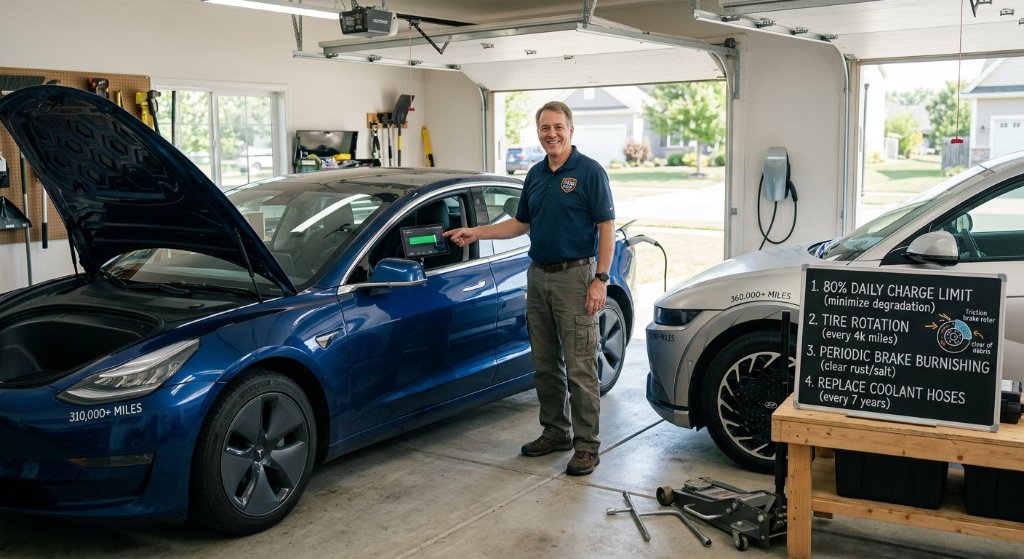
The myth of the "maintenance-free" electric vehicle is officially dead—and its demise is the best thing that could happen to EV longevity. Early EV marketing promised a simplified future: buy an electric car, wave goodbye to oil changes, spark plugs, and timing belts, and drive off into a trouble-free sunset. But as the first generation of mass-market EVs reaches ultra-high mileage, a new reality is setting in. Real-world data compiled by automotive channel Seats & Wheels—analyzing a Canadian owner's 310,000-mile Tesla Model 3 and a South Korean fleet operator’s 360,000-mile Hyundai Ioniq 5—reveals that while EVs require far fewer traditional powertrain repairs, keeping them on the road past the 300,000-mile mark demands a highly specialized, proactive maintenance regimen.
The 80% Rule: Taming Lithium-Ion Calendar Aging
At the heart of any EV longevity strategy is the high-voltage battery pack. While modern battery management systems (BMS) are highly sophisticated, they cannot completely stop the chemical degradation known as "calendar aging." High-mileage trailblazers agree that managing state-of-charge (SoC) is the single most critical factor in keeping the original battery healthy for hundreds of thousands of miles.
- Set Daily Charge Limits to 80%: Restricting regular daily charging to 80% keeps the lithium-ion cells outside of high-voltage stress zones. Standard NMC (Nickel Manganese Cobalt) and NCA (Nickel Cobalt Aluminum) chemistries degrade significantly faster when left sitting at 100% charge.
- Avoid the Extremes: Keeping the battery operating between 20% and 80% for daily commutes minimizes mechanical stress on the anodes and cathodes, dramatically extending the chemical lifespan of the pack.
Tire Rotation: Combating the Heavyweight, High-Torque Penalty
If there is one area where EVs cost more than their internal combustion engine (ICE) counterparts, it is rubber. Electric vehicles are exceptionally heavy—a Tesla Model Y weighs over 4,400 pounds, while a Ford F-150 Lightning tips the scales at nearly 6,000 pounds—and they dump 100% of their torque instantly.
- Rotate Tires Every 3,000 to 5,000 Miles: Because of the high weight and instant acceleration, rear-wheel and all-wheel-drive EVs chew through tread with astonishing speed. Regular, frequent tire rotations are mandatory to prevent irregular wear patterns.
- Address Regenerative Braking Wear: Regenerative braking transfers massive deceleration forces back through the drivetrain and front tires, creating unique wear patterns that do not exist on traditional gas cars.
Burnishing the Brakes: Reclaiming the Friction System
One-pedal driving is one of the most beloved features of modern EVs, but it introduces a bizarre mechanical paradox: by relying on regenerative braking to slow the car down, owners rarely use their physical friction brakes.
- Defeat Rust Build-Up: Left unused, moisture causes rust to accumulate on the steel brake rotors, eventually causing the calipers to seize and slide pins to corrode.
- Perform Periodic "Burnishing": High-mileage drivers recommend regularly performing firm mechanical stops in safe environments. Forcing the hydraulic brakes to engage clears off surface rust, cleans the pads, and ensures the mechanical system is fully functional when an emergency stop is actually required.
Thermal System Integrity: The Seven-Year Coolant Hose Overhaul
Keeping a massive high-voltage battery pack within its optimal operating temperature is a complex thermodynamic challenge. EVs rely on intricate liquid-cooling loops to manage heat during rapid charging and heavy acceleration.
- Replace Coolant Hoses Every Seven Years: High-mileage data indicates that the rubber hoses and connectors transporting battery coolant face severe thermal cycling. After seven years, these hoses begin to soften, weep, or corrode.
- Prevent Catastrophic Failures: A leaked drop of coolant or a localized drop in pressure within the battery's cooling jacket can lead to localized overheating, BMS lockout, or in worst-case scenarios, thermal runaway. Replacing these hoses preemptively is cheap insurance against a $15,000 battery replacement.
Why This Matters:
This shift from "zero maintenance" to "specialized maintenance" is a watershed moment for the electric vehicle industry. For years, OEMs used the promise of zero maintenance as a blunt instrument to convert skeptical ICE owners. Now, as high-mileage data emerges, we see that EVs are not maintenance-free—they simply require a different flavor of mechanical stewardship.
This reality creates clear winners and losers. Dealerships and independent repair shops that pivot quickly to offer EV-specific services—such as reduction gear oil flushes, coolant system pressure testing, and brake burnishing services—stand to gain a highly lucrative, recurring revenue stream that compensates for lost oil change business. Conversely, automakers who fail to educate their customers on these long-term habits risk a wave of premature out-of-warranty battery and thermal failures, which could severely damage brand reputation. Ultimately, for the consumer, a documented history of EV-specific care will become the ultimate currency in the used EV marketplace, defining resale values far more than a simple odometer reading.
In the long run, the data from these 300,000-mile pioneers proves that EVs possess unprecedented mechanical durability. By trading the chaotic vibration and heat of a combustion engine for a disciplined regimen of battery management, frequent tire maintenance, and thermal system care, EV owners can realistically expect their vehicles to outlast any gas car on the road today. The future of automotive longevity is electric, but only for those willing to learn the new rules of the road.