Slate Auto’s $24,950 'Blank Slate' Challenges the EV Elite with Low-Tech, High-Customization Pickup
For years, the electric truck segment has chased a bigger-is-better, high-tech arms race. From the six-figure GMC Hummer EV to the polarizing Tesla Cy...
Editorial Team
World Of EV
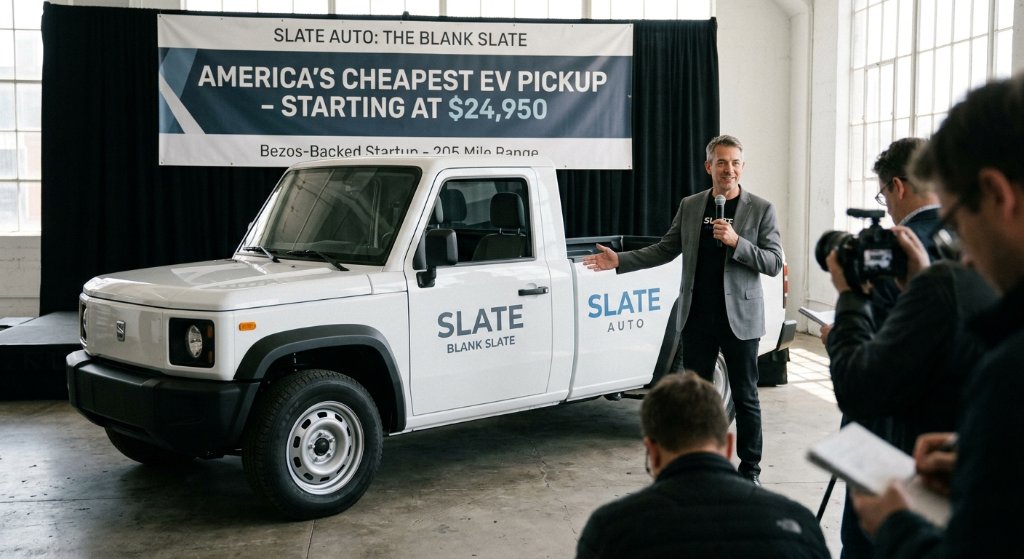
For years, the electric truck segment has chased a bigger-is-better, high-tech arms race. From the six-figure GMC Hummer EV to the polarizing Tesla Cybertruck, legacy automakers and startups alike have packed their vehicles with oversized touchscreens, massive battery packs, and premium price tags. But as the broader EV market cools and buyers increasingly balk at sticker shock, Michigan-based startup Slate Auto is executing a radically different playbook.
Backed by Amazon founder Jeff Bezos, Slate Auto has officially opened pre-orders for its ultra-affordable, bare-bones electric pickup truck: the 'Blank Slate.' Starting at an eye-watering base price of $24,950, the vehicle represents a direct, disruptive challenge to the industry’s obsession with complexity. With 180,000 initial reservations now converting into $300 nonrefundable deposits, Slate plans to begin customer deliveries by late 2026.
Stripped-Down Specs and Retro Simplicity
The Blank Slate is an unapologetic rejection of modern automotive bloat. Instead of loading the truck with proprietary software and expensive microchips, Slate focuses on raw utility and retro mechanical simplicity. Key specifications and features include:
- Unrivaled Pricing: A base price of $24,950 (excluding destination fees), comfortably positioning it as the most affordable electric truck—and one of the cheapest new EVs—in the United States.
- The Powertrain: A single-motor, rear-wheel-drive configuration paired with a 65 kWh battery pack (63 kWh usable), delivering a targeted EPA range of 205 miles. While this range falls short of the 300-plus-mile capabilities of heavyweights like the Rivian R1T or Ford F-150 Lightning, the lightweight Blank Slate promises superior miles-per-kWh efficiency by shedding thousands of pounds of battery weight and tech bloat.
- Zero-Tech Cabin: The interior features absolutely no touchscreens and no built-in radio. Instead, drivers get a heavy-duty phone mount, manual climate knobs, and raw dashboard slots for aftermarket audio systems.
- Manual Everything: To bypass microchip supply chain bottlenecks and keep assembly costs rock-bottom, the truck relies on retro manual crank windows and physical door locks.
- Working Capabilities: Despite its compact footprint, it boasts a highly respectable 2,000-pound payload capacity and a 1,550-pound towing capacity.
The 'Build-A-Bear' Modular Revolution
Instead of forcing buyers to pay for bloated options packages, Slate’s philosophy is simple: "We built it, you make it." The truck acts as a modular foundation, allowing owners to customize their vehicles through over 200 factory-designed accessories. This enables a level of personalization rarely seen in the automotive world:
- The SUV Conversion: For an additional $5,000, buyers can install a second-row bench seat and a rear canopy, instantly transforming the two-seat utility truck into a five-passenger SUV.
- Aesthetic and Utility Packages: Owners can opt for a sporty $2,000 'Fastback' canopy, or an open-air package complete with a rugged, treated roll cage.
- DIY Customization: The truck features pre-wired electrical pathways, integrated mounting points, and door bins designed to house customized 3D-printed accessories or wrap-around vinyl decals in over 100 colors.
Why This Matters:
The launch of the Blank Slate represents a major pivot point for the electric vehicle industry. Historically, EV startups like Lordstown Motors, Fisker, and Canoo have collapsed or teetered on the brink of bankruptcy trying to manufacture complex, high-tech vehicles with astronomical overhead costs. By stripping out the microchips, complex software stacks, and expensive digital displays, Slate bypasses the "production hell" and software bugs that have delayed rivals like Chevrolet's Blazer EV.
Furthermore, Slate’s heavy-hitting backing—including Jeff Bezos and production partner Re:Build Manufacturing—gives the startup the industrial credibility that previous newcomers lacked.
Who wins? Budget-conscious consumers, DIY enthusiasts, and commercial fleet operators who desperately need low-cost, utilitarian electric workhorses.
Who loses? Legacy automotive giants. For years, Detroit has claimed it cannot build a profitable, affordable electric vehicle in the United States due to high labor and material costs. If Slate successfully scales its Indiana plant and delivers on its 180,000 reservations, it will expose that narrative. Slate's success will force players like Ford and General Motors to rethink their high-margin, tech-heavy product strategies and finally address the massive, unsatisfied demand at the bottom of the market.
The Bottom Line
By ignoring the tech-heavy playbook of the Silicon Valley elite, Slate Auto is betting that simplicity is the ultimate selling point. If the startup can execute on its late 2026 delivery timeline, the Blank Slate won’t just be a quirky retro truck; it could very well write the blueprint for the next phase of mass EV adoption.