E
World Of EVEditorial
News 54 mins ago
Sleeping at the Wheel: Federal Pressure Mounts on Tesla as Congress Demands Crackdown on Autopilot and FSD Misuse
America’s roads are facing a silent safety crisis, and federal lawmakers are finally losing patience. In a formal, sharply worded demand to the Depart...
E
Editorial Team
World Of EV
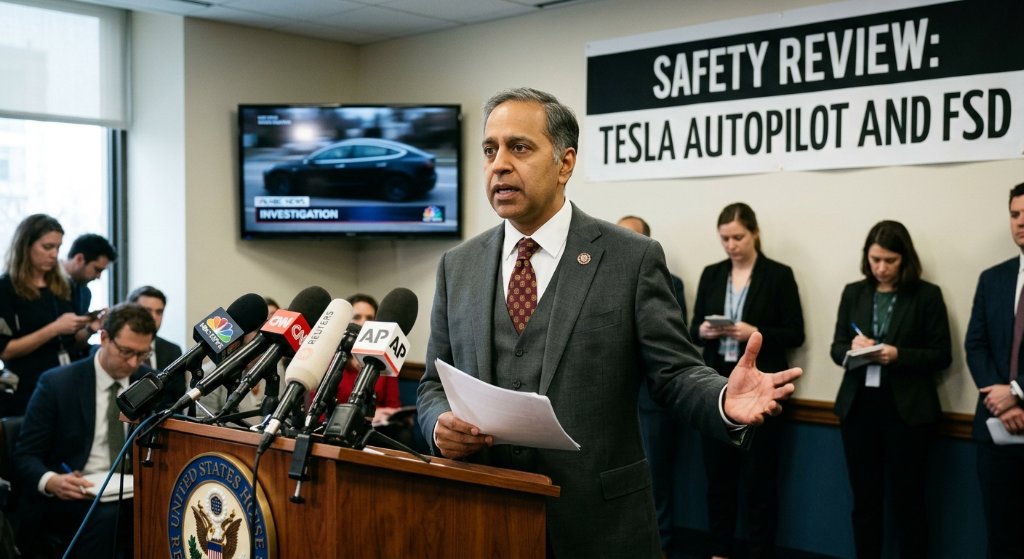
America’s roads are facing a silent safety crisis, and federal lawmakers are finally losing patience. In a formal, sharply worded demand to the Department of Transportation (DOT) and the National Highway Traffic Safety Administration (NHTSA), U.S. Congressman Raja Krishnamoorthi (D-IL) has called for immediate, aggressive action against the rampant misuse of Tesla’s Autopilot and Full Self-Driving (FSD) systems. The pressure campaign follows a damning NBC News investigation that uncovered dozens of videos showing Tesla drivers asleep at the wheel of moving vehicles, raising critical questions about whether the EV pioneer's driver-monitoring safeguards are fundamentally broken.
This escalation is not occurring in a vacuum. For years, Tesla has walked a razor-thin wire, marketing its driver-assist suites with highly suggestive names like "Full Self-Driving" while legally burying the caveat that these systems require 100% driver attentiveness in the fine print. Despite a massive federal recall aimed at reinforcing driver alertness, and NHTSA upgrading its current FSD probe to an intensive 'engineering analysis'—affecting over 3 million vehicles—the tech giant continues to struggle with keeping drivers focused. Congressman Krishnamoorthi's intervention highlights a dangerous gap between Tesla's marketing-driven software design and real-world highway safety.
### The Catalyst: Sleeping Drivers and Defeated Safeguards
The formal inquiry directed at newly minted Transportation Secretary Sean Duffy points directly to the stark findings of the NBC News investigation. Out of 43 separate videos showing drivers apparently asleep or completely disengaged while their Teslas sped down public highways, 17 were filmed and posted in this year alone. This persistent, highly visible misuse demonstrates that the safety updates deployed via over-the-air (OTA) recalls have largely failed to curb dangerous driver complacency.
Compounding this issue is the ease with which users bypass Tesla's internal driver-monitoring hardware:
* **Camera Loopholes:** Drivers have reportedly discovered simple workarounds, such as hanging a folded bill or tape over the cabin camera to trick the vehicle into thinking the driver is watching the road.
* **Torque Tricks:** Aftermarket steering wheel weights continue to bypass steering wheel torque sensors, allowing drivers to keep their hands off the wheel for extended periods.
* **Systemic Failure:** While other automakers utilize robust infrared eye-tracking systems (such as GM's Super Cruise or Ford's BlueCruise) that shut down if the driver looks away, Tesla’s reliance on steering wheel torque and standard optical cabin cameras leaves massive loopholes for negligent behavior.
### The Conflicting Message: "Drowsiness Detected"
Perhaps the most alarming detail highlighted by Congressman Krishnamoorthi is a controversial software prompt recently pushed to Tesla vehicles. When the vehicle detects driver fatigue, it displays the message: *“Drowsiness detected. Stay focused with FSD.”*
The letter argues that this prompt is a dangerous paradox:
* **Misleading Encouragement:** Instead of instructing an exhausted driver to pull over, the prompt suggests that the driver rely *more* heavily on FSD—a Level 2 driver-assist system.
* **Encouraging Negligence:** By prompting drivers to engage FSD precisely when their cognitive and physical capabilities are compromised, Tesla may be actively encouraging fatigued driving.
* **Regulatory Contradiction:** This messaging directly conflicts with Tesla's legal definitions, which state that FSD is not an autonomous driving system and requires continuous human supervision.
### Why This Matters:
* **The Valuation Risk for Tesla:** This is a high-stakes, do-or-die moment for Tesla's valuation. Wall Street prices Tesla not as a traditional car company, but as an AI and robotics pioneer. If the DOT and NHTSA decide to impose heavy-handed restrictions on FSD—or force a massive software rollback that limits where and when FSD can be engaged—it could severely damage Elon Musk’s narrative of near-term autonomous ride-hailing dominance.
* **The Winner's Circle:** Legacy automakers like General Motors (Super Cruise), Ford (BlueCruise), and Mercedes-Benz (Drive Pilot) stand to win. By implementing strict, infrared-based driver monitoring from day one, and in Mercedes' case, accepting legal liability for Level 3 autonomy, these brands have positioned themselves as the responsible adults in the room. This federal scrutiny will likely validate their conservative approach to driver-assist technology.
* **The Loser's Corner:** Tesla owners and prospective buyers are the ultimate losers here. Savvy EV buyers who spent up to $15,000 on FSD packages expecting true convenience may find themselves saddled with highly restrictive software that "nags" constantly. If NHTSA clamps down, FSD could become more stressful to use than manual driving.
* **Market-Wide Signal:** This federal pressure signals that the "move fast and break things" era of automotive software is rapidly drawing to a close. Regulators are no longer content with passive, post-crash investigations; they are actively targeting how software nudges human behavior before a tragedy occurs.
### Conclusion
The Department of Transportation has until September 30 to respond to Congressman Krishnamoorthi's sharp inquiries. For Tesla, the clock is ticking. As federal investigations edge closer to a potential mandatory redesign of Autopilot and FSD, Tesla must decide whether to proactively overhaul its driver-monitoring tech or risk a heavy-handed federal shutdown that could derail its autonomous future entirely. On today's increasingly crowded highways, one thing is clear: technology meant to assist drivers should never be used as a pillow.