Software Bug Knocks Out Power: Toyota, Lexus, and Subaru Recall 21,000 EVs, Exposing Glaring Tech Gaps
Just as Japanese automakers seemed to finally find their footing in the battery-electric vehicle (BEV) market, a major software glitch has pulled the ...
Editorial Team
World Of EV
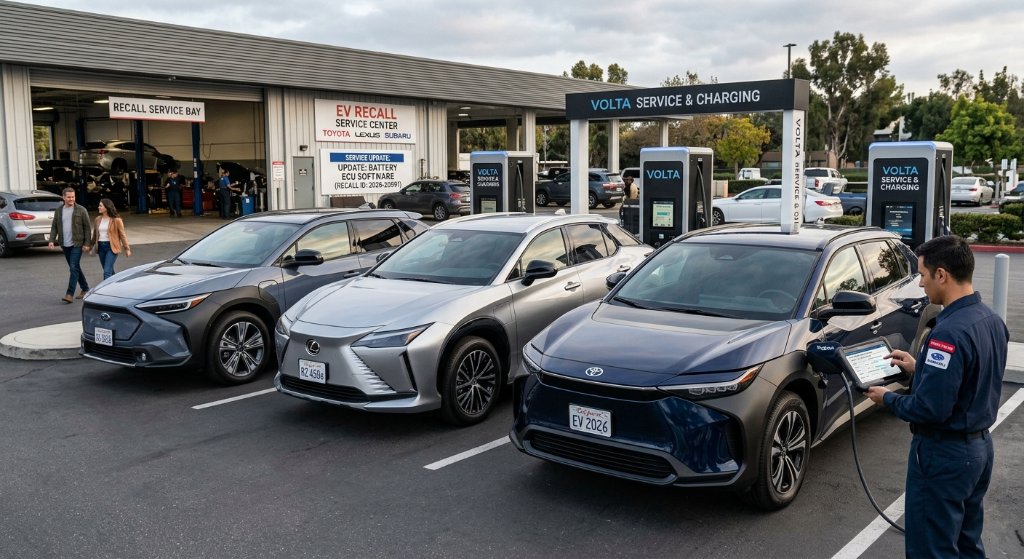
Just as Japanese automakers seemed to finally find their footing in the battery-electric vehicle (BEV) market, a major software glitch has pulled the plug on their momentum. Toyota, Lexus, and Subaru are issuing a voluntary safety recall for 20,991 of their model-year 2026 e-TNGA-based EVs, citing a critical software bug that can cause a sudden, dangerous loss of drive power at highway speeds.
This setback is a painful case of déjà vu. Back in 2022, the launch of Toyota's first global EV, the bZ4X, was plagued by an embarrassing recall where the wheels could literally fall off due to faulty hub bolts, forcing a stop-sale. While the 2026 models featured crucial updates—including native NACS ports, improved range, and surprisingly strong sales that pushed the bZ to become the third-most popular EV in the US in the first quarter—this latest electronic failure threatens to revive doubts about the legacy giants' readiness for the software-defined EV era.
The Tech Bug: Why the Powertrain Unexpectedly Shuts Down
According to filings with the National Highway Traffic Safety Administration (NHTSA) under campaign number 26V393, the recall impacts 11,495 Toyota bZ models, 4,757 Subaru Solterra models, and 4,739 Lexus RZ models. The culprit is not a physical defect in the batteries or motors, but a software conflict inside the battery Electronic Control Unit (ECU) supplied by Denso.
The technical breakdown reveals a classic software design conflict:
- The Conflict: The battery ECU uses two integrated circuits (a control IC and a monitoring IC) that share the same memory address location.
- The Trigger: Under certain high-load conditions—specifically when the battery has a low state of charge and CPU demand spikes—the monitoring IC repeatedly overwrites memory before the control IC can finish its check.
- The Failure: After multiple failed operational checks, the vehicle triggers an "EV System Malfunction" warning on the dash, and the entire electric drive system shuts down instantly.
- The Safety Risk: While power steering and power-assisted braking continue to function, the abrupt loss of motive power at high speeds significantly increases the risk of a highway collision.
The Catch: No Over-the-Air Solution
In an era where automakers like Tesla, Rivian, and even Hyundai-Kia routinely patch drivetrain and battery management bugs over-the-air (OTA), Toyota’s e-TNGA platform falls short. Impacted owners cannot simply wait for a home Wi-Fi update.
- The Remedy: Owners must schedule a physical service appointment at their local Toyota, Lexus, or Subaru dealership.
- The Process: Technicians will manually reflash and update the battery ECU software.
- The Cost: The update will be performed completely free of charge.
- The Timeline: Official notification letters are scheduled to be mailed out beginning August 3, 2026, though drivers can use the NHTSA recall lookup tool to check their VIN immediately.
Why This Matters:
This recall is more than a routine maintenance headache; it exposes a fundamental, structural gap between legacy automotive giants and pure-play EV leaders.
- The Legacy Software Bottleneck: The inability to resolve a critical ECU software bug via OTA update is a glaring weakness. While Toyota has spent decades mastering physical hardware manufacturing and supply chains, this incident proves they are still lagging behind in software-defined vehicle (SDV) architecture. Requiring over 20,000 customers to physically visit a dealership to patch a few lines of code is an archaic solution.
- The Danger of Shared Platforms: The e-TNGA platform was designed as a multi-energy architecture to accommodate hybrids and ICEs alongside BEVs. This compromise continues to haunt them. Shared platforms inherently limit the deep, centralized software integration seen in dedicated, ground-up "skateboard" platforms.
- Momentum Interrupted: This could not have come at a worse time. In early 2026, the Toyota bZ had climbed to become the third-best-selling EV in the United States, proving that consumers were finally responding to their range improvements and the adoption of the NACS charging standard. This recall risks halting that hard-won sales momentum and feeding into the narrative that Japanese automakers aren't fully committed to, or capable of, building cutting-edge EVs.
Ultimately, Toyota, Lexus, and Subaru will get these 21,000 vehicles patched, but the damage to consumer confidence may linger. If Japanese legacy automakers want to successfully transition to the next generation of electric mobility, they must stop treating software as an afterthought. Hardware reliability has always been Toyota's crown jewel—but in the EV world, software is king.