Software is King: Why an Ultra-Reliable Mustang Mach-E is Failing to Keep This Owner From a 2026 Tesla Model Y
Legacy automakers thought they could beat Tesla at its own game by doing what they do best: building rock-solid hardware. But as the electric vehicle ...
Editorial Team
World Of EV
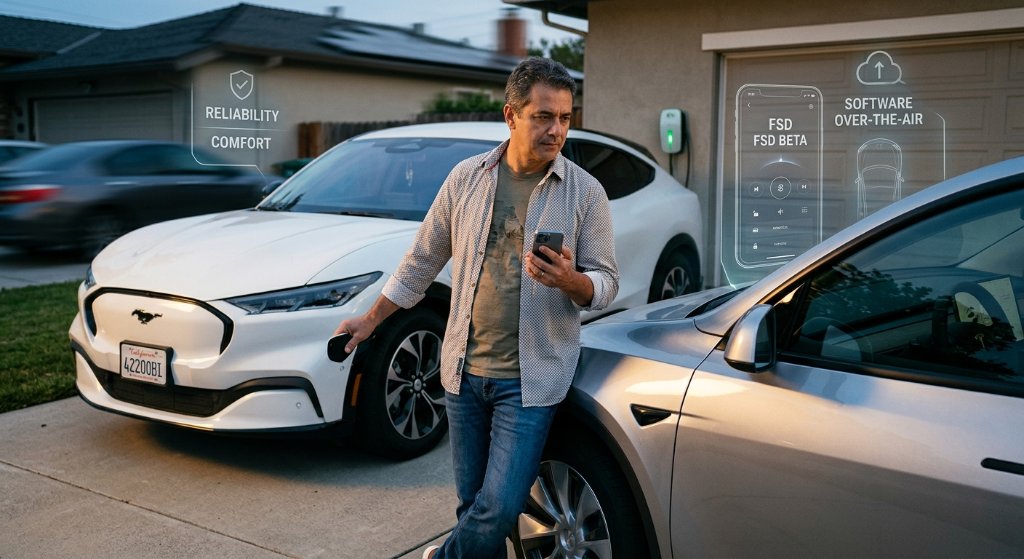
Legacy automakers thought they could beat Tesla at its own game by doing what they do best: building rock-solid hardware. But as the electric vehicle market matures, a cold hard truth is setting in—in the era of the software-defined vehicle, premium build quality cannot compensate for a second-rate digital experience. This hard-learned lesson is perfectly illustrated by real-world EV owner Marcio Cavalcanti, who recently detailed his journey of transitioning from a 2021 Tesla Model 3 to a Ford Mustang Mach-E—and why he is already planning his return to the Tesla fold.
Despite praising the Mach-E's exceptional mechanical reliability and structural integrity, Cavalcanti admits that Ford's clunky software, sluggish over-the-air (OTA) updates, and a subpar mobile app are driving him straight toward a 2026 Tesla Model Y. For legacy giants like Ford, this is a flashing red warning light. It proves that satisfying drivers on the road is no longer enough if you frustrate them every time they interact with your software.
The Iron-Clad Hardware of the Mustang Mach-E
There is no denying that Ford got the physical fundamentals right with the Mustang Mach-E. Moving from a 2021 Model 3—an era of Tesla production notorious for thin paint, misaligned panel gaps, and highway cabin noise—the Mach-E offered a revelation in fit and finish. Cavalcanti’s experience highlights just how well the crossover has held up over the long haul:
- The 42,000-Mile Sturdiness: Even after cross-country road trips and years of daily driving, the Mach-E still "feels brand new," completely free of the squeaks and rattles that often plague older Teslas.
- Premium Cabin Comfort: Sound dampening and suspension tuning in the Mach-E deliver a quiet, composed highway cruise that early Tesla Model 3 and Model Y models struggled to match.
- Exceptional Durability: The paint quality, interior materials, and overall assembly have resisted wear-and-tear, proving that Detroit’s century of manufacturing experience still counts for something.
Where Ford Stumbles: The Digital Friction
However, the honeymoon ended once the dashboard screen boot-looped and the smartphone app stalled. Like many legacy EV efforts, the Mach-E suffers from fragmented electronic control unit (ECU) architecture. Instead of a single "brain" running the car, Ford relies on dozens of disparate modules sourced from various suppliers, leading to a host of digital pain points:
- Glitchy OTA Updates: Ford's over-the-air updates have a reputation for failing, freezing, or requiring dealership visits to resolve—a stark contrast to Tesla’s seamless, background-downloading system.
- A Sluggish Mobile App: Pre-conditioning, locking doors, and monitoring charge status through the FordPass app are often marred by latency and connection drops.
- Stagnant Driver-Assist Tech: While Ford’s hands-free BlueCruise performs admirably on designated highways, it lacks the rapid iterative improvements and active lane-navigation confidence of Tesla's Autopilot and Full Self-Driving (FSD) suite.
The Pull of the Refreshed 2026 Tesla Model Y "Juniper"
The ultimate threat to Ford and other legacy automakers is that Tesla hasn't stood still. With the launch of the refreshed 2026 Model Y (codenamed "Juniper"), Tesla has aggressively targeted its historic hardware weaknesses. The newer Model Y features acoustic glass, a redesigned suspension, and premium cabin materials—effectively neutralizing the comfort advantage previously held by the Mach-E. By combining these hardware upgrades with its undisputed software lead, Tesla makes a return to the brand almost irresistible for tech-focused owners.
Why This Matters:
This testimonial is a micro-level symptom of a macro-level industry crisis. Legacy automotive manufacturers are fighting a war with weapons from the last century. They are measuring success in panel gaps and paint depth, while the modern EV buyer measures it in latency, feature updates, and app ecosystem integration.
- The Winners: Tesla. By establishing a centralized computing architecture from day one, Tesla built an insurmountable lead in software agility. As they finally patch their hardware and build-quality shortcomings with the "Juniper" Model Y, they leave very little leverage for competitors.
- The Losers: Legacy OEMs like Ford and General Motors. Despite spending billions to engineer competent electric drivetrains, their inability to recruit top-tier software talent and rebuild their vehicle architectures from the ground up is alienating premium customers.
- The Market Signal: The battleground has permanently shifted. If a legacy carmaker cannot deliver a smartphone-smooth user interface, buyers will happily trade a rattle-free dashboard for a car that seamlessly integrates into their digital lives. Software is no longer a feature; it is the ultimate customer retention tool.
Conclusion
Marcio Cavalcanti’s experience proves that while good hardware can win a customer today, poor software will lose them tomorrow. Ford built an incredibly durable, reliable machine in the Mustang Mach-E, but in the modern EV market, reliability is merely the price of entry—not the selling point. As the brilliantly refined 2026 Tesla Model Y "Juniper" hits the streets, legacy automakers are running out of time to bridge the software chasm. If they don't, they will continue to watch their most valuable customers migrate back to the tech giant that started it all.