Software Over Hardware: Why Apple CarPlay and ABRP Are the Real Cure for EV Range Anxiety
For all the engineering marvels packed into modern electric vehicles, the fear of the open road remains the ultimate barrier to mainstream adoption. T...
Editorial Team
World Of EV
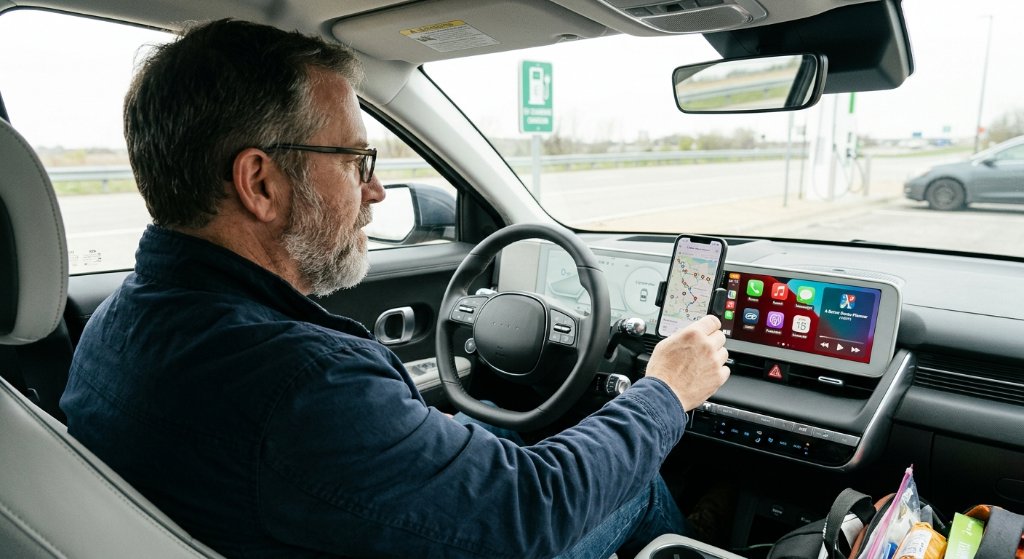
For all the engineering marvels packed into modern electric vehicles, the fear of the open road remains the ultimate barrier to mainstream adoption. The award-winning Hyundai IONIQ 5, built on the cutting-edge 800-volt E-GMP platform, is a hardware masterpiece capable of hyper-fast charging from 10% to 80% in a blistering 18 minutes. Yet, even with world-class battery technology, long-distance travel can still induce sweating over broken chargers, opaque pricing, and inaccurate dashboard range estimates.
While Tesla conquered this puzzle early on by tightly integrating its proprietary Supercharger network with its in-house software, non-Tesla EV owners have historically been thrown into a wild west of fragmented networks and clunky native infotainment systems. But a shift is underway. EV drivers are discovering that they don't need to wait for automakers to fix their software. By pairing third-party mapping applications with smart mobile integration, drivers are taking control of the road trip narrative—proving that software, not just battery size, is the true key to neutralizing range anxiety.
The Software Bridge: CarPlay, ABRP, and Real-Time Data
In a recent hands-on case study, veteran tech journalist Adam Engst detailed his highly successful, stress-free weekend road trip to Boston in a Hyundai IONIQ 5. Rather than relying on Hyundai’s native navigation—which, like many legacy OEM systems, lacks dynamic multi-stop optimization—Engst supercharged his cockpit using the premium tier of A Better Route Planner (ABRP) running via Apple CarPlay.
To bridge the gap between static route planning and real-time driving conditions, Engst utilized a multi-layered data strategy to feed live vehicle metrics directly into the mapping software:
- Live Vehicle Integration: By linking the Enode API to Hyundai’s Bluelink service and plugging a Bluetooth OBD (On-Board Diagnostics) dongle (the Veepeak OBDCheck BLE) into the car’s port, ABRP received hyper-accurate, real-time updates on the battery's exact State of Charge (SoC).
- Dynamic CarPlay Dashboard: Operating ABRP via Apple CarPlay allowed the navigation, mapping, live traffic, and weather data to display directly on the IONIQ 5’s primary screen, removing the need to juggle phone mounts.
- Conservative Safety Buffers: By setting deliberate, generous arrival buffers (e.g., targeting 15-20% battery remaining upon arrival), the system insulated the route plan against sudden headwinds, elevation changes, or the nightmare of rolling up to a broken charging pedestal.
The Wild West of Charging Rates and the 'Slow' Charge Hack
Beyond keeping the battery alive, smart planning has become a financial necessity. Unlike gas stations, which are legally mandated to display pricing on massive, highly visible street signs, public EV fast-charging rates are shockingly volatile and frequently obscured behind mobile app paywalls.
During his route planning and charging stops, Engst documented an eye-watering pricing variance across different networks on his journeys:
- EVgo: $0.72 per kWh
- Electrify America: $0.64 per kWh
- Tesla Supercharger (Open to Non-Tesla): $0.58 per kWh
- Previous Off-Peak/Regional Trips: $0.48 to $0.56 per kWh
Paying $0.72/kWh compared to $0.48/kWh represents a massive 50% markup for the exact same electrons. Without a tool like ABRP to compare networks ahead of time, drivers are highly susceptible to getting price-gouged at the plug.
Furthermore, Engst bypassed traditional charging wisdom by employing a "slow-charging" hack. Conventional advice dictates unplugging at 80% because EV DC fast-charging speeds drop off a cliff after that threshold. However, because the IONIQ 5’s E-GMP platform charges so rapidly in its sweet spot, pushing the battery from 80% to 100% only added roughly 10 to 15 minutes to his stop. This minor delay allowed him to completely bypass additional charging stops later in the trip, trading frequent, frantic stops for fewer, more relaxed pauses.
Why This Matters:
First, it highlights that software remains the ultimate bottleneck for legacy OEMs. Hyundai can build an industry-leading 800V physical powertrain, but if its native infotainment cannot seamlessly route a driver through a cost-optimized, multi-stop road trip with real-time battery feedback, the hardware advantage is blunted.
Second, it cements the dominance of third-party ecosystems. Companies like Rivian—which acquired ABRP in 2023—clearly understand that mapping software is intellectual gold. By allowing Apple CarPlay and Android Auto to act as the primary interface, automakers are effectively conceding the dashboard to tech giants. OEMs who refuse to support these projection systems (such as General Motors) risk alienating a tech-savvy buyer base that demands tools like ABRP.
Finally, the extreme pricing disparity ($0.48 to $0.72/kWh) reveals a market desperately in need of maturity. As EVs transition from early adopters to mainstream families, consumers will not tolerate hidden, predatory pricing structures. The networks that win the long game will be those that integrate transparent pricing directly into dominant routing applications.
Conclusion
Ultimately, a successful EV road trip shouldn't require an engineering degree or a meticulously managed suite of dongles and third-party APIs. However, until public charging networks standardize pricing and legacy automakers catch up on native software, tools like ABRP via Apple CarPlay are the bridge to the future. They turn what used to be a high-stress adventure into what a road trip should be: delightfully boring, highly predictable, and entirely stress-free.