Swaptopus Is Here: Octopus and CATL Join Forces to Solve Europe’s Biggest Electric Truck Problem
The heavy-duty trucking industry faces a massive, multi-billion-dollar roadblock: charging downtime. While a passenger electric vehicle (EV) can comfo...
Editorial Team
World Of EV
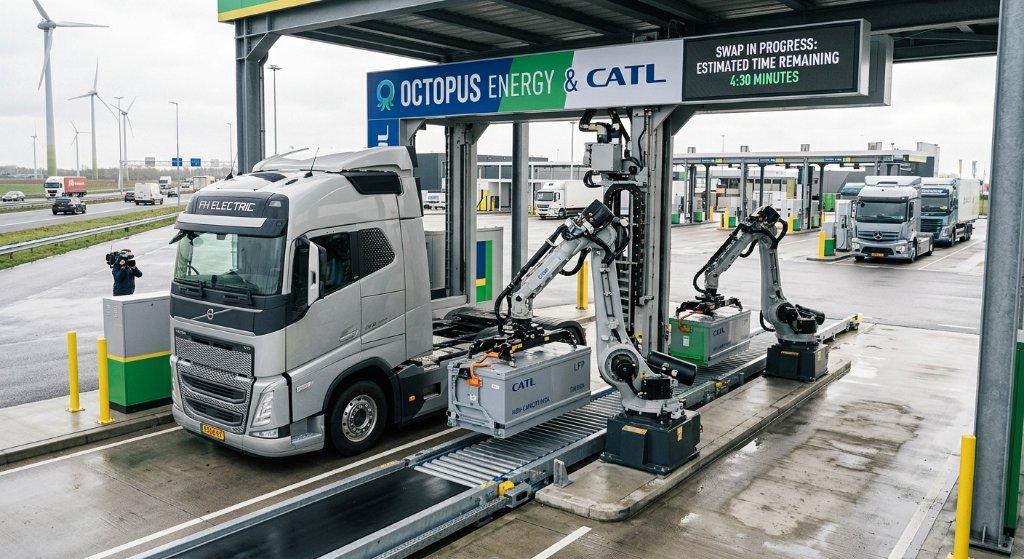
The heavy-duty trucking industry faces a massive, multi-billion-dollar roadblock: charging downtime. While a passenger electric vehicle (EV) can comfortably top up overnight or at a rapid charger, a massive, long-haul freight truck requires hours of charging even with ultra-high-power megawatt chargers. This costly downtime has kept fleet operators stubbornly tethered to diesel. Now, a massive new alliance is about to change that.
At the Octopus Energy Tech Summit (ETS26) in London, UK energy giant Octopus Energy and the world’s largest battery manufacturer, CATL, announced a groundbreaking 50-50 joint venture dubbed "Swaptopus". This partnership plans to deploy a sprawling heavy-duty battery-swapping network targeting over 300,000 electric commercial trucks across Europe. By replacing flat batteries with fully charged packs in a matter of minutes, Swaptopus is primed to rewrite the rules of continental logistics and eliminate the single biggest barrier to heavy EV adoption.
The Swaptopus Roadmap: Speed, Scale, and "Qiji" Tech
The venture is not just a theoretical concept; it brings CATL’s highly successful, battle-tested Chinese technology directly to European soil.
- The Tech: The network will utilize CATL's proprietary Qiji battery-swapping system, which has already proven its viability at scale across China.
- The Speed: Instead of waiting hours for a plug, trucks will pull into a dedicated hub and have their massive 513 kWh battery packs swapped out in under five minutes—faster than refueling a traditional diesel rig.
- The Timeline: The first UK-based demonstration hubs are scheduled to open in 2027 along major highway arteries and key logistics ports.
- The Ultimate Goal: By 2035, Swaptopus aims to scale to over 30 mega-hubs across Europe, including strategic hubs in Scotland and Wales, supporting hundreds of thousands of trucks.
Solving the Economic Equation with BaaS
Historically, the high upfront cost of electric heavy goods vehicles (HGVs)—frequently double or triple that of diesel equivalents—has terrified fleet managers. Swaptopus aims to demolish this financial hurdle by utilizing a Battery-as-a-Service (BaaS) business model.
By decoupling the battery (which represents up to 50% of an electric truck's total cost) from the vehicle purchase, fleet operators only pay for the truck chassis upfront. They then lease or pay-per-use for the battery swapping service. This dramatically slashes the initial capital expenditure and shifts battery health risks and degradation concerns entirely onto CATL and Octopus.
A Smart Grid Weapon: Virtual Power Plants
This partnership is as much an energy play as it is a logistics one. The massive swapping stations will house dozens of high-capacity truck batteries at any given time. Rather than just sitting idle, these hubs will act as massive Virtual Power Plants (VPPs).
Using Octopus’s advanced energy-trading software, the stations can charge the batteries when renewable energy is abundant and cheap, and then feed power back into the grid during peak demand. This grid-balancing capability turns what would normally be a massive drain on localized power grids into a stabilizing asset.
Why This Matters:
The implications of "Swaptopus" stretch far beyond the logistics sector:
- The Ultimate Winner: Fleet Operators and Consumers. Slashing charging downtime to five minutes keeps trucks on the road and earning money. Furthermore, by utilizing cheap, off-peak renewable energy to charge the batteries, hauling goods becomes significantly cheaper. This will eventually translate to lower shipping costs and cheaper retail prices for consumers.
- The Strategic Shift: A Second Life for Battery Swapping. A decade ago, Tesla tried and quickly abandoned battery swapping for passenger cars, and Better Place famously went bankrupt trying. Passenger EV swapping has largely remained a niche play, spearheaded by NIO. However, Swaptopus proves that commercial trucking is where battery swapping truly belongs. Trucks travel predictable routes, carry standardized heavy loads, and cannot afford the operational penalty of sitting at a charger.
- The Market Signal: This is a clear warning shot to diesel and hydrogen fuel cell advocates. While manufacturers like Nikola and Hyundai have heavily bet on hydrogen as the only viable zero-emission solution for heavy-duty, long-haul trucking, the rapid scaling of a battery-swapping network backed by the world's battery king (CATL) could render hydrogen dead on arrival.
In conclusion, the Swaptopus venture is a watershed moment for commercial transit. By combining CATL's absolute dominance in battery tech with Octopus Energy’s smart-grid capabilities, this joint venture addresses both fleet economics and grid capacity in one fell swoop. The road to zero-emission freight just got a lot shorter—and infinitely faster.