Tesla and SpaceX Unleash Terafab: A Trillion-Dollar Bet on Vertical Integration and AI Dominance
In a seismic shift poised to redefine the landscape of advanced technology, Tesla and SpaceX have officially confirmed Terafab, a colossal joint ventu...
Editorial Team
World Of EV
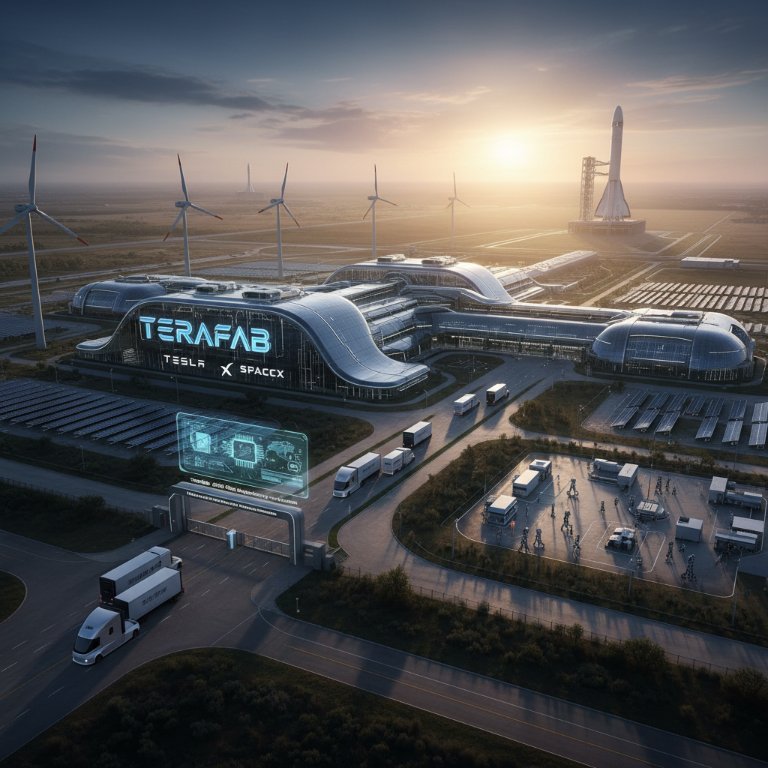
In a seismic shift poised to redefine the landscape of advanced technology, Tesla and SpaceX have officially confirmed Terafab, a colossal joint venture aimed at establishing a shared semiconductor manufacturing facility in Grimes County, Texas. This ambitious undertaking, which includes xAI and Intel as key partners, represents an initial investment of a staggering $55 billion, with potential total investment soaring to $119 billion across all phases. Terafab is not merely another chip plant; it is a strategic imperative designed to produce critical silicon for Tesla's Full Self-Driving (FSD) stack, Optimus humanoid robot development, AI data center infrastructure, and SpaceX's orbital compute systems, directly confronting a persistent and critical chip supply bottleneck that has hampered Elon Musk's interconnected enterprises.
After years of navigating a volatile global semiconductor market, this move signals a profound commitment to vertical integration, echoing a strategy Tesla has increasingly embraced, from battery production to software development. The venture aims to consolidate every stage of semiconductor production under one roof, from chip design and fabrication to memory production, advanced packaging, and testing.
Terafab: A New Semiconductor Powerhouse Takes Shape
The confirmed Terafab project centers around a massive vertically integrated facility in Grimes County, Texas, with initial prototype operations focusing on Austin, in close proximity to Tesla's Gigafactory Texas. Its audacious goal: to yield more than one terawatt (one trillion watts) of artificial intelligence (AI) compute capacity annually.
This unprecedented scale directly addresses the insatiable demand for custom silicon across Musk's diverse portfolio:
- Tesla's FSD and AI Ambitions: Tesla embarked on its journey to design custom FSD chips as early as 2016, moving from relying on third-party hardware to developing its own Hardware 3 (HW3) and subsequently Hardware 4 (HW4). These in-house chips are crucial for the complex real-time processing required by Full Self-Driving. The development of Optimus humanoid robots, which is projected to demand ten times the compute power of Tesla's vehicle AI, further underscores the urgent need for dedicated, high-performance silicon. The global chip shortage has repeatedly strained Tesla's production lines, forcing the company to innovate by rewriting software to adapt to available components and highlighting its vulnerability to external supply chain disruptions.
- SpaceX's Orbital Compute Systems: SpaceX, particularly with its Starlink constellation, requires robust, custom-designed chips for its orbital and ground-based compute systems. The evolution of Starlink Mobile, aiming for direct-to-device 5G connectivity, necessitates highly specialized and compact multi-chip modules (MCMs) to manage radio frequencies efficiently and reduce the size, power consumption, and cost of hardware. Current collaborations, such as with STMicroelectronics for Starlink chips, already demonstrate a reliance on custom solutions and high-volume production.
Why This Matters:
This joint venture signals a profound strategic pivot, not just for Tesla and SpaceX, but for the entire technology and automotive industries. Elon Musk's companies are moving beyond mere in-house chip design — a trend many automakers are exploring — to direct, large-scale chip manufacturing. This is a "do-or-die" moment, a testament to the existential threat posed by semiconductor supply chain vulnerabilities and the sheer computational requirements of their future-defining projects.
- Strategic Imperative: Unparalleled Vertical Integration: Terafab represents a bold step towards an end-to-end vertically integrated supply chain, giving Tesla and SpaceX unprecedented control over the most critical components of their technology. This insulates them from geopolitical risks, trade disputes, and future global chip shortages, which have previously cost the automotive industry billions in lost revenue. By controlling silicon design and manufacturing, they can optimize hardware and software in concert, accelerating innovation cycles and potentially achieving significant cost efficiencies at scale. This mirrors historical trends where major tech players, like smartphone manufacturers, brought chip design in-house to gain a competitive edge.
- Acceleration of AI and Autonomy: The ability to produce purpose-built chips precisely tailored for FSD, Optimus, and advanced orbital systems will be a game-changer. It promises to unlock new levels of performance and efficiency, pushing the boundaries of what's possible in autonomous driving, general-purpose robotics, and global satellite internet. This direct control can drastically reduce the time from ideation to deployment for critical AI capabilities, potentially leaving competitors relying on off-the-shelf solutions far behind.
- Market Signal and Competitive Landscape: Terafab sends a powerful message to the market: future technological leadership is inextricably linked to semiconductor independence. This aggressive move could compel other automotive and tech giants to re-evaluate their own supply chain strategies, potentially triggering a wider trend of vertical integration in critical component manufacturing. Traditional semiconductor foundries may face increasing pressure as their largest customers choose to bring more production in-house. While the upfront investment is massive, the long-term gains in security, performance, and cost could provide an insurmountable competitive advantage.
However, this audacious undertaking is not without its challenges. The capital expenditure is staggering, the technical complexities of operating a cutting-edge chip fab are immense, and the project's success hinges on flawless execution and talent acquisition. As SpaceX's S-1 filing revealed, these collaborations are in their "very early stages" with many details, including financial terms and IP rights, still being finalized.
Terafab is more than a factory; it's a declaration of intent. Tesla and SpaceX are not just building cars and rockets; they are building the foundational infrastructure for an AI-powered future, aiming to secure their destiny by taking direct control of the silicon that will power it all. This move solidifies their position at the forefront of technological innovation and signals a future where strategic independence drives unprecedented progress.