Tesla Blows Up Dallas Geofence: Robotaxi Territory Swells 158% as Waymo Rivalry Intensifies
Tesla is aggressively drawing new battle lines in the race for autonomous dominance. CEO Elon Musk recently amplified a map comparison revealing that ...
Editorial Team
World Of EV
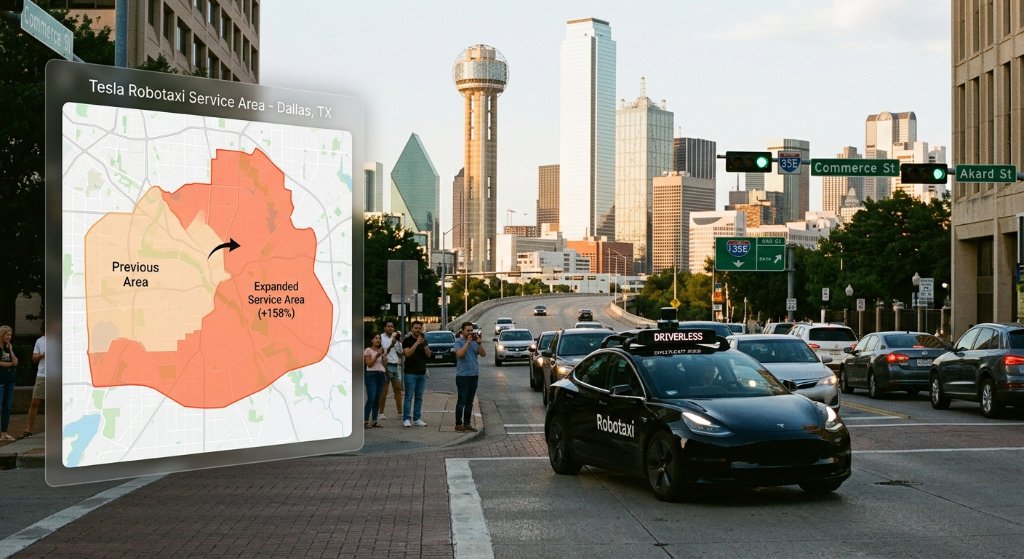
Tesla is aggressively drawing new battle lines in the race for autonomous dominance. CEO Elon Musk recently amplified a map comparison revealing that Tesla’s Robotaxi service area in Dallas, Texas, has expanded by a staggering 158% compared to its previous geofenced coverage zone. The massive expansion comes just months after the service made its quiet North Texas debut in April 2026, signaling that Tesla is rapidly accelerating its software-driven "Tesla Network" before the highly anticipated September 3 unveil of its dedicated Cybercab.
For years, skeptics argued that Tesla’s vision-only approach to autonomy would struggle to scale compared to the heavily mapped, LiDAR-reliant setups used by Alphabet’s Waymo. However, by leveraging its massive fleet of consumer vehicles to gather real-world driving data, Tesla is proving it can scale its driverless geofences at a pace hardware-heavy competitors struggle to match. This sudden land grab in Dallas is the clearest signal yet that Texas has become ground zero for the driverless ride-hailing wars.
Breaking Down the 158% Dallas Land Grab
Tesla first brought its unsupervised Robotaxi service to Dallas and Houston in April 2026. Initially, the Dallas zone was a highly conservative proof-of-concept—roughly 30 to 35 square miles centered around the affluent Highland Park neighborhood. This new update blows those boundaries wide open.
While Tesla has not yet released the exact new mileage figures, the 158% expansion pushes the geofence deep into more complex urban environments. The expansion strategy mirrors Tesla's playbook in Austin, where the service grew from a tiny 20-square-mile zone to a massive 245-square-mile footprint over the span of a year.
Key metrics of Tesla's rapid Texas scaling include:
- The Growth: A 158% increase in the Dallas geofenced service area.
- The Launch Vehicle: Unmodified Model Ys running unsupervised Full Self-Driving (FSD).
- The Footprint: Tesla's ride-hailing app is now active in Austin, Dallas, Houston, Miami, Orlando, and Tampa.
- The Catalyst: This expansion lays the operational groundwork ahead of the September 3, 2026, production reveal of the steering-wheel-free "Cybercab".
The Reality Check: Coverage vs. Density
Despite the impressive map expansion, Tesla still faces a persistent hurdle: density. It is relatively easy for Tesla to expand a digital boundary on a map; it is far more difficult to flood those zones with enough active driverless vehicles to keep wait times competitive.
Industry analysts point out that while Waymo operates dense, highly visible fleets of autonomous Jaguar I-Pace vehicles in cities like San Francisco and Phoenix, Tesla's actual active driverless fleet remains comparatively tiny. In Austin, despite a huge 245-square-mile map, only a fraction of Tesla's roughly 80-vehicle fleet runs fully unsupervised at any given time. In Dallas, the initial rollout operated with single-digit active driverless vehicles. Expanding the map by 158% without a corresponding surge in fleet deployment risks leaving eager customers facing long wait times and stranded rides.
Why This Matters:
This massive geofence expansion is a calculated flex ahead of a make-or-break moment for Tesla. On September 3, 2026, the company will officially unveil the production version of its dedicated, pedal-free Cybercab. To justify the immense hype—and a valuation that heavily relies on Tesla being treated as an AI and robotics powerhouse rather than a mere automaker—Musk must prove that Tesla’s driverless network is a scalable, living product, not just a laboratory promise.
- The Winners: Tesla’s engineering team and prospective Cybercab owners. By aggressively widening the Dallas geofence, Tesla is feeding its Neural Networks a highly diverse set of complex Dallas traffic scenarios, highway merges, and construction zones. This data engine is the lifeblood of FSD and will accelerate the software's safety profile.
- The Losers: Legacy ride-hailing networks and, ultimately, Waymo. Waymo's localized, high-definition mapping process is notoriously slow and expensive to deploy in new cities. Tesla, operating on a vision-only system, can theoretically expand its service area overnight via software updates. If Tesla can successfully transition its massive consumer fleet into part-time autonomous taxis (the "Tesla Network"), it will bypass the massive capital expenditure required to buy and maintain its own multi-billion-dollar fleet.
This is a critical pivot point for Tesla. The company is betting its entire future on autonomy. By expanding its service footprint in Texas—a state with highly favorable autonomous vehicle regulations—Tesla is building a fortress to block Waymo's southern expansion and setting the stage for a commercial showdown.
Conclusion
Tesla's 158% expansion in Dallas proves that the automaker is no longer treating its Robotaxi service as a side project. It is a rapid, calculated scaling effort designed to establish market dominance before the dedicated Cybercab even hits the assembly line. If Tesla can back up this massive new map with actual vehicle density and reliable wait times, it may finally silence the critics and deliver on the autonomous future Elon Musk has promised for nearly a decade.