Tesla Closes the Supply Chain Loop: Texas Lithium Refinery Fully Integrates with Giga Texas to Power Domestic 4680 Cells
In an industry-shifting milestone for North American manufacturing, Tesla has achieved full integration of its domestic battery supply chain. The comp...
Editorial Team
World Of EV
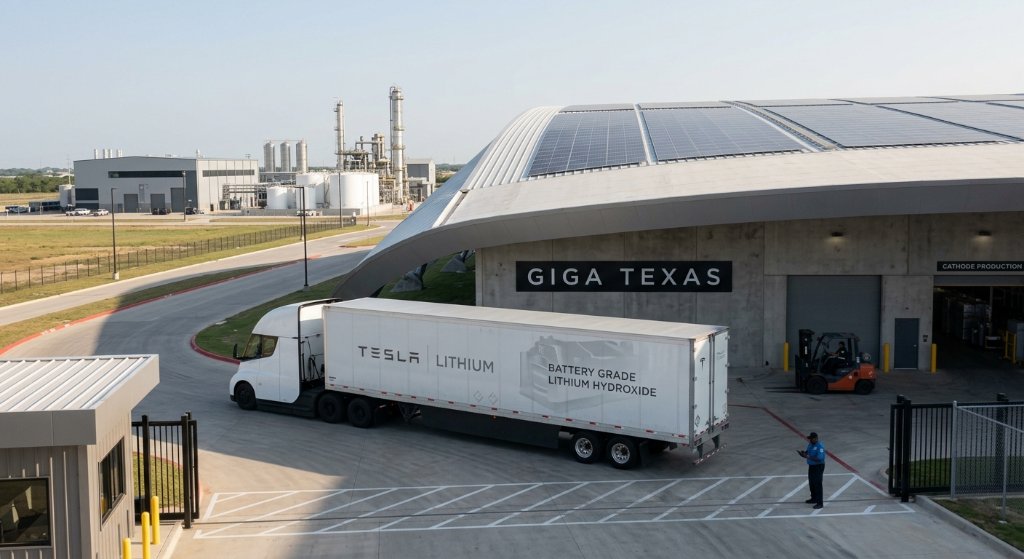
In an industry-shifting milestone for North American manufacturing, Tesla has achieved full integration of its domestic battery supply chain. The company’s newly operational lithium refinery in Robstown, Texas, has successfully begun delivering battery-grade lithium hydroxide monohydrate directly to the cathode production facility inside Gigafactory Texas. This crucial step closes the loop on a completely localized, in-house supply chain—taking raw materials, refining them, synthesizing cathodes, manufacturing 4680 battery cells, and rolling finished electric vehicles off the line, all within the borders of the Lone Star State.
For years, Western automakers have wrung their hands over China's near-monopoly on critical mineral refining. While legacy competitors have turned to complex joint ventures or third-party sourcing agreements to meet the strict requirements of the Inflation Reduction Act (IRA), Tesla has once again chosen the path of extreme vertical integration. This integration milestone follows hard on the heels of another historic first: the recent rollout of the first Tesla Cybertruck equipped with 4680 cells powered entirely by in-house refined lithium.
From Gulf Coast to Giga Texas: The Localized Loop
By linking the Robstown refinery directly to the cathode plant in Austin, Tesla is effectively bypassing the global logistics spiderweb. Instead of shipping mined lithium to Asia for processing before sending it back to North America, Tesla is conducting the entire high-value chemical processing sequence domestically. This localized, closed-loop system is anchored by several notable technical accomplishments:
- North America's Largest Processor: Located on a 1,200-plus acre site near Corpus Christi, the Robstown refinery is designed to reach a massive 30 GWh of annual capacity—enough to power approximately one million EVs.
- Eco-Friendly, Acid-Free Chemistry: Eschewing the traditional, highly pollutive sulfuric acid leaching method used by most of the industry, Tesla employs a proprietary acid-free alkaline leaching process. This innovation slashes carbon emissions by 30% and reduces reagent costs by roughly 60%.
- Zero-Waste Operations: The refining process yields non-hazardous anhydrite (calcium sulfate) rather than toxic chemical waste. Tesla intends to sell this byproduct directly to the construction industry for soil conditioning and drywall manufacturing.
- On-Site Cathode Synthesis: The refined lithium hydroxide is delivered straight to Giga Texas's new cathode facility—the first large-scale cathode plant in North America—where it is instantly converted into active battery chemistry.
Defeating the Commodity Volatility Beast
Historically, lithium hydroxide has been the most volatile component on an EV battery's bill of materials. Contract prices for the mineral have behaved like a roller coaster, fluctuating wildly from around $10 per kilogram in 2020, skyrocketing to over $80 per kilogram at their peak in 2022, and then settling back below $15 per kilogram in 2024. For an automaker buying refined materials on the open spot market, these price swings represent a direct threat to gross margins.
By owning the refining process, Tesla insulates itself from these market shocks. The company can purchase raw spodumene or unrefined lithium concentrate under long-term contracts, perform the chemical transformation in-house, and maintain stable, predictable manufacturing costs. Furthermore, this deep level of domestic integration positions Tesla to fully capture lucrative Inflation Reduction Act (IRA) tax credits, including the Section 45X advanced manufacturing credit, giving it a massive cost advantage over foreign-dependent rivals.
Why This Matters:
This is a masterclass in industrial strategy and a watershed moment for the electric vehicle transition. It signals that the era of simply assembling cars is over; the future belongs to the automakers that control the chemical elements.
- The Big Winners: Tesla’s Margins and the U.S. Supply Chain: Tesla secures a virtually untouchable competitive moat. By refining its own lithium and producing its own cathodes, the company secures maximum protection from geopolitical trade disputes—specifically the looming tariffs and export restrictions from China. It also secures the premium consumer perception of driving a vehicle powered by truly domestic energy.
- The Big Losers: Legacy Automakers and Overseas Refiners: Legacy OEMs (like Ford, GM, and Stellantis) are left looking highly vulnerable. While they scramble to secure joint-venture battery plants, they remain heavily reliant on third-party, often foreign, chemical processors. Meanwhile, traditional Asian battery-component giants are losing their leverage over Tesla’s supply chain.
- The Market Signal: This is a do-or-die signal to the rest of the automotive industry. It proves that vertical integration cannot stop at battery cell assembly. To survive the next decade of price wars and geopolitical friction, automakers must become chemical engineering companies.
Conclusion
Tesla’s full integration of the Robstown refinery with Giga Texas’s cathode facility is a massive leap forward for the brand and the broader industry. It proves that localized, environmentally sustainable, and economically resilient battery production is not a distant dream, but a current reality. By controlling the battery chemistry from the Texas dirt to the driveway, Tesla has rewritten the rulebook on how electric vehicles are built, leaving its competitors with a very steep hill to climb.